Part 10 of 17 in Your Child Is Not a Marksheet← Part 9Part 11 →
The City Is a Campus explains how neighbourhoods, public spaces and mixed-age groups can support meaningful learning beyond school. It helps parents and educators consider supervised community learning while addressing safety, inclusion, access and cost.
- Real learning can happen in parks, markets, kitchens, libraries and other places where questions meet reality.
- Mixed-age groups help children practise teaching, listening, patience and leadership with people of different ages and backgrounds.
- Community learning pods need a safe place, reliable adult, useful resources, individualized guidance and strong safeguarding.
- Any community learning model should be judged by learning outcomes, child safety, inclusion and cost.
- A supervised weekend pilot can involve four to six families investigating a local public-interest question.
A neighbourhood can teach what no single classroom can
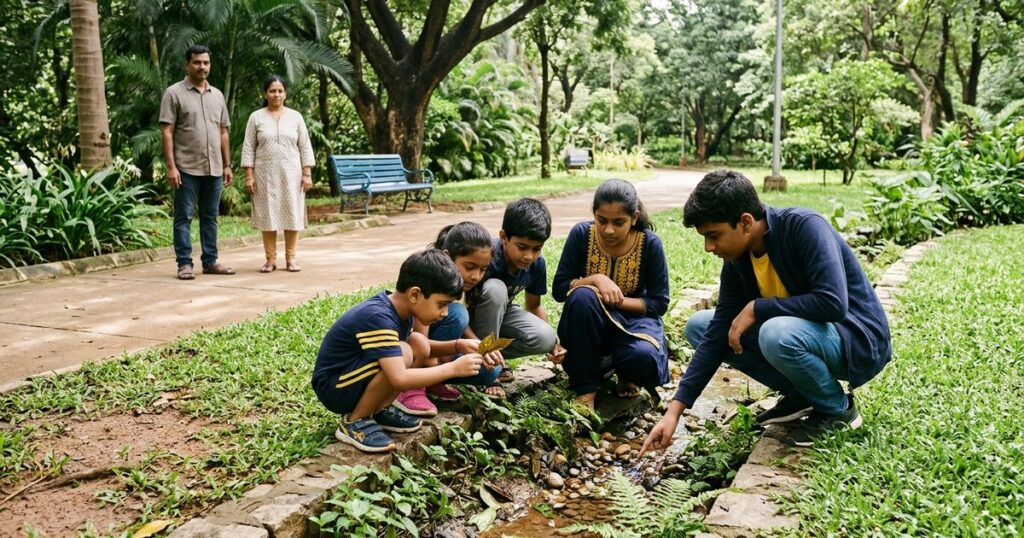
Imagine a Saturday learning walk in Bengaluru. Five children of different ages begin at a public park. One identifies birds; another measures the length of a shadow; a third interviews the gardener about water use. At the bus stop they read a route map. At a small shop they compare the unit price of two snacks. At lunch they argue about whether a city should spend more on roads or buses. The adults are alert to traffic, consent and safety, but they are not dictating every question.
This is an illustrative scene. It is not a proposal to abandon schools and wander without supervision. It is a reminder that meaningful learning occurs wherever questions meet reality. A laboratory is useful, but so is a kitchen. A library is essential, but so is a market. A classroom can teach civic duties, but so can helping residents understand how waste collection actually works.
We also need a richer idea of socialization. Many parents worry that children will not become social unless they spend long days with twenty or forty others of the same age. School offers important friendships, shared routines and opportunities to negotiate conflict. But the world does not organize people into single-year age groups. Work and citizenship require us to speak with younger children, older neighbours, people with disabilities, craftspeople, customers and strangers from different backgrounds.
In a mixed-age learning group, a twelve-year-old may help an eight-year-old read while a sixteen-year-old helps both debug a simple computer program. Teaching another person is not free labour to exploit; it is an opportunity to explain, listen and discover what you do not yet understand. Younger learners see a near peer who makes advancement imaginable. Older learners practise patience and leadership.
That is the intuition behind a community learning pod: a safe place, a small group, a reliable adult and access to books, tools, connectivity where possible, and individualized guidance. Projects such as Apni Pathshala are exploring versions of this idea alongside AI learning companions such as Eklavya. The promise is attractive, but the case for scaling any particular model should depend on independent learning outcomes, child safety, inclusion and cost—not on enthusiasm alone.
A pod should not become a miniature coaching factory with fewer desks. Give children real choices. Offer access to a printer or a basic computer when available, but do not confuse equipment with education. Teach them to organize a reading circle, grow plants, repair a simple object, interview an elder, stage a play and document a neighbourhood issue. Rotate responsibilities. Invite local adults as mentors only with appropriate safeguarding and supervision.
The barriers are genuine. Space costs money. Girls may face mobility restrictions that boys do not. Some children need accessibility accommodations. Reliable electricity and internet cannot be assumed. Adults require background checks, clear boundaries and sensible ratios. A romantic slogan about community will not address any of these problems. A serious model makes them part of the design from day one.
A low-cost pilot. Bring together four to six families for one supervised ninety-minute session each weekend. Choose a public-interest question, such as drinking-water quality or local tree cover. Agree on consent rules and safe boundaries. Let children divide the work and present their findings. Ask each child what they learned, what they contributed and what they would change. Do not collect more personal information than needed.
Use AI this week. Ask: “Design a ninety-minute, mixed-age learning session for five children aged nine to fourteen on the problem of summer water shortages. Include three difficulty levels, a local-language option, offline materials, a reflection activity and safeguards for adult supervision. The children must produce one useful artefact.”
School can be one part of a child’s learning ecosystem. It is a mistake to assume it must be the entire ecosystem. When we make the neighbourhood educational, children begin to see themselves not as passengers through a syllabus but as participants in the world.
Frequently asked questions
What is a community learning pod?
It is a safe place with a small group, a reliable adult, access to books and tools, connectivity where possible, and individualized guidance.
How can children learn outside school?
They can identify birds, measure shadows, read route maps, compare prices, interview local people, grow plants, repair objects and document neighbourhood issues.
What safeguards are needed for community learning?
Adults should supervise children, follow consent rules and safe boundaries, use background checks, maintain clear boundaries and sensible ratios, and provide accessibility accommodations when needed.
How can families start a low-cost community learning pilot?
Four to six families can hold one supervised ninety-minute session each weekend, choose a public-interest question, divide the work among children and discuss what each child learned and contributed.