Part 9 of 17 in Your Child Is Not a Marksheet← Part 8Part 10 →
This chapter explains why effective teaching depends on coaching, listening and helping children take responsibility for their understanding. It helps teachers and parents use questions, practice and technology without replacing human attention.
- Teaching is a relationship, not simply delivering information or completing a syllabus.
- Teachers help children think by asking about their reasoning, attempts and possible changes.
- AI can provide explanations, hints and practice, but cannot reliably understand a child's emotional situation.
- Technology can reduce administrative work so teachers have more time to listen, observe and encourage.
- Good coaching balances clear instruction, guided practice, questions and stepping away.
The adult's value is not the number of answers delivered
Think of the best teacher you ever had. You probably remember someone who noticed you. Perhaps she made you explain your reasoning. Perhaps he refused to let you give up after the first failure. Perhaps an ordinary conversation made you believe you could do more than you had imagined. You may have forgotten the chapter he taught. You remember the confidence he lent you until you could generate your own.
Indian teachers are often asked to do the impossible: finish a packed syllabus, maintain discipline, manage records, prepare tests, answer parents, and teach children whose needs vary enormously. The result is a system that rewards coverage. “I taught it” becomes the same as “they learned it.” But teaching is not broadcasting. It is a relationship in which someone learns how to take increasing responsibility for their own understanding.
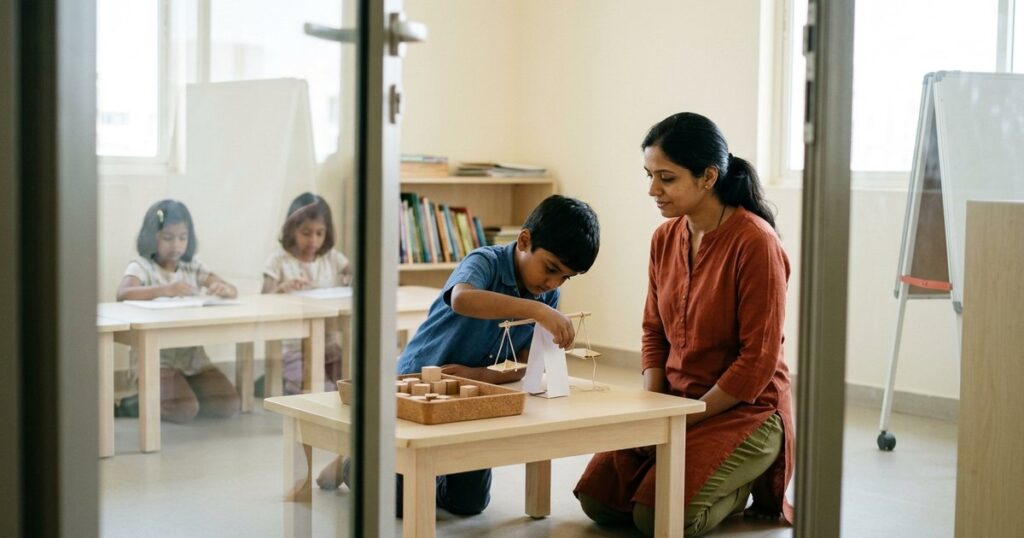
Consider a composite scene from a low-cost neighbourhood learning group in Bhopal. Six children are solving different problems. One adult moves between them, asking: “How do you know?” “What did you try before?” “Can you show your friend?” “What would change your answer?” She has not delivered a speech on critical thinking. She has created the habits from which critical thinking grows.
This is why I am enthusiastic about AI while remaining sceptical of claims that an AI tutor can replace teachers. A digital system can offer repeatable explanations, hints and practice at any hour. It cannot reliably know whether a child is frightened, lonely, hungry, bullied, ashamed of failing or simply pretending to understand. Even when it guesses correctly, it does not carry the ethical responsibility of a trusted adult.
The most powerful use of technology may therefore be to free teachers from work that consumes their attention without improving relationships. Draft a differentiated worksheet. Translate a parent message. Create examples for three different levels. Organize notes after a lesson. Then let the teacher spend the reclaimed time listening, coaching, observing and encouraging.
Parents must change their habits too. We are tempted to ask for the “right answer,” and then supply it the moment a child hesitates. Instead, try a sequence of prompts: “What is the problem asking?” “Can you draw it?” “What do you already know?” “Which part is confusing?” “What could you test?” Wait for the response. The silence is not evidence that nothing is happening. It may be the moment thinking begins.
Good coaching still includes explicit instruction. A child learning letter sounds, a complex mathematical procedure or a safety-critical skill may need clear demonstration and guided practice. Coaching is not standing aside while confusion becomes frustration. It is making an informed choice about when to show, when to ask, when to practise and when to step away.
The two-minute teacher audit. At the end of a lesson, ask yourself how many children actually spoke, explained, attempted and corrected something. If the adult talked for forty minutes and everyone else wrote silently, that may have been an efficient lecture. It was not necessarily an efficient learning experience.
Use AI this week. For a teacher: “Here is my Class VII lesson objective on heat transfer. Create three activities for students at beginner, intermediate and advanced levels. Each must include a misconception check. Suggest questions I can ask rather than a script I must read. Make a low-tech version with no internet.” Test every activity before class.
The future teacher is not a human loudspeaker competing with a machine. The future teacher is a mentor who can use machines without surrendering the irreplaceable human art of helping someone grow.
Frequently asked questions
What is the difference between teaching and coaching?
Teaching is not just broadcasting information. Coaching helps children take increasing responsibility for understanding through questions, practice, feedback and encouragement.
Can an AI tutor replace a teacher?
AI can offer repeatable explanations, hints and practice, but it cannot reliably know when a child is frightened, lonely, hungry, bullied, ashamed or pretending to understand.
What questions should parents ask instead of giving the right answer?
Parents can ask, “What is the problem asking?”, “Can you draw it?”, “What do you already know?”, “Which part is confusing?” and “What could you test?”
How can teachers check whether students were actively learning?
At the end of a lesson, teachers can ask how many children spoke, explained, attempted and corrected something. Forty minutes of adult talk and silent writing is not necessarily an efficient learning experience.