Part 2 of 17 in Your Child Is Not a Marksheet← Part 1Part 3 →
Your Child Is Not a Marksheet examines how school routines and marks can turn childhood into a project. It helps parents protect academic foundations while making room for curiosity, practical learning, trusted mentors, and careful use of AI.
- Parents often pressure children because they see school success as protection from uncertainty.
- Regular attendance, respectable marks, memorization, and completed notebooks do not guarantee useful learning.
- Marks are measurements taken under specific conditions, not verdicts on a child.
- Children need foundations, curiosity, real projects, human mentors, and AI used as a learning partner.
- Parents can begin with twenty minutes, a question, and the humility to listen.
At seven in the morning, a mother in Pune is reminding her son to finish his worksheet. At four in the afternoon, she is driving him to tuition. At nine at night, she is asking why he lost three marks in mathematics. They love each other dearly. Yet most of their conversations are beginning to sound like performance reviews.
This is a composite scene, but the anxiety is real. Parents do not pressure their children for pleasure. A good school, good marks and a secure career seem like protection from uncertainty. For families who have fought hard for opportunity, the fear of wasting it runs deep.
The trouble is that we have confused the infrastructure of schooling with the outcome of education. A child can attend school regularly, earn respectable marks, memorize the textbook, complete every notebook and still be unable to explain a simple idea, solve an unfamiliar problem, ask for help, collaborate with a stranger, or teach herself something new.
I am a doctor. In medicine, we distinguish between a test result and the health of the patient. A laboratory number is useful, but it is not the person. We should be equally careful with marks. They are one measurement made at one moment under one set of conditions. We have turned them into a verdict on the child.
This book is not a plea to abandon reading, mathematics, science, examinations, or hard work. Nor is it a romantic claim that every child can flourish without structure. It asks a more uncomfortable question: what if we preserved the useful parts of school while refusing to let school occupy the whole of childhood?
Clark Aldrich’s Unschooling Rules sharpened that question for me: why treat the industrial classroom as inevitable? Indian children need better ways to learn inside schools, alongside schools, and in communities. They should not have to pay for our experiments.
AI can explain fractions in Hindi and question a teenager about biology. It can also invent facts, complete homework instead of teaching, and expose private data. Its value depends on how we use it.
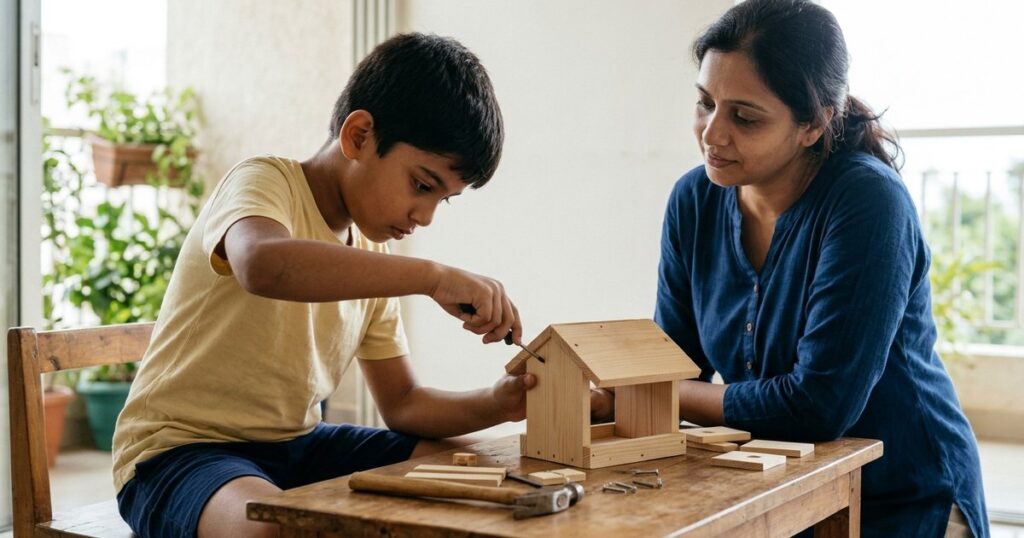
My proposal is simple: protect foundations, invite curiosity, build real things, give children trusted human mentors, use AI as a learning partner, and judge progress by what the child can actually do. You do not need to become an unschooling purist. You can begin this evening with twenty minutes, a question, and the humility to listen.
Frequently asked questions
Why are marks not enough to measure a child's education?
Marks are one measurement made at one moment under one set of conditions. A child may earn respectable marks yet struggle to explain ideas, solve unfamiliar problems, ask for help, collaborate, or learn something new.
Does this approach reject school, examinations, or hard work?
No. It does not call for abandoning reading, mathematics, science, examinations, or hard work. It asks parents to preserve useful parts of school without letting school occupy the whole of childhood.
How can AI help children learn?
AI can explain fractions in Hindi and question a teenager about biology. It can also invent facts, complete homework instead of teaching, and expose private data, so its value depends on how it is used.
How can parents start changing learning at home?
Parents can begin with twenty minutes, a question, and the humility to listen. The proposal also includes protecting foundations, inviting curiosity, building real things, and giving children trusted human mentors.