Part 7 of 19 in Why Schools are Broken: and How to Fix Them← Part 6Part 8 →
This chapter presents Paul Goodman’s practical alternatives to conventional schooling and connects them with Indian traditions of learning through observation, practice, and apprenticeship. It helps readers consider small schools, community-based learning, and real-world work as ways to make education more meaningful.
- Goodman proposed tiny schools, city-based learning, apprenticeships, flexible schooling, and fewer job credential requirements.
- Small schools can mix ages, follow children’s interests, and use neighbourhood resources.
- Students can learn from markets, workshops, hospitals, farms, factories, artisans, and local entrepreneurs.
- Adults can guide observation, questions, and practice instead of only delivering lectures.
- An Ahmedabad learning pod connected market observations with economics, mathematics, civics, AI tutoring, and written reports.
Paul Goodman did not stop at criticism. He offered concrete alternatives. He proposed tiny, decentralised schools. He suggested using the city itself as a classroom. He advocated apprenticeships and real work for adolescents. He argued for letting some children skip parts of formal schooling. And he called for cutting back on credential requirements for jobs so that young people could enter useful work earlier.
These ideas are not foreign to Indian tradition. Gurukuls were small. Learning happened through observation and practice. Many skills were transmitted through family and caste-based apprenticeships (whatever their other flaws). The modern challenge is to recover the spirit of those arrangements without their rigidities, and to do so at a time when technology can amplify them.
Tiny Schools and Microschools
A school of 15 to 30 children, run by one or two adults who know the children well, can do things a school of 1,000 cannot. Indian examples already exist: some alternative schools, some home-schooling pods, and the growing number of microschools started by parents and young graduates. These schools can mix ages, follow children’s interests, and use the neighbourhood as a resource.
The City (or Village) as Classroom
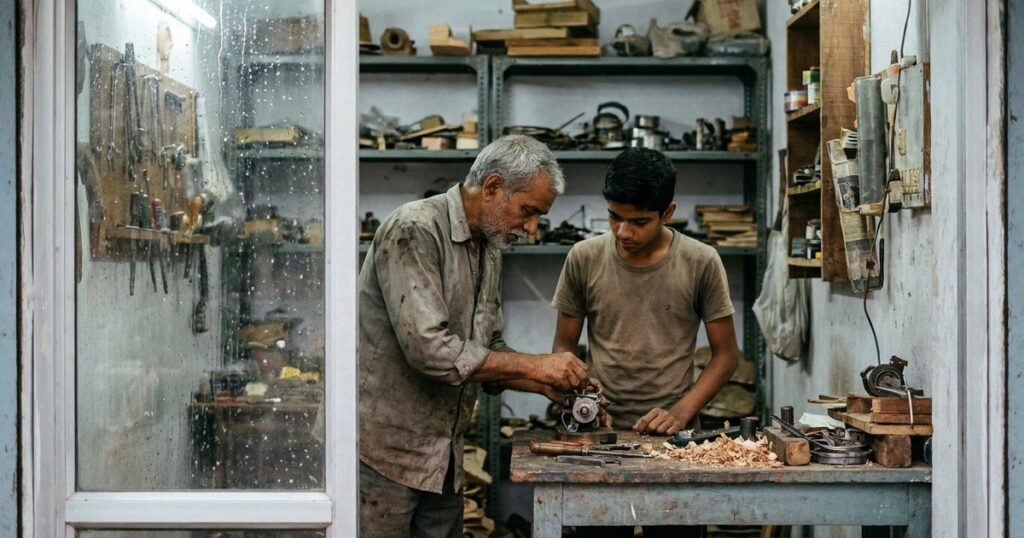
Goodman wanted young people to learn from the real world around them. In an Indian city, this could mean spending time in workshops, markets, hospitals, courts, farms on the outskirts, or small factories. In a village, it could mean systematic learning from farmers, artisans, and local entrepreneurs. The adult’s role becomes that of a guide who helps the young person observe, ask questions, and practise, rather than that of a lecturer who delivers content.
Practical Example: Learning from a Local Market
A group of Class 8 students in Ahmedabad spent one morning a week at a wholesale vegetable market. They observed how prices were set, how disputes were resolved, how credit was given, and how waste was managed. They interviewed traders. Back in their small learning pod, they used an AI tutor to connect what they saw to concepts in economics, mathematics (percentages, profit and loss), and civics. They wrote short reports. The learning was memorable because it was real. No textbook chapter on “markets” could have matched it.
Such arrangements require adult time and some negotiation with schools or parents. They do not require large budgets. They do require a willingness to trust that the world outside the classroom contains valuable knowledge.
Frequently asked questions
What school alternatives did Paul Goodman propose?
He proposed tiny decentralised schools, learning in the city, apprenticeships, real work for adolescents, flexible formal schooling, and fewer credential requirements for jobs.
How can a city or village become a classroom?
Students can learn in workshops, markets, hospitals, courts, farms, factories, and from farmers, artisans, and local entrepreneurs.
What are microschools?
A microschool may have 15 to 30 children and one or two adults who know them well. It can mix ages, follow interests, and use the neighbourhood as a resource.
What did Ahmedabad students learn at a wholesale vegetable market?
They observed pricing, disputes, credit, and waste management, interviewed traders, and connected their observations to economics, mathematics, and civics.