Part 3 of 17 in Your Child Is Not a Marksheet← Part 2Part 4 →
The Report Card Knows Too Little examines why marks can miss important parts of a child’s learning. It helps parents and teachers look beyond scores at understanding, practical skills, effort, and the ability to use knowledge in unfamiliar situations.
- High marks can reflect memorized answers, while lower marks can overlook useful practical skills.
- A test can reveal learning gaps, but a narrow result cannot describe everything a child knows.
- ASER 2024 found foundational reading gaps among rural children in India, including Class V pupils in government schools.
- Practice testing and spaced learning are more reliable than relying only on rereading or highlighting.
- Parents can ask children to explain ideas, apply them, and discuss mistakes instead of focusing only on marks.
Why a school result can conceal a learning problem
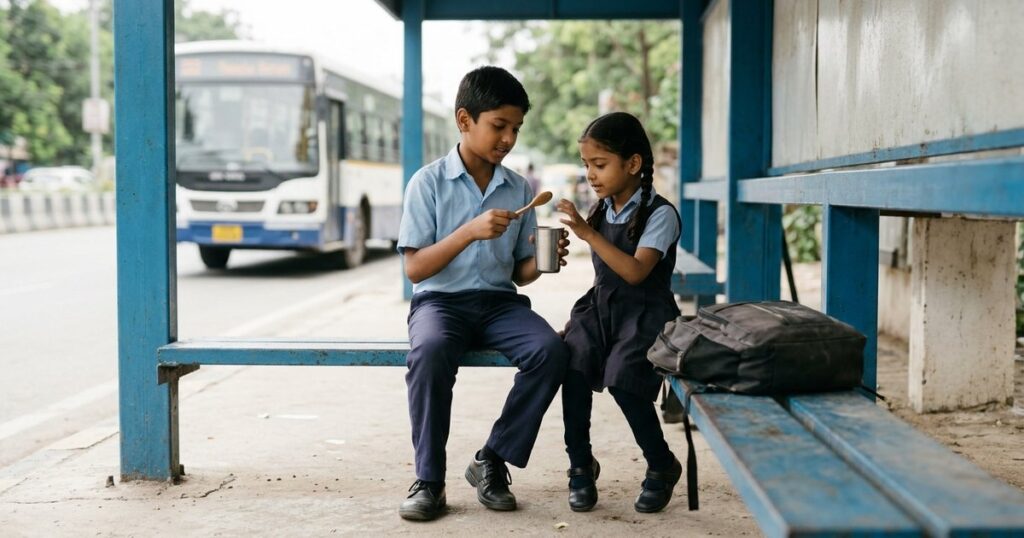
A boy returns home with 92 percent. His father orders sweets. His grandmother calls relatives. That evening, a question about why a steel spoon becomes hot in a cup of tea receives a memorized answer about conductors. When his younger sister asks what would happen with a wooden spoon, he looks uncertain. The exam tested a definition; life has asked him to think.
In another house, a girl gets 61 percent. She has quietly learned to keep accounts for her mother’s tailoring business, calculate fabric requirements, negotiate with the cloth seller and repair the family’s old bicycle. Nobody puts any of that on her report card. Two children, two sets of numbers, and a very incomplete picture of both.
These are illustrative composites, not anecdotes about specific children. Their point is not that marks are worthless. When a question paper is well designed, a test can reveal useful gaps. The mistake is believing that a narrow test result tells us everything we need to know.
Look at the larger picture. The Annual Status of Education Report (ASER) 2024 surveyed children in rural India at home and checked basic reading and arithmetic, rather than taking enrollment or class progression on trust. Its findings showed substantial foundational gaps even as some outcomes had recovered from the pandemic years. For example, only 44.8 percent of Class V pupils in government schools surveyed could read a Class II-level text. That is not an argument against teachers; it is an argument for looking directly at learning. [1]
A child who cannot read a paragraph comfortably will struggle in history, biology and even word problems in mathematics. If you respond by buying three new workbooks, you may make the problem worse. The urgent question is not, “Why is she behind the class?” It is, “What can she do today, and what would help her do one more thing tomorrow?”
I would like every parent-teacher meeting to begin with three demonstrations. Ask the child to explain one new idea without looking at notes. Ask her to use it in an unfamiliar situation. Ask her to identify one mistake she made and how she corrected it. Those three minutes tell us a great deal that a percentage does not.
We also need to stop treating effort and learning as synonyms. A child can spend four hours highlighting a textbook and remember little of it next week. Research on learning strategies finds strong support for practice testing and spreading learning over time; just rereading or highlighting is not an equally reliable substitute. [2] Children deserve methods that work, not merely rituals that look hardworking.
A better family question. Instead of asking, “How many marks did you get?” try, “What can you teach me that you could not teach me last week?” Let the child choose. A confident explanation of a small concept can be a stronger sign of progress than a prestigious rank secured by repetition.
Use AI this week. With an adult supervising where appropriate, ask a learning tool: “My child is in Class V and is learning fractions. Ask one question at a time, beginning with a real-life example from an Indian kitchen. Do not tell the answer. If the child is wrong, help us discover the misconception. Finish with one new problem we can solve without the screen.” Keep the child’s attempt, not the AI’s polished solution, as evidence.
The report card should start a conversation. It should never end one. Our aim is not to produce a better number; it is to raise a person who can look at an unfamiliar problem and say, with curiosity rather than fear, “Let me try.”
Frequently asked questions
Why are school marks not enough to measure learning?
A narrow test may measure definitions or memorized answers without showing whether a child understands ideas or can use them in unfamiliar situations.
What did ASER 2024 find about reading in rural India?
Only 44.8 percent of Class V pupils in government schools surveyed could read a Class II-level text.
What should parents ask instead of how many marks a child got?
Ask, "What can you teach me that you could not teach me last week?" The child can choose a concept and explain it.
Which learning methods are more reliable than highlighting?
Research on learning strategies finds strong support for practice testing and spreading learning over time. Rereading or highlighting alone is not an equally reliable substitute.