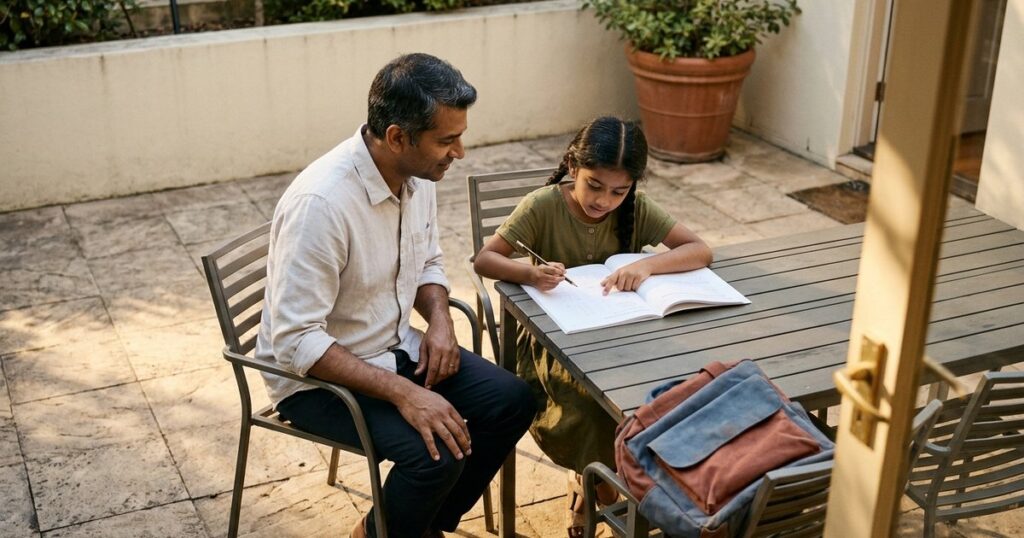
I hear this complaint regularly from parents: “My child is not interested in studies. He only wants to play, watch videos, or meet friends.” My first advice is not to start with tuition, threats, or a bigger pile of textbooks. Find out what “not interested” actually means. Is the child bored, frightened, exhausted, unable to understand, being bullied, distracted, or simply more interested in something outside school? The remedy depends entirely on the diagnosis.
I have seen parents spend thousands of rupees on tutors when the real problem was that the child could not read fluently. I have seen bright children labelled lazy because they refused to memorise answers they could not see the point of. I have also seen children who were genuinely spending too much time on screens and needed firmer boundaries. Treating all three cases as “lack of discipline” is bad parenting and bad diagnosis.
The comfortable belief is that a child who is interested in learning will automatically study, and a child who does not study must be lazy. I do not believe this. Children are naturally curious. They ask endless questions when they are three. They investigate how switches work, why the moon follows the car, and what happens when a toy is taken apart. If that curiosity disappears in school, I ask what happened to the learning environment before I blame the learner.
“My child is not interested in studies” is not a diagnosis
Parents often use one sentence to describe several very different situations.
| What you observe | What may be happening | What I would investigate first |
|---|---|---|
| The child avoids opening books | The work feels difficult, boring, or associated with criticism | Whether the child understands the basics and feels safe asking for help |
| The child studies but remembers little | The child is memorising without understanding, or is anxious | How the child studies, sleeps, and handles tests |
| The child performs well in one subject but not others | Interest, teaching quality, or a learning difficulty may differ by subject | Whether the problem is specific rather than general |
| The child cannot sit still for any task | There may be excessive screen use, poor sleep, anxiety, or attention difficulties | Whether the pattern exists at home, school, and during enjoyable activities |
| The child has suddenly changed | Stress, bullying, family conflict, puberty, illness, or a recent academic failure | What changed around the same time |
This distinction matters. A child who does not understand fractions needs teaching, not punishment. A child who is terrified of being compared with a high-performing sibling needs reassurance and a change in family behaviour. A child who is spending six hours a day on short videos needs limits. The same instruction—“sit down and study harder”—will help none of them.
I would begin by asking the child to show me one piece of work that feels difficult. I would sit beside the child without correcting every answer. I would ask, “Which part makes you want to stop?” not “Why are you so careless?” The answer may be revealing. Children who have been scolded repeatedly learn to say “I don’t know” even when they know perfectly well what is wrong.
Before blaming the child, check the foundations
Learning requires energy and attention. Sleep, food, movement, eyesight, hearing, emotional security, and a tolerable level of stress are not luxuries. They are prerequisites.
I have had parents bring a child for an opinion about poor concentration when the child was sleeping late every night and waking early for school. Another child was sitting at the back of the classroom and could not see the board clearly. A third was anxious because of constant conflict at home. None of these children needed a motivational lecture.
I would check five simple things:
- Sleep: Is the child getting enough sleep, or is the phone being used in bed until midnight?
- Vision and hearing: Can the child see the board and follow classroom instructions?
- Basic skills: Can the child read a paragraph and explain it? Can the child perform the arithmetic expected at that grade?
- Emotional state: Has the child become unusually withdrawn, irritable, tearful, fearful, or angry?
- School experience: Is there bullying, humiliation, an unreasonable workload, or a teacher the child is afraid of?
A sudden fall in marks or interest deserves more attention than a child who has always disliked a particular subject. Sudden change is a clue. I would not ignore persistent headaches, stomach aches before school, nightmares, refusal to attend school, major changes in appetite or sleep, or talk about worthlessness. These may indicate anxiety, depression, bullying, or another problem that requires a qualified professional rather than a tutor.
Parents should also be honest about the atmosphere they create. A child who is asked about marks before being asked about the day may conclude that marks are the only thing that matters. A child who is compared with cousins and neighbours may stop taking academic risks because every mistake becomes public evidence of failure.
A child who is afraid of making mistakes will eventually become afraid of learning.
The school may be the problem
We often assume that the child must adapt to the school. Sometimes the school must change its approach.
Much of Indian schooling still rewards copying, speed, obedience, and memory. A child may spend hours preparing answers that will be forgotten after the examination. A child who asks “Why?” may be treated as troublesome. A child who needs more time may be called slow. A child who learns through drawing, building, discussion, or movement may be told to sit quietly and reproduce the textbook.
I have written elsewhere about helping children think rather than merely memorise. The point is not that memorisation has no place. It does. A child must remember multiplication tables, vocabulary, dates, scientific terms, and basic facts. But memory should support understanding, not replace it.
Parents should speak to the teacher with specific observations rather than accusations. “My daughter refuses mathematics” is less useful than “She can solve problems orally but freezes when she sees a worksheet.” “My son is careless” is less useful than “He understands the chapter when I discuss it but leaves questions blank in class.” Good teachers can act on specific information.
I would also ask the teacher whether the child participates, plays with others, and appears alert in class. A child who is lively during art and sports but silent during mathematics is giving us information. A child who is disengaged everywhere may need a broader assessment.
Do not turn the home into a second school
Many Indian homes have an exhausting routine: school, van ride, tuition, another tuition, homework, test preparation, and parental interrogation. The child is expected to study every available minute, while adults spend the evening discussing marks. This is not a recipe for loving learning. It is a recipe for associating books with pressure.
I am not arguing for an absence of structure. Children need routines. They need to know when homework will be done, when screens are available, and when they can play. But a routine is different from surveillance.
I would create a short, predictable study period rather than demand an undefined evening of studying. For a younger child, this might be 20 or 25 minutes followed by a break. Older children may manage longer periods. The exact number matters less than the principle: begin with a task the child can complete, remove obvious distractions, and stop before the child is completely depleted.
During that period, the phone should not be on the desk. Parents should not sit beside the child correcting every line unless the child has asked for help. I would agree on one concrete task: read two pages, solve five problems, or write a paragraph. “Study science” is vague and easy to avoid. “Read the section on photosynthesis and explain it to me afterwards” is clear.
At the same time, children need unstructured play, physical activity, conversation, and rest. A child who has no time to play may be more resistant to studying because study feels like the removal of the last enjoyable part of the day.
Screen time is a real issue—but not the whole explanation
Parents often ask whether the phone is the reason their child is not interested in studies. Sometimes it is. Short videos and games provide immediate rewards, while a textbook may offer no reward until an examination weeks away. It is unrealistic to expect a child to make this comparison using adult self-control.
But “take away the phone” is not a complete parenting strategy. If the child has no friends, hobbies, physical activity, or meaningful projects, removing the screen simply creates a vacuum. The family must replace some of the screen’s attractions with real alternatives.
I would set rules that apply to adults as well as children: no phones during meals, no devices in the bedroom at night, and a clear time when screens are switched off. I would explain the reason and enforce it calmly. Repeatedly threatening to confiscate a device and then returning it after an argument teaches the child that persistence defeats boundaries.
I would also distinguish between passive consumption and active creation. A child watching random videos for three hours is not doing the same thing as a child making a short animation, building a game, editing a video, or learning to code with guidance. I have written about whether children should learn to code, and my answer is not that every child needs to become a software engineer. It is that making something can be far more educational than endlessly consuming something.
Still, parents should not use “educational” as a label to justify unlimited screen use. A coding app can also become another form of distraction. The test is simple: Is the child producing, explaining, experimenting, and persisting—or merely tapping?
Interest is useful, but persistence matters more
I am wary of the advice that children should study only what they enjoy. Interest can be a good starting point, but every worthwhile skill contains boring parts. A child may enjoy writing stories but dislike spelling. A budding entrepreneur may enjoy ideas but dislike accounts. A medical student may enjoy seeing patients but dislike anatomy.
In my work with startups, I see the same pattern. Founders are enthusiastic when discussing their idea. The serious ones remain willing to speak to customers, examine uncomfortable data, fix small bugs, and repeat a task that is not glamorous. Interest starts the journey; persistence carries it.
So I would not ask only, “What does your child enjoy?” I would also ask, “What does your child willingly practise?” A child who spends an hour improving a drawing, building with Lego, practising cricket, or solving a difficult puzzle is not incapable of concentration. That child may need help transferring persistence to an academic task, or may be trapped in a subject where the basics are missing.
This is why praise should focus on the process, but not in the empty way of praising every effort. I would say, “You tried three different ways to solve that,” or “You came back to the paragraph after getting stuck.” Specific praise teaches the child what good work looks like. “You are so intelligent” is less useful. It makes failure threatening because the child begins to protect the identity of being intelligent rather than attempt difficult work.
What parents should do over the next two weeks
I would not make a dramatic declaration on Sunday night that the child’s entire life will now change. I would run a small experiment.
- Observe for three days. Note when the child studies, when the child avoids work, what subject is involved, how much sleep the child gets, and what happens immediately before the avoidance.
- Have one calm conversation. Ask what feels hardest about school. Do not interrupt with solutions. If the child says “nothing,” try a more concrete question: “If I could change one thing about homework, what would you choose?”
- Choose one academic gap. Do not attack every weak subject at once. Identify the missing foundation that is causing the greatest frustration and arrange appropriate help.
- Create a modest routine. Set one or two defined study periods, keep the phone away, and include play and sleep. Make the first tasks achievable.
- Speak to the teacher. Share the pattern you observed and ask what the teacher sees in class. Look for agreement rather than a culprit.
- Review after two weeks. Has the child started more easily? Is the child less distressed? Is there better understanding, even if marks have not yet changed? If nothing improves, seek a learning assessment or mental-health consultation rather than increasing punishment.
The order matters. Parents often jump directly to the last resort—more tuition—without observing the child or speaking to the teacher. A tutor can help when the problem is a knowledge gap. A tutor cannot solve bullying, depression, sleep deprivation, or a humiliating classroom.
What if the child is simply not academic?
This is the question parents are often afraid to ask. Not every child will enjoy textbooks, examinations, or conventional classroom learning. That does not mean the child has no future. It does mean that parents must stop treating academic performance as a complete measure of intelligence or character.
India has a narrow definition of success. We push children towards engineering, medicine, management, and government examinations because these paths appear safe. As an angel investor, I see how damaging this can be. Some young people have excellent marks but cannot communicate, take initiative, handle rejection, or solve an unfamiliar problem. Others had ordinary school records but became capable founders, designers, technicians, teachers, artists, or craftspeople.
This is not an argument for abandoning basic education. Every child needs functional reading, writing, numeracy, communication, and the ability to learn independently. These are not optional. But once the foundations are secure, I would rather see a child become competent and curious than merely collect marks through coaching.
Parents should expose children to real work. Visit a workshop, museum, farm, laboratory, theatre, library, or small business. Let them see how adults use mathematics, language, tools, design, and judgement. A subject becomes less pointless when it is connected to something the child can see.
I am also cautious about premature career labelling. A twelve-year-old who loves drawing does not necessarily need to become a designer. A child who dislikes mathematics at thirteen may later discover its usefulness. We should offer experiences without converting each interest into a career plan.
When professional help is sensible
There is no virtue in waiting until a child is in crisis. I would seek help when there is a persistent and marked change in behaviour, repeated school refusal, severe anxiety around tests, ongoing bullying, inability to read despite teaching, extreme difficulty sustaining attention across settings, or a widening gap between apparent understanding and written performance.
The right professional depends on the concern. A paediatrician can check health and development. An educational psychologist can assess learning and attention. A counsellor can help with anxiety, low mood, family conflict, or school stress. A specialist teacher can work on reading, writing, or mathematics. Parents should ask what assessment is being done and what practical recommendations will follow. A label without a plan is not enough.
Do not accept every diagnosis casually, but do not reject all diagnoses because you fear stigma. A child with dyslexia is not lazy. A child with attention difficulties is not morally weak. An anxious child is not manipulating the family. Proper identification can replace years of shame with appropriate support.
I have written about talking to children about examination stress because the way we speak matters as much as the timetable we create. “You will never succeed if you continue like this” may produce a few hours of frantic study, but it does not build confidence or independence. It teaches the child that love is conditional on performance.
The parent’s job is not to manufacture marks
My job as a doctor is not to make a patient’s report look normal by hiding an abnormal result. It is to understand what is happening and help the patient make a sensible decision. Parents should take the same approach to education.
If the child is struggling, our first responsibility is to understand the struggle. If the child is bored, we should improve the challenge. If the child is anxious, we should reduce the fear. If the child lacks foundations, we should teach them patiently. If the child is distracted, we should set boundaries. If the school is a poor fit, we should have the courage to question it. These are different responses because these are different problems.
Marks are feedback, not a verdict. They tell us that something happened in a particular assessment under particular conditions. They do not tell us whether the child is kind, resourceful, honest, creative, resilient, or capable of learning throughout life. Even in investing, I would never judge a company solely by one month’s revenue. I would examine the people, the product, the customers, the cash, and the direction of travel. Children deserve at least as much care in our assessment.
I would rather have a child who can explain what she does not understand than one who produces a perfect worksheet through fear. I would rather have a son who reads slowly but asks good questions than one who memorises answers without knowing what they mean. Our task is not to make children look successful to other parents. It is to help them become capable adults who can think, work, and continue learning after school has ended.
The child who refuses to study is often telling us something. Sometimes the message is “I am bored.” Sometimes it is “I am lost.” Sometimes it is “I am scared.” Sometimes it is simply “I have discovered something more immediately rewarding.” We should listen carefully enough to tell the difference.
When a child tells me, “I hate studies,” I do not hear a permanent statement about the child’s character. I hear a failed relationship between the child and a particular way of learning. My first question is not how to force the child back to the desk. It is what we adults have done to make the desk feel like a place of defeat—and what small change we can make tomorrow morning.