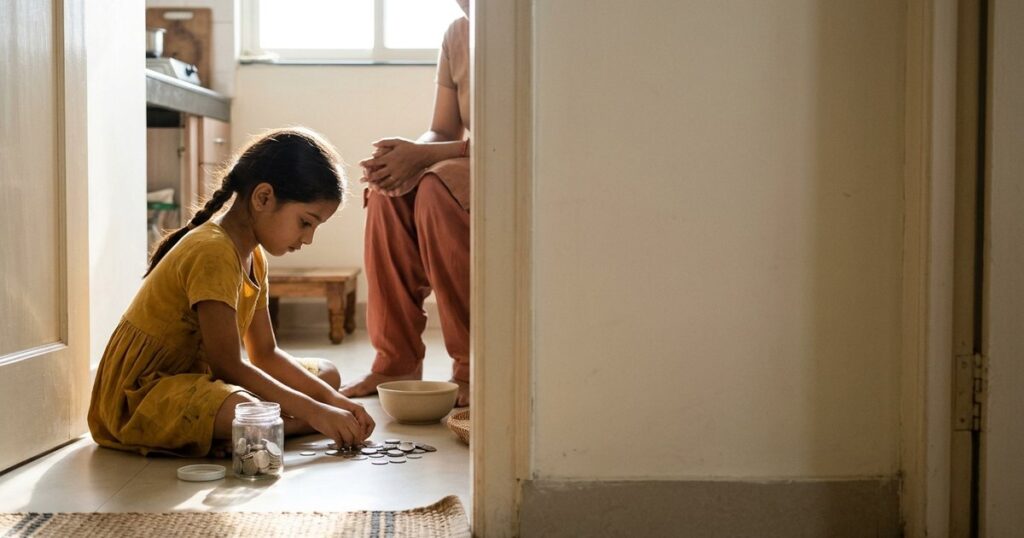
When my children were young, I discovered that the difficult part of pocket money was not deciding whether they needed ₹100 or ₹500. It was resisting the temptation to rescue them whenever they spent it badly.
My practical answer is this: start when a child can count and make small purchases, usually around six or seven. Give a modest, predictable amount—perhaps ₹50–₹100 a week for a young child, ₹200–₹500 a month for a primary-school child, and ₹500–₹2,000 a month for a teenager, depending on what the money is expected to cover and what your family can afford. The exact number matters less than the system. Pocket money should teach choice, delay, saving and consequences—not become a reward for obedience or an unlimited ATM.
I have seen parents spend years teaching their children every academic subject except money. The child can solve quadratic equations but cannot distinguish between a want and a need. He can discuss the latest phone but has never had to save for one. This is a serious educational gap.
Pocket money for kids in India: what is it meant to teach?
Money is an abstract idea until a child has too little of it.
If I give my son ₹500 whenever he asks, he does not learn that money is scarce. He learns only that asking works. If I give him a fixed amount and allow him to spend it on something silly, he learns a more useful lesson: choices have consequences.
This is why I am uncomfortable with parents who give pocket money only for good marks, cleaning a room or behaving well. Chores are part of living in a family. I do not pay my children for brushing their teeth, just as I do not pay my colleagues for attending a meeting. If every ordinary responsibility is converted into a transaction, the child begins to ask, “What will you give me?” before doing anything.
I would rather separate three things:
| Purpose | How I would handle it | What the child learns |
|---|---|---|
| Basic needs | Parents pay directly | Family responsibilities are not negotiable |
| Personal wants | Fixed pocket money | Choice and budgeting |
| Extra work | Occasional payment, agreed in advance | Effort can create income |
| Gifts and festivals | Discuss, save or spend separately | Windfalls need planning too |
A child should not have to use pocket money to buy school books, lunch or essential transport. Those are parental obligations. Pocket money is for the small discretionary decisions that make a child feel some ownership over money.
When should you start giving pocket money?
I would not use age as the only test. A child is ready when she can count small amounts, understand that money buys different things, and remember that spending it means having less left.
For many Indian children, this happens somewhere between six and eight. Some children are ready earlier; some are not. A child who still loses every coin in the house is probably not ready for a monthly allowance. Start with a weekly amount instead.
Frequency matters. Young children have a short time horizon. Giving a seven-year-old ₹400 at the beginning of a month and expecting her to manage it for four weeks is not financial education; it is an experiment designed to fail. I would begin with ₹50 or ₹100 every week, preferably in cash, and make the child physically divide it into three jars:
- Spend: for small pleasures now.
- Save: for something that costs more.
- Give: for a gift, donation or helping someone.
The ratios do not need to be rigid. The habit is more important than the arithmetic. If the child wants to put everything into the spending jar, I would allow it occasionally. A lesson learned from a foolish purchase is usually remembered longer than a lecture about saving.
For a teenager, monthly money works better. A 15-year-old can plan across four weeks, compare prices and understand trade-offs. But I would not suddenly hand over ₹5,000 without explaining what it is expected to cover.
How much pocket money should you give at each age?
There is no scientifically correct Indian pocket-money number. Household income, city, school, peer group and the expenses covered by the allowance all differ. A child in a boarding school has a different requirement from one who travels by school bus and eats at home.
Still, parents often need a starting point. This is the range I would use as a rough guide, not as a rule:
| Age | Suggested amount | Frequency | What it might cover |
|---|---|---|---|
| 6–8 | ₹50–₹100 | Weekly | Small treats, stationery, saving for a toy |
| 9–11 | ₹100–₹250 | Weekly or fortnightly | Snacks, small hobbies, gifts for friends |
| 12–14 | ₹300–₹800 | Monthly | Small outings, treats, personal purchases |
| 15–17 | ₹800–₹2,000 | Monthly | Social spending, transport top-ups, gifts and hobbies |
| 18 and above | Based on an agreed budget | Monthly | Food, transport and personal discretionary expenses |
These figures assume that parents continue to pay for necessities. If the teenager must pay for local transport, school projects and occasional meals outside, the amount must be higher. But I would make that division explicit. “Here is ₹2,000” is vague. “Here is ₹2,000; it includes your weekend snacks and gifts, but not your bus pass or textbooks” is a budget.
I would also adjust for the family’s means. A child does not need to receive the same amount as classmates whose parents earn five times as much. Nor should a prosperous family pretend that ₹100 teaches thrift if the child can ask for another ₹2,000 whenever needed.
The right amount of pocket money is not the amount that makes the child happy. It is the amount that creates meaningful choices without making the child anxious about basic needs.
Should pocket money be linked to marks or chores?
I would not pay for marks.
Learning is the child’s work, and marks are an imperfect measure of learning. Paying for every test score teaches the child to optimise for the reward rather than develop curiosity or discipline. It also creates a problem when the marks fall: is the child now less worthy of money, or merely struggling with a subject?
I am equally wary of a detailed price list for household chores: ₹20 for folding clothes, ₹50 for washing a plate, ₹100 for taking out the rubbish. Children should contribute to the household because they belong to it. If I pay them for every normal task, I turn family life into a labour contract.
There is a useful distinction between responsibility and extra work. Making one’s bed is a responsibility. Helping to clean the storeroom before Diwali, organising old books for donation or doing a substantial task that is normally done by an adult may reasonably attract a payment. The amount should be agreed before the work begins. Otherwise, the child may complete the task and then negotiate emotionally.
This is similar to what I see with young founders. A founder who expects a reward for every ordinary responsibility will struggle to build a company. A founder who can work patiently without immediate applause has a better chance of surviving the long, dull middle. Children need practice with both effort and delayed reward.
Cash, bank account or digital wallet?
For younger children, I prefer cash. Notes and coins make the transaction visible. The child can see the ₹100 disappear when the toy is bought. That physical experience is difficult to reproduce with a tap on a phone.
Older children can use a bank account or a supervised payment instrument. This is a good time to teach them to check balances, record expenses and understand that digital money is still real money. I would not give an unrestricted credit card to a teenager. Credit makes spending painless and repayment someone else’s problem.
A simple arrangement works well:
- Transfer the agreed monthly amount on the same date.
- Ask the child to record every expense for one month.
- Review the record together, without mocking foolish purchases.
- Increase the amount only when the child can explain where the existing amount goes.
The review should be a conversation, not an audit. I would ask, “Were you happy with how you spent this?” rather than “Why did you waste ₹300?” Shame makes children hide spending. Curiosity makes them examine it.
Parents should also model this behaviour. If I lecture my child about saving while buying an expensive phone on impulse, the lecture will be ignored—and rightly so. Children notice our actual behaviour far more accurately than they listen to our financial advice.
What if the child spends everything immediately?
Let the small mistake happen.
If a child spends the full week’s allowance on chips and then asks for money on Wednesday, I would usually say no. Not angrily. Not with a speech. Just no.
This is the point at which many parents fail. They want the child to learn budgeting, but they cannot tolerate the child being disappointed. So they provide an advance, call a grandparent, or quietly pay for the requested treat. The child learns that the budget is fictional.
There can be exceptions. If the child has lost money needed for a genuine necessity, I would help. If the allowance was obviously too small for the expenses I assigned to it, I would revise the amount. But I would not bail the child out merely because a want arrived before payday.
The same rule applies to saving. If a child wants a ₹1,500 toy and has saved ₹700, I would not automatically contribute the remaining ₹800. I might help the child find extra work, wait for a birthday, or choose a cheaper alternative. The frustration of waiting is not a harm. It is a skill.
This is also why I dislike parents who buy everything immediately. A child who never has to wait cannot understand the pleasure of obtaining something after saving for it. Instant gratification is not a sign of privilege; it is often a failure to teach patience.
Should you give more pocket money to children from wealthy families?
Affluent parents often say, “The amount is too small to matter to us.” That misses the point. Pocket money is not primarily about the family’s ability to pay. It is about giving the child a bounded area in which decisions matter.
A wealthy family may give ₹2,000 a month, while another gives ₹300. Both can teach the same principles if the amount is fixed and the child has to make choices within it. The wealthy child may spend on a more expensive hobby, but he should not receive unlimited top-ups simply because the family can afford them.
There is a second danger. Parents who give very large allowances sometimes believe they are teaching independence. In reality, they may be outsourcing parenting. If a 14-year-old has enough money to order anything at any time, the parent no longer knows what the child is eating, buying or sharing.
I would rather give a smaller amount and remain engaged with the decisions. Independence is not the same as unrestricted consumption.
What about relatives giving cash gifts?
Indian children often receive cash during birthdays, festivals and family visits. I would not confiscate this money or insist that every rupee be invested. A gift belongs to the child.
But I would ask what the child wants to do with it. A useful division might be:
- some for immediate enjoyment;
- some for a larger purchase;
- some for a savings account or long-term investment;
- some for giving.
The proportions can change with age. A five-year-old may spend most of a ₹500 gift. A 16-year-old should be able to explain why he wants to spend ₹5,000 rather than save it.
I would be careful about opening investments in the child’s name merely to feel responsible. A child does not become financially literate because a parent buys a mutual fund. The child becomes financially literate by understanding what was invested, why it was invested, how long it may take to grow and what risk means. An account statement is not a lesson.
If you are teaching a teenager about investing, start with a small amount and explain that returns are uncertain. Do not turn the child into a miniature trader. I have written separately about how much money someone needs to start angel investing in India; the same principle applies here: do not put money at risk until you understand what you may lose.
Should pocket money be used to teach charity?
I think every child should experience giving, but I would not make charity a compulsory tax on pocket money. Compulsory generosity is a contradiction.
Instead, I would discuss real choices. If the child wants a second expensive toy, could that money help buy books for a municipal-school library? If a birthday is approaching, would she prefer one large gift or contribute to something useful? The child should see that money expresses priorities.
This is one reason I like the three-jar method. The giving jar makes generosity visible without turning it into punishment. Sometimes the child will give to a cause the parent considers trivial. That is acceptable. The first lesson is not to choose the perfect charity. It is to recognise that money can be used for someone else.
The mistakes I would avoid
Several errors recur in families I know.
Changing the amount unpredictably. If pocket money depends on the parent’s mood, the child cannot plan. Fix the date and amount, then review it every few months.
Giving too much to avoid embarrassment. A child should not be humiliated because she cannot match every classmate’s spending. But the solution is not to imitate every expensive habit. Explain the family’s budget honestly.
Using money as punishment. If the child misbehaves, address the behaviour. Do not make food, transport or basic dignity conditional on pocket money.
Interfering with every purchase. If the child is allowed to spend only on things the parent approves, the allowance is not really hers. Set boundaries around safety and values, but leave room for harmless mistakes.
Increasing the amount without increasing responsibility. If a teenager receives more money, some additional expenses should move from parent-funded to child-managed. Otherwise the increase teaches only consumption.
Ignoring digital spending. Small online purchases add up quickly because there is no physical exchange. A monthly statement should be reviewed together, especially when games, subscriptions or in-app purchases are involved.
How I would introduce pocket money in a family
If I were starting from scratch, I would not announce a complicated financial curriculum. I would have one short family conversation.
- Explain the purpose. “This is money for your personal choices. We will continue to pay for your essential needs.”
- Choose a realistic amount. Start low enough that the child must choose, but high enough that the money is useful.
- Set the timetable. Weekly for younger children; monthly for adolescents.
- Define the boundaries. No unsafe purchases, gambling, tobacco, alcohol or spending that violates family rules.
- Decide what happens when it is finished. Usually, there is no advance.
- Review after a month. Ask what worked and what did not. Adjust the system, not every impulse.
I would write the arrangement down for an older child. Not because this is a legal contract, but because clarity prevents arguments. The child should know whether school canteen expenses, gifts, transport, mobile data and hobbies are included.
For example, a 15-year-old might receive ₹1,500 a month. The parents may continue to pay for school transport and textbooks. The child pays for weekend snacks, small gifts, and personal entertainment. If she saves ₹500, the parents might match that amount once for a specific goal—not forever, and not as a way to replace the discipline of saving.
The matching contribution is optional. I would use it sparingly. If every saving decision is matched, the child may save only when the parent subsidises it. The deeper lesson is that money grows through time, not through parental rescue.
The surprising lesson: pocket money is really about failure
Parents usually think pocket money is meant to teach saving. I think its more valuable purpose is to give children a safe place to fail.
A child who spends ₹200 on a toy that becomes boring after one day has made a cheap mistake. A young adult who spends an entire salary on a car he cannot afford has made a costly one. A teenager who learns that a digital subscription renews automatically has learned something before the stakes become serious.
This is exactly how I think about early-stage investing. I do not expect every company I back to succeed. I do expect the founder to learn from mistakes, understand the downside and avoid repeating the same error with a larger cheque. Small, survivable failures are part of becoming capable.
We should give children the same opportunity. If I prevent every bad purchase, I may preserve ₹500 today while depriving the child of judgment tomorrow.
There is no perfect pocket-money amount for an Indian child. ₹100 may be generous in one family and meaningless in another. The number should be calibrated to the child’s age, the family’s finances and the expenses included. But the principle is fixed: give enough to create choices, not enough to remove them.
My strongest recommendation is to stop treating pocket money as a monthly gift. Treat it as a small laboratory. Let the child spend, save, regret, wait, give and try again. The child who wastes ₹300 today and has to wait until next month may be learning a lesson that no school, app or lecture can teach: money is not a measure of love, and parents are not obliged to erase every consequence.