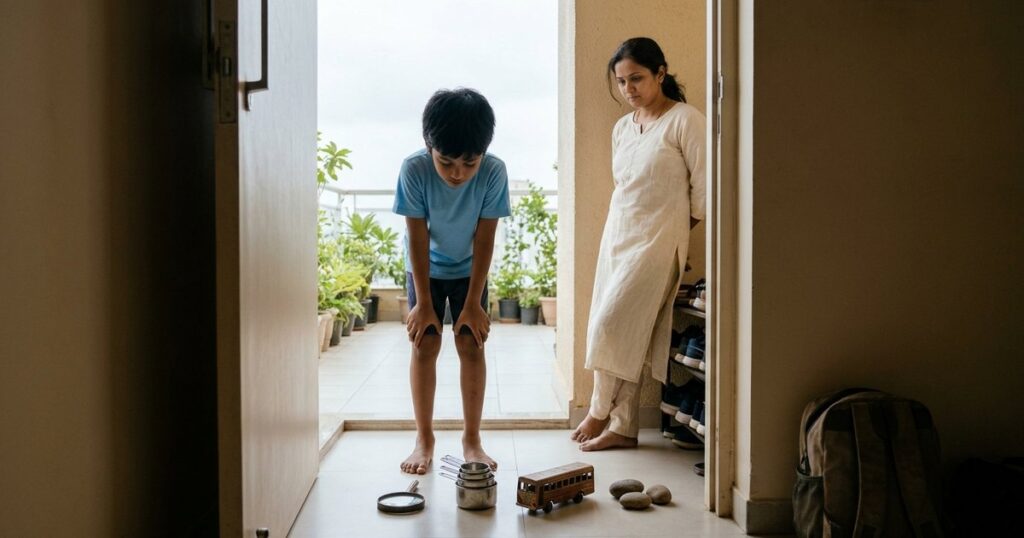
A parent recently told me that she was considering unschooling her eight-year-old son in Mumbai. Her immediate worry was not mathematics, socialisation, or even the legality of it. It was simpler and more painful: “How do I explain to my parents that I am not neglecting his education?”
I understood the question. In India, the word unschooling sounds to many people like an admission of failure. It suggests that the child is being left to do whatever he wants, while the responsible adults have abandoned their duty. That is not what unschooling means.
Unschooling in India is a form of home education in which the child’s interests, questions, and pace guide learning, rather than a fixed school curriculum. Homeschooling usually brings school into the home: subjects, timetables, textbooks, assignments, and assessments remain, even if parents modify them. Unschooling questions that entire structure. Learning is treated as part of ordinary life, not as something that happens only between 9 am and 3 pm.
Both approaches are legally part of the broader category of home education. The law does not usually recognise “unschooling” as a separate legal category. I have written separately about whether homeschooling is legal in India, because parents should understand the practical implications before making a decision.
What homeschooling usually means
When an Indian parent says, “We homeschool,” I usually assume that the family has moved the location of schooling, not necessarily changed its underlying philosophy.
The child may follow CBSE, ICSE, Cambridge, or an eclectic curriculum. There may be a daily timetable, workbooks, online classes, tutors, tests, and grade-level expectations. The parent may make lessons more enjoyable and adapt the pace, but the basic model remains familiar:
| Homeschooling | Unschooling | |
|---|---|---|
| Who chooses the subject? | Usually the parent or curriculum | Usually the child’s interests and questions |
| Structure | Timetable, lessons, subjects, planned progression | Flexible rhythm shaped by daily life and curiosity |
| Learning path | Often grade-based and sequential | Individual and non-linear |
| Assessment | Tests, worksheets, grades, or formal examinations are common | Less emphasis on grades; parents observe understanding and capability |
| Role of the parent | Teacher and curriculum manager | Observer, guide, resource-provider, and fellow learner |
This is not a criticism of homeschooling. It can be an excellent choice for a child who benefits from structure, or for a family that wants to prepare for a recognised board examination while avoiding the daily grind of school. A parent may decide that her child should complete algebra by a particular age, or that a certain amount of writing practice is non-negotiable. There is nothing wrong with that.
The difficulty begins when parents call something unschooling merely because the lessons happen at home. A child who spends the morning completing a mathematics workbook, attends a history class after lunch, and writes a weekly test is being homeschooled, even if the workbook is attractive and the classes are online.
Unschooling is not simply school with nicer furniture.
What unschooling changes
Unschooling begins with a different assumption: children are naturally curious and do not need to be constantly compelled to learn. The adult’s job is not to manufacture motivation but to notice it, protect it, and provide the people, tools, books, experiences, and time that allow it to deepen.
A child who becomes fascinated by trains may begin by watching videos of locomotives. Then she may want to know how engines work, why railway tracks curve, how timetables are designed, how many passengers a train carries, and what the difference is between kilometres and miles. Mathematics, geography, physics, history, drawing, writing, and computer skills can enter through that one interest.
The unschooling parent does not say, “That is an interesting question, but it is not on today’s timetable.” Nor does the parent need to convert every interest into a formal lesson. Sometimes the child simply wants an answer. Sometimes the question disappears after ten minutes. Sometimes it becomes a serious project lasting six months.
The distinction is not whether the parent teaches. The distinction is who initiates the learning and how much control the child has over its direction.
Unschooling does not mean that parents stop educating their children. It means that parents stop confusing education with compliance.
This is much harder than it sounds. A parent who has spent fifteen years in school and college has been trained to recognise learning only when it looks like a lesson. A child reading about dinosaurs is learning. A child negotiating the price of mangoes with a vendor is learning. A child building a game in Scratch is learning. But the parent may still feel guilty because no chapter has been completed.
I see a similar confusion in healthcare. Patients often believe that a treatment is working only when it produces something visible and immediate: a scan, a prescription, a procedure. Yet observation, waiting, and changing course can be part of good medical care. The absence of a tablet does not mean the absence of treatment. In the same way, the absence of a worksheet does not mean the absence of learning.
What unschooling is not
The biggest misunderstanding is that unschooling means allowing a child to spend the entire day on YouTube, gaming, or social media without boundaries. That is not unschooling. It is abdication.
Freedom requires a relationship. The parent must know the child well enough to distinguish deep interest from passive consumption. A child watching twenty videos about space may be exploring astronomy. Or he may simply be clicking from one entertaining video to another. The difference becomes visible only when the parent pays attention.
Unschooling also does not mean that the child must learn everything alone. A child may need help with reading, a mentor for music, a tutor for advanced mathematics, or a group for sport. An unschooling family may use online courses, libraries, museums, makerspaces, co-learning groups, and examinations. The difference is that these resources serve the child’s learning rather than define the child’s entire life.
Nor does unschooling mean that parents never say no. A family can have rules about sleep, safety, respectful behaviour, screens, money, and time spent outside. A child can have considerable control over what she learns without having control over every family decision.
This is where some advocates make a mistake. They present unschooling as a pure philosophy in which any adult intervention is suspect. I do not find that useful. Children need freedom, but they also need capable adults. A five-year-old cannot assess the long-term consequences of every choice. A fourteen-year-old may need help recognising that an online community is manipulating him. Trust does not require blindness.
Why Indian parents are attracted to it
Many Indian parents do not begin with a grand educational philosophy. They begin with an exhausted child.
The child wakes early, travels through traffic, spends six or seven hours in school, attends tuition, completes homework, prepares for tests, and still gets told that he is not working hard enough. A child who was once curious about how things work begins to ask only one question: “Will this come in the exam?”
The pandemic made this absurdity visible to many families. Parents saw young children struggling to learn basic concepts through screens. They saw the difference between attending a class and understanding something. Some realised that the school timetable had been doing the work of organising adults, not necessarily the work of educating children.
There are other reasons. A child may have a disability, anxiety, a chronic illness, a learning difference, or a temperament that makes a conventional classroom particularly painful. A family may live in a town where the available schools are poor. A child may be a serious athlete, musician, actor, or coder. Some families simply believe that the standard system rewards memory and obedience at the expense of judgment.
I agree with much of this criticism. Our schools often treat children as containers into which information must be poured. They reward the student who can reproduce the teacher’s answer and penalise the student who asks whether the question itself is sensible. I have written about why India needs to respect learning by doing. The same principle applies here: children understand more deeply when they make, test, fail, revise, and try again.
But dissatisfaction with school is not, by itself, a sufficient reason to unschool. Leaving a bad system does not automatically create a good one.
The parent is the hidden curriculum
In a school, much of the educational burden is outsourced. Teachers decide what to teach, when to teach it, and how to assess it. A timetable provides a rhythm. Other children provide companionship and comparison. The institution supplies a certificate at the end.
In unschooling, the parent becomes responsible for much more than buying books. The parent has to create an environment in which questions are welcomed and resources are available. This may mean visiting a science centre, finding a Hindi-speaking mentor, arranging a football group, reading aloud every evening, or helping a child apply for an examination when she later wants one.
It also means examining one’s own anxiety. Parents who say they want child-led education often intervene every time the child chooses something they consider unproductive. They say they trust the child, but keep asking, “What did you learn today?” They reject grades, but compare their child with a cousin who is preparing for IIT. They dislike school pressure, but recreate it at home through a never-ending list of projects.
A parent cannot offer freedom while communicating panic.
I have seen this in founders as well. A first-time founder often says she wants to build a company patiently, but then changes the product every week because another founder has raised money. Her stated philosophy is patient learning; her actual behaviour is driven by fear. Children notice the same contradiction immediately.
Unschooling works best when the parent can tolerate uncertainty for long enough to observe what is actually happening. That does not mean ignoring gaps. It means responding to evidence rather than to relatives’ questions.
The difficult question of basic skills
Here I part company with the most romantic versions of unschooling. I do not believe that every child will automatically acquire every skill at the right time simply because adults leave him alone.
Children differ. Some learn to read spontaneously. Others need systematic, patient instruction. Some develop number sense through cooking and shopping. Others need explicit practice with place value and arithmetic. A child who has never been asked to write may have wonderful ideas but struggle to communicate them on paper. Freedom does not remove the need for teaching; it changes the reason and timing for teaching.
I would be particularly careful about literacy. Reading gives a child access to almost everything else. If a child is not progressing in reading, I would not wait indefinitely in the name of respecting his pace. I would seek help, check for dyslexia or other learning difficulties, and provide direct instruction without shame.
The same applies to health, safety, and digital literacy. A child should not be expected to discover vaccination, road safety, consent, or online privacy through personal experimentation. Some knowledge is too important to leave entirely to chance.
This is why I prefer to describe unschooling as child-led rather than adult-free. The adult remains responsible for ensuring that the child has access to foundational tools and can make informed choices later.
How families can begin without making a mess
I would not advise a family to withdraw a child from school on Friday and declare that unschooling begins on Monday. The child may need a period of recovery from years of imposed schedules. Parents may need to unlearn their own school habits. This transition is often called deschooling, though families use the term differently.
If I were advising a family seriously considering this route, I would suggest doing the following in order:
- Clarify the problem. Write down what is not working. Is it excessive homework, bullying, a poor fit with the child’s learning style, health issues, or a deeper objection to competitive schooling? A vague dislike of school produces vague solutions.
- Understand the legal and examination options. Find out how the child could later appear for recognised examinations, including through open schooling or another board. Do not assume that every future college will interpret an unconventional transcript generously.
- Observe before redesigning everything. For several weeks, watch what the child chooses when there is no immediate assignment. Record questions, activities, conversations, books, friendships, and frustrations. This is more useful than buying a large curriculum package.
- Build a weekly rhythm, not a rigid timetable. Include sleep, outdoor activity, reading, household responsibilities, social time, and periods of uninterrupted interest. Unschooling should not become an unstructured life in which the child is always online.
- Protect foundational learning. Check whether the child can read with understanding, write clearly enough to communicate, handle basic mathematics, and ask for help. Arrange targeted teaching where necessary.
- Find other adults and children. One parent cannot be the entire world. Co-learning groups, sports teams, music teachers, relatives, libraries, and community activities matter. Socialisation is not simply being placed among thirty children of the same age; it is learning to cooperate with different people.
- Review the arrangement honestly. Every few months, ask what the child is actually learning, whether curiosity is growing, and whether the family can sustain the time and money involved. A decision can be changed without being called a failure.
The common mistake is to spend heavily before understanding the child. Parents buy imported curricula, subscriptions, tablets, craft kits, and online courses because purchases feel like progress. They are not. A child may need one good book, a patient adult, and the freedom to stay with a question for an afternoon.
What about socialisation?
This is the question relatives ask first, and it deserves a serious answer. A child who never meets anyone outside the family may become isolated. But a conventional school is not automatically a model of healthy social development. It can teach cooperation, but it can also teach conformity, status anxiety, bullying, and fear of being different.
Unschooling families have to create social opportunities deliberately. The child may join a sports club, theatre group, robotics class, neighbourhood activity, volunteering project, or mixed-age learning community. This requires effort. It is not enough to say that the child will socialise naturally while remaining at home.
I like mixed-age settings because they resemble adult life more closely than a classroom of thirty children born in the same academic year. A younger child can learn from an older one; an older child can learn patience and responsibility. But the group must be chosen carefully. A group that merely reproduces school pressure under a different name has not solved much.
Will unschooled children get into college?
Some will. Some will not. The answer depends on the child’s goals, the family’s planning, and the flexibility of the institution.
Indian higher education still relies heavily on marks, board certificates, entrance examinations, and standardised documentation. A child who wants to pursue medicine, engineering, law, or another regulated profession will eventually need to meet formal requirements. Unschooling does not repeal them.
This does not mean that an unschooled child must abandon the approach. It means that the family should work backwards from the desired destination. If the child wants to sit for a competitive examination at seventeen, systematic preparation cannot be postponed until sixteen and a half. If the child wants to study design, entrepreneurship, music, or writing, a portfolio, body of work, and evidence of sustained practice may matter more than a conventional transcript—but the family should verify what each institution accepts.
There is a danger in using exceptional university admissions stories as proof that the system has changed. A talented child with unusual achievements may find a path. That does not mean every college is ready to assess a learner without marks. Parents should be optimistic, but not careless.
I tell founders something similar when they say they do not need revenue because a large investor will eventually recognise their vision. Perhaps. But a founder should not build a company on the assumption that every future investor will be unusually perceptive. Likewise, a family should not build an educational life on the assumption that every future admissions officer will understand it.
Is unschooling affordable in India?
It can be cheaper than a private school, but it is not automatically cheap. The largest cost is often the parent’s time. If one parent leaves paid employment, the opportunity cost can be substantial. There may be spending on tutors, transport, activities, books, travel, devices, and examination preparation.
Families with money can make unschooling look effortless because they can provide mentors, travel, equipment, and social opportunities. A lower-income family may have fewer choices, although ordinary life itself can provide rich learning. Cooking, repairing, selling, farming, budgeting, caring for siblings, and navigating public transport all teach useful skills.
The important question is not whether the family can recreate an expensive private school at home. It is whether the family can provide attention, safety, access to people and resources, and a realistic path for the child’s future.
The privilege in unschooling is not only money. It is also having a parent who can absorb uncertainty, spend time, and defend the child’s choices when relatives and institutions demand conventional proof.
This is why I am wary when unschooling is presented as a universal prescription. It may be liberating for one family and financially destructive for another. A parent who must give up a job should make that decision consciously, not because a social media post made conventional schooling sound morally inferior.
My position
I am deeply sympathetic to unschooling because I believe that Indian education asks children to surrender too much of their childhood in exchange for certificates of uncertain value. I would like to see far more room for curiosity, projects, practical work, reading, play, and independent thought inside ordinary schools.
But I do not believe that every child should be unschooled. Nor do I believe that every parent who chooses it is automatically brave or enlightened. Some parents are escaping a real problem. Others are escaping the responsibility of setting limits. Some children flourish with autonomy. Others become anxious when there is no structure. Some families have the time and temperament for this experiment. Others do not.
The label matters less than the daily reality. Is the child becoming more curious or merely more entertained? Is she learning to persist when something is difficult? Can she read, write, reason, collaborate, and care for herself? Does she have relationships beyond the immediate family? Can she explain what she wants to learn and why? Is the parent watching closely enough to know?
For me, the best test is not whether the child can recite the syllabus. It is whether the child gradually becomes more capable of directing her own life. That is also what I look for in founders. I do not expect a nineteen-year-old entrepreneur to know everything. I do expect her to ask good questions, learn from evidence, find the right help, and take responsibility for the next step.
Unschooling in India will remain uncomfortable because it challenges the belief that education must be visible, standardised, and externally certified to be real. I am comfortable with that discomfort. But I would never advise a parent to replace one rigid ideology with another. The child is not a laboratory for the parent’s educational beliefs.
If I had to choose one principle, it would be this: give the child genuine freedom, but keep the adult genuinely responsible. The parent must resist both temptations—the temptation to turn home into a miniature school, and the temptation to call neglect “freedom.”
The parent who can sit beside a child, notice the question behind the question, and stay with it long enough for real understanding to emerge is already doing something our schools rarely manage. That, to me, is the heart of unschooling—not the absence of school, but the presence of an attentive adult.