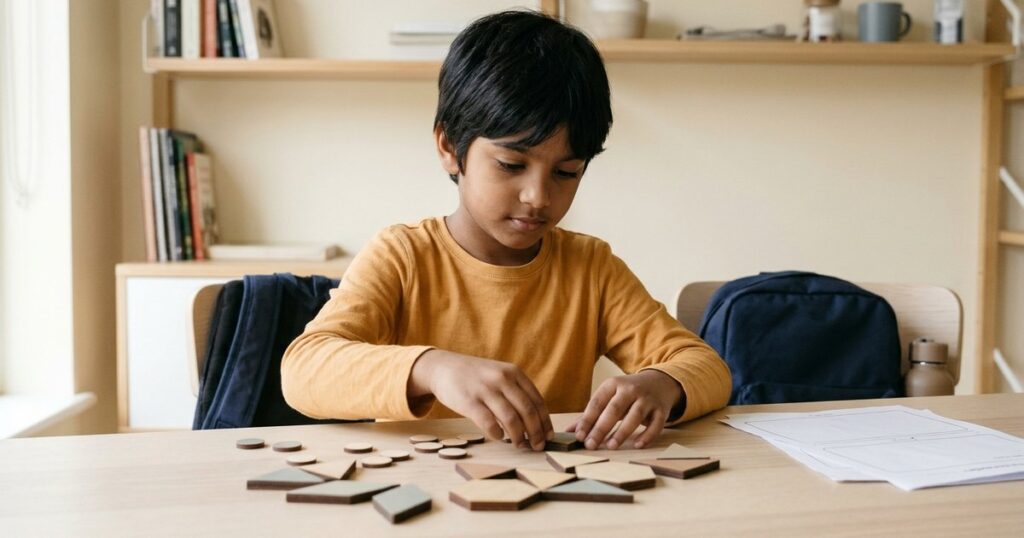
I have watched parents spend an entire Sunday moving their child from one coaching class to another, with an Olympiad workbook wedged between the schoolbag and the water bottle. The child is tired, the parent is anxious, and nobody is quite sure what the exercise is meant to achieve.
So, are Olympiad exams worth it? My answer is: sometimes, but certainly not by default. A well-designed Olympiad can make a child think beyond memorised school answers. It can reveal a genuine interest in mathematics or science and give a curious student an enjoyable intellectual challenge. But for many children, especially very young ones, the commercial Olympiad industry adds another rank, another certificate and another source of parental pressure without adding much learning.
The exam is not the problem. The question is what the child is doing to prepare for it, and what the parent expects the result to prove.
The comfortable belief that needs examining
Parents often assume that an Olympiad medal is an early signal of future academic success. A child wins a school-level mathematics competition in Class 3, and everyone starts speaking about IIT-JEE. A certificate arrives in the post, and it is treated as evidence that the child is unusually gifted.
I understand the temptation. Indian parents have very few reliable signals about whether their children are learning well. School marks are often inflated or inconsistent. Entrance examinations are years away. A rank printed on a certificate feels objective.
But most of these signals are much weaker than they appear.
There is a vast difference between an official, selective Olympiad pathway and a private examination conducted in hundreds or thousands of schools, where participation is open to nearly everyone and the main achievement is completing an additional worksheet. Both may use the word “Olympiad”. They should not be treated as equivalent.
Some examinations associated with recognised national selection processes are genuinely demanding. They require deep conceptual understanding and sustained problem-solving ability. Other school-level competitions are useful practice, but their medals should be understood as participation and encouragement, not as a national assessment of exceptional talent.
This distinction matters because parents can spend months preparing for the wrong outcome. They may believe they are building mathematical thinking when they are really training a child to recognise recurring multiple-choice patterns.
An Olympiad certificate is not a diagnosis of intelligence. At best, it is one small piece of information about how a child performed on one paper, on one day.
What a good Olympiad can teach
A strong problem is different from a routine school exercise. In a school test, a child may be asked to apply the formula that was taught in class yesterday. In a good Olympiad question, the child has to decide which idea is relevant, combine concepts, eliminate wrong answers and persist when the route is not obvious.
That is valuable. It is also close to the kind of thinking I look for in founders I meet as an angel investor. A founder rarely succeeds because she has memorised the answer to a familiar business question. She succeeds because she can understand an unfamiliar problem, identify what matters, test an assumption and change direction when the evidence is poor.
Children can develop similar habits through mathematics, science, puzzles, chess, building things or simply asking difficult questions. An Olympiad is one possible setting for this. It is not the only one.
I would look for four benefits.
First, conceptual understanding. A child who has only memorised procedures will struggle when the question is presented in an unfamiliar form. Olympiad-style problems can expose this quickly. That exposure is useful if it leads to discussion and understanding rather than more frantic drilling.
Second, comfort with difficulty. Children need to learn that not solving a problem immediately is normal. When the preparation is healthy, a difficult question becomes an invitation to try several approaches. This is a better lesson than being praised only for speed and accuracy.
Third, self-knowledge. A child may discover that she enjoys number theory but dislikes routine arithmetic, or that she prefers experiments to written questions. This information is more valuable than a medal because it helps the child choose future challenges.
Fourth, independent learning. The best preparation involves reading, trying, failing, discussing and trying again. The child begins to own the process. The worst preparation involves a parent or tutor demonstrating ten methods while the child copies them without understanding.
I have written earlier about the difference between helping a child think and helping a child memorise. That distinction is central to this topic; the child who learns to think benefits from Olympiad problems, while the child who is trained only to reproduce solutions gains very little.
When Olympiad preparation becomes counterproductive
The danger is not that a child will take one extra examination. The danger is that the examination becomes the centre of the child’s academic life.
I have seen this pattern repeatedly in education. A parent starts with a reasonable aim: “Let us see whether my daughter enjoys mathematics.” A coaching class is added. Then a workbook. Then weekly tests. Then a second Olympiad in science. Soon the child is spending several hours each week preparing for competitions that were supposed to be enrichment.
The child stops asking, “Why does this work?” and starts asking, “Which trick should I use?”
This is particularly damaging for younger children. A seven-year-old does not need a five-year competitive-examination plan. She needs time to play, read widely, draw badly, build things that collapse, talk to adults and become bored enough to invent something. These activities do not produce a rank, but they build the curiosity on which later learning depends.
There is also a psychological cost to making every activity competitive. A child who repeatedly sees classmates ranked above him may conclude that mathematics is a test of personal worth. A child who repeatedly wins may become afraid to attempt anything where victory is uncertain. Neither response is desirable.
Parents sometimes tell me that their child has become “careless” because she makes mistakes in Olympiad papers. I would rather know whether she can explain her reasoning, recognise an error and correct it. A perfect score achieved through memorised patterns may tell me less than a wrong answer followed by an intelligent explanation.
| Type of experience | What the child usually practises | What the result can reasonably tell you |
|---|---|---|
| Routine school examination | Recall, written presentation and syllabus coverage | How well the child has learned the taught material |
| Commercial school-level Olympiad | Timed multiple-choice questions and pattern recognition | How the child performed on that particular paper |
| Selective, recognised Olympiad pathway | Deep problem-solving and advanced conceptual reasoning | Evidence of unusual interest or ability, but not a complete picture of the child |
| Open-ended projects and experiments | Curiosity, persistence, communication and practical reasoning | How the child thinks when there is no answer key |
The last row is often neglected because it is difficult to measure. It is also where much of the real learning happens.
Are Olympiads useful for JEE or NEET?
Parents commonly justify Olympiads as early preparation for JEE or NEET. There is a limited truth here. A student who learns to reason carefully, tolerate difficult questions and manage time may find later competitive examinations less alien.
But an Olympiad is not a substitute for learning the school curriculum, and it is not a reliable shortcut to an entrance examination. JEE and NEET demand years of preparation, broad syllabus coverage, sustained revision and the ability to perform under pressure. An Olympiad medal in Class 5 does not predict that a child will enjoy coaching in Class 11.
In fact, premature coaching can produce the opposite result. The child may become exhausted before the serious preparation begins. I have met students who had been solving advanced worksheets for years but had lost all pleasure in learning. They could handle a familiar format, but became helpless when asked to explain an idea in their own words.
I am wary whenever an education provider promises that an Olympiad programme will guarantee admission to an elite college. This is the same sales tactic I see in healthcare: a legitimate intervention is presented as a universal solution. In fertility treatment, one test or one procedure cannot guarantee a baby. In education, one examination cannot guarantee a career.
If a child is genuinely interested in mathematics, by all means give her access to challenging problems. But I would not make a five-year-old solve competitive worksheets because someone has told me that this is the first step towards an engineering seat a decade later.
Parents who are considering a JEE or NEET drop year may find it useful to think about the same issue of opportunity cost in my earlier post on taking a drop year. Extra preparation is not automatically valuable. Its benefit must be weighed against the time, stress and alternatives it displaces.
The child matters more than the examination
I would ask three questions before registering a child.
- Does the child want to do it? Not because the parent wants a medal, and not because every classmate is participating. Genuine interest need not be dramatic. The child may simply enjoy puzzles or ask to try another paper.
- What will preparation replace? If it replaces mindless television, fine. If it replaces sleep, outdoor play, reading or time with family, I would be cautious. The opportunity cost is real even when the fee is modest.
- What will we do with the result? If the answer is “we will discuss the questions and identify what was interesting”, the exam may be worthwhile. If the answer is “we will compare the rank with cousins and decide whether the child is gifted”, I would not register.
I would also ask to see the actual question paper before paying for preparation material. Are the questions testing reasoning, or are they mostly testing speed and familiarity with a narrow format? Does the paper contain explanations, or only an answer key? Is the organisation transparent about who conducts the examination, how rankings are calculated and what the awards mean?
Parents should be especially careful with claims such as “international rank”. If a competition is open to large numbers of students and has multiple papers, categories and participation levels, the rank may have little meaning outside the marketing brochure. That does not make the activity worthless. It simply means we should value the questions, not the label.
How I would introduce an Olympiad to my own child
I would begin with a small experiment rather than a long commitment.
- Find a few sample papers. I would not begin with a coaching package. I would look at the questions with the child and see what produces curiosity rather than dread.
- Let the child attempt them without teaching tricks. I would watch how she approaches an unfamiliar problem. Does she draw a picture? Try examples? Ask what the question really means? These behaviours matter more than the score.
- Review the mistakes together. I would ask, “What did you think the question was asking?” before explaining the answer. The purpose is to understand the reasoning, not to deliver a lecture.
- Keep the preparation bounded. One short session a week may be enough for a young child. If the child wants more, we can increase it. The exam should fit into the child’s life, not consume it.
- Stop when the learning disappears. If every session ends in tears, bargaining or mechanical repetition, I would stop. Persistence is a virtue; forcing a child through an activity she has come to hate is not.
This approach may not produce a medal. It may produce something better: a child who learns that hard questions can be enjoyable.
What parents should measure instead of rank
Rank is easy to display and difficult to interpret. I would pay attention to quieter evidence.
Can the child explain the solution without looking at the answer? Can she solve a similar problem when the numbers and wording change? Does she notice when an answer is absurd? Does she ask a question that was not in the workbook? Does she return to a problem after failing?
These are signs of learning.
I would also look at whether the child can transfer an idea. If she learns ratios in a workbook, can she use them while cooking, comparing prices or reading a map? If she studies forces in science, does she start noticing why a bicycle slows down? Knowledge becomes useful when it leaves the page.
This is one reason I am sceptical of excessive worksheet culture. A child may complete hundreds of questions and still have no opportunity to use the underlying ideas in the real world. I would rather see ten well-discussed problems than a hundred hurried ones.
There is a parallel with early-stage investing. When I assess a startup, I do not place much faith in a single impressive presentation. I want to see how the founder thinks when I change an assumption, challenge a number or ask about an unexpected problem. A child’s rank is also a presentation. The more revealing evidence lies in how she responds when the question is unfamiliar.
Which children benefit most?
An Olympiad is most likely to help a child who already enjoys the subject and wants harder questions. Such a child may find ordinary schoolwork repetitive and appreciate a different kind of challenge. The competition can provide structure, peers and a reason to explore topics beyond the textbook.
It can also help a child who is not yet confident, provided the environment is supportive. A well-chosen paper may show that school marks do not capture every kind of ability. Some children who write slowly or dislike long answers are excellent at spotting patterns and reasoning through a puzzle.
But a child who is struggling with basic concepts does not necessarily need a more difficult examination. She may need a patient teacher, a different explanation and time to practise without embarrassment. Giving her an advanced workbook can make the gap feel larger.
Likewise, a child who is already overloaded does not need another badge of achievement. The correct intervention may be subtraction.
Parents often find it hard to accept this because adding is emotionally easier than removing. A new class feels like responsible parenting. Allowing a child to spend an afternoon doing nothing feels like neglect. I believe we have this backwards. Children need unstructured time to digest what they have learned.
The commercial question
There is nothing wrong with private organisations charging for examinations and books. They provide a service, and some provide useful material. But parents should recognise that the business model rewards participation, repeat registration and visible certificates. It does not necessarily reward deep learning.
Before paying, I would ask:
- Who sets and reviews the paper?
- Is the syllabus and marking method clearly published?
- Are rankings comparable across all participating schools?
- Does the organisation provide explanations of answers?
- Is the prize meaningful, or is it mainly a sales device for the next level?
I would not spend heavily on books and tuition for a low-stakes examination. Free sample papers, library books, good schoolteachers and conversations at home may be sufficient. If the child develops a serious interest, then a specialist mentor or a more demanding programme may make sense.
Parents should also remember that the cost is not only the registration fee. It includes travel, preparation time, emotional energy and the activities that are postponed. In investing, I insist on asking what capital is being allocated and what alternative use is being sacrificed. The same discipline is useful in education.
My verdict
Olympiad exams are worth the effort when they are used as a doorway into interesting problems, not as a scoreboard for parental ambition. They are useful for a child who enjoys the subject, has enough time and receives feedback that improves understanding. They are not worth it when preparation becomes rote drilling, when the child’s self-worth is tied to rank, or when the exam is sold as an early guarantee of JEE, NEET or career success.
I would choose one good challenge over five branded competitions. I would value a child’s explanation over her certificate. I would protect sleep and play before adding another class. And I would stop the moment the activity teaches the child to fear mistakes rather than learn from them.
The best outcome of an Olympiad is not a medal hanging on the bedroom wall. It is a child who sees a difficult problem, stays with it for another ten minutes, tries a different route and remains curious even when the answer does not come. That habit will help her far more than an “international rank” printed on glossy paper.