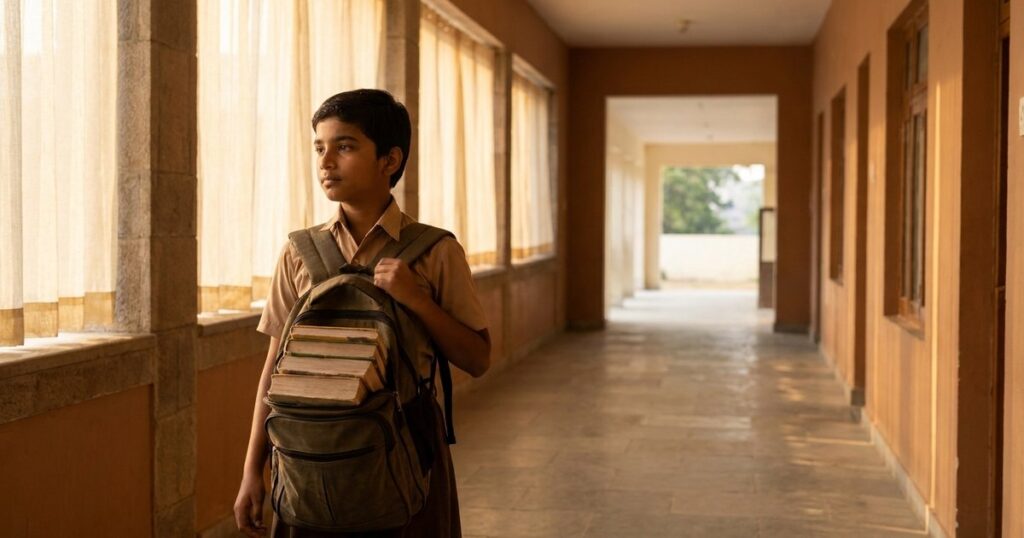
I have seen Class 7 children reach home at 4.30 pm, attend tuition, eat dinner late, and still sit with six separate homework assignments before they are allowed to sleep. Each teacher may have assigned only twenty minutes. The child receives two hours.
So here is my answer to how much homework is too much: any amount that regularly takes away sleep, outdoor play, reading, family conversation, hobbies, or the child’s ability to think calmly is too much. As a rough ceiling, primary-school children should usually have very little written homework, and secondary-school students should rarely be spending several hours every evening on routine worksheets. The exact number matters less than the total load and its purpose.
I am not arguing that children should never practise mathematics, revise vocabulary, read a chapter, or complete a project. Learning requires effort. But I am increasingly convinced that Indian schools have confused visible effort with useful learning. A thick notebook is not evidence of a good education.
The child sees the total. The school does not.
Ask a Class 7 mathematics teacher how much homework she sets. She may say twenty minutes, and she may be right. Ask the science teacher, the social science teacher, the English teacher, the Hindi teacher, and the second-language teacher. Each may give you the same answer.
Nobody in that chain is necessarily unreasonable. The problem is that the child receives all six assignments on the same evening.
This is one of the simplest management failures in Indian schools. Homework is assigned by individual teachers, but experienced by one child. There is usually no person who sees the combined load, no daily ceiling, and no timetable that tells teachers which subjects have already claimed the evening.
The parent sees the total. The child sees the total. The school usually sees six separate, defensible decisions.
That is why telling teachers to “set less homework” rarely solves the problem. Each teacher thinks she is setting a modest amount. She is probably correct. Asking six people to reduce a reasonable amount by a little produces a token change while leaving the system untouched.
The right question is not “How much homework does each teacher set?” It is “How much work does this child receive altogether tonight?”
I have encountered the same mistake in medicine and in investing. A doctor may prescribe each medicine for a sensible reason, but the patient experiences the combined side effects. An investor may make several individually small bets, but the founder experiences the total reporting burden. Someone has to look at the whole person, or the whole company. Schools need to do the same for a child’s evening.
How much homework is too much by age?
There cannot be one universal number. A ten-minute reading assignment is not equivalent to ten minutes of copying definitions. A thoughtful mathematics problem may be more useful than forty repetitive sums. A project completed over two weeks is different from a project announced on Friday and due on Monday.
Still, parents need a practical starting point. I would use the following as a ceiling rather than a target:
| Age or stage | Reasonable routine homework | What should make me concerned |
|---|---|---|
| Classes 1–2 | Reading with an adult, brief handwriting or number practice | Daily worksheets, copying, or work that takes more than 20–30 minutes |
| Classes 3–5 | Short practice, reading, and occasional preparation | More than 30–45 minutes most evenings, especially with tuition added |
| Classes 6–8 | Focused practice and reading, usually within about an hour | Regularly crossing 90 minutes, or work continuing after dinner and bedtime |
| Classes 9–10 | Purposeful revision and practice, with heavier periods before examinations | Several hours of routine written work every night, leaving no time for sleep or exercise |
| Classes 11–12 | Independent study adjusted to the student’s goals and subjects | A timetable dominated by assignments that are completed for submission rather than learning |
These are not medical prescriptions. Children differ. A child preparing seriously for a competitive examination will sometimes choose a demanding schedule. That is different from a school imposing an uncoordinated load on every child, including those who are exhausted, struggling, or learning in a language that is not spoken at home.
The most useful test is what happens after the nominal homework is finished. Is the child sleeping adequately? Is she playing outside? Does she read anything that was not assigned? Can she speak to her parents without everyone being irritable? Does she have time to pursue an interest simply because she enjoys it?
If the answer to all of these is no, the homework is too much even if the school insists that every assignment is “only twenty minutes”.
What the research tells us—and what it does not
A Stanford study of 4,317 students in ten high-performing American high schools found that the students were doing a median of about 3.1 hours of homework each night. More than half described homework as a primary source of stress. Students also reported sleep deprivation, health complaints, and less time for friends, family, and activities.
The researchers referred to earlier work suggesting that the benefits of homework plateau at roughly two hours a night for older students, with around 90 minutes to two and a half hours being a useful range for high-school students. I would not transplant those numbers mechanically into an Indian school. The school day, commute, tuition culture, examination system, and home circumstances are different.
But the underlying warning travels well: more homework does not automatically produce more learning. At some point, it produces tired compliance.
We should also be careful about what the evidence cannot tell us. A child who spends three hours on homework may already be anxious, perfectionistic, or under pressure from parents. Homework may be part of the problem rather than the only cause. Correlation is not proof that every minute of homework creates harm.
Yet schools do not need perfect scientific certainty before avoiding an obviously poor design. If children are routinely sleeping late, copying answers, abandoning sports, and crying over assignments, the burden of proof should be on the school to explain why the work is necessary.
What is homework actually supposed to do?
Before discussing quantity, I would ask every teacher to complete one sentence: “This homework is being set because…”
There are only a few defensible answers.
| Purpose | Good example | Common mistake |
|---|---|---|
| Practice | Five carefully chosen mathematics problems based on today’s concept | Twenty nearly identical sums copied from a guidebook |
| Retrieval | A brief quiz revisiting a topic taught two weeks earlier | Re-reading the entire chapter without knowing what to remember |
| Preparation | Reading a short passage that the next lesson will discuss | Assigning reading that the teacher never refers to |
| Independent thought | Writing a paragraph, testing an idea, or collecting an observation | Copying a page from the textbook to demonstrate diligence |
| Extended work | A project with a clear deadline and reduced routine work that week | Adding a project on top of the normal daily assignments |
Some assignments have no educational purpose at all. They exist because the school wants parents to see full notebooks. They exist because the teacher has to “cover” a portion of the textbook. They exist because unfinished classwork has to go somewhere.
Sending unfinished classwork home is especially unfair. If a child did not complete the work in class because she found the concept difficult, removing the teacher and sending the same task home does not solve the learning problem. It merely transfers the problem to the family. The child now needs help precisely when the person who understands the topic is absent.
I would rather see a teacher assign five difficult but purposeful questions and discuss the answers the next day than assign two pages that are checked only for completion.
The homework that is never checked
There is another uncomfortable question: what happens after the child submits the work?
If the teacher does not read it, discuss it, correct it, or use it to change the next lesson, the assignment was mostly theatre. It may train the child to fill pages, but it does not reliably train the child to understand.
Unmarked homework creates two bad incentives. The conscientious child spends an evening completing work that nobody examines. The practical child learns that copying, borrowing a notebook, or submitting incomplete work has little consequence. Schools then describe the second child as lazy or dishonest, when the system has taught her that the work is not important.
I have seen the same pattern in startup reporting. A founder who sends a monthly report that no investor reads eventually stops putting thought into it. The ritual remains, but the information disappears. Homework without feedback is the educational version of an unread investor update.
Teachers cannot mark unlimited work properly. That is an argument for assigning less, not for assigning more and checking superficially.
Copying is information
Every school has a copying problem. The usual response is punishment: a note in the diary, a warning, a phone call to the parents. Sometimes punishment is justified. But copying is often a signal that the work is too long, too difficult, badly explained, or perceived as pointless.
A child who copies one answer may be careless. A whole class that copies an entire assignment is telling the teacher something about the assignment.
I would ask four questions before calling the child dishonest:
- Did the child understand the concept needed to complete the work?
- Was the assignment short enough to be completed honestly?
- Was it checked or discussed the next day?
- Did the child have access to a quiet place, help, and the required language or materials at home?
This does not mean that children should be excused from effort. It means that discipline should follow diagnosis. In my IVF practice, when a treatment does not work, I do not simply tell the patient to try harder. I ask where the process failed and what can be changed. Schools should show the same seriousness with learning.
Homework widens the gap between children
The same assignment is not the same experience for every student.
One child has a parent who can explain algebra in English, a quiet desk, reliable internet, and a private tutor. Another shares a room with two siblings, travels an hour each way to school, speaks a different language at home, and is expected to help with household work. A third has parents who care deeply but cannot help with the subject.
When schools assign large amounts of work for home, they are not measuring only the child’s understanding. They are also measuring the family’s time, money, education, language, and patience.
This is one reason I am wary of elaborate take-home projects in primary and middle school. They often become competitions between parents. The child brings a beautifully printed model or a polished presentation, but the school has no idea who actually did the work.
Homework should not be designed around an imaginary home in which one adult is always available, the house is quiet, and every child has a laptop. Indian schools serve families with very different circumstances. If an assignment requires substantial adult teaching, the school has quietly outsourced its own job.
This is also why I believe reading should be protected rather than crowded out. I have written earlier about why reading habits are dying in Indian homes. A child who spends every evening completing school worksheets may never discover that reading can be pleasurable. That loss is not visible in the homework register, but it matters far more than another page of copied answers.
What parents should do when homework takes over the evening
Parents often approach the school in the wrong way. They say, “Please reduce the homework.” The school hears a request for lower standards.
I would make the conversation more specific. Keep a simple record for one week: the assignment, subject, time started, time finished, whether help was needed, and whether the work was checked. Do not exaggerate. If the child spent 35 minutes distracted and 20 minutes working, record that honestly.
Then ask the class teacher or coordinator three questions:
- What is the intended total homework time for this class on an ordinary weekday?
- Who coordinates the combined assignments across subjects?
- What work will be removed when a project, test, or major assignment is added?
The third question is the one schools often avoid. A project is not free. If it takes three hours, those three hours must come from somewhere. Adding it on top of daily homework is not planning; it is simply shifting the burden to the family.
Parents should also resist becoming unpaid teaching assistants. Helping a child understand a difficult idea is reasonable. Completing the model, writing the essay, or solving every sum is not. If the assignment cannot be done without substantial adult labour, tell the teacher plainly. The school needs accurate information about the task it has designed.
At home, I would protect three things before protecting the appearance of a complete notebook: sleep, physical activity, and the child’s emotional stability. A missed worksheet is recoverable. A child who learns that learning is a nightly punishment may take much longer to recover.
What schools can change next Monday
This does not require a new app or an expensive consultant. It requires one adult to own the total.
I would ask a school to do the following in order:
- Set a ceiling for each class. Make it a ceiling for total work, not for each subject.
- Create a shared homework calendar. Every teacher should see what has already been assigned to that class.
- Reserve some evenings for some subjects. Mathematics need not set written work every day, and neither does every language.
- Remove routine work when major assessments are due. A test week should not also be a full homework week.
- Audit assignments for purpose. If the teacher cannot explain what the work will help the child learn, remove it.
- Check fewer assignments properly. Feedback is more valuable than a tick mark on every page.
- Review the load with students. They know exactly which assignments are useful and which are performed only to avoid punishment.
The shared calendar is the least glamorous and probably the most useful intervention. A short weekly plan visible to all teachers can prevent six reasonable decisions from becoming an unreasonable evening.
Schools should also distinguish between practice and punishment. Practice is short, focused, and connected to a learning goal. Punishment is repetitive, excessive, and often unrelated to whether the child understands anything. Writing a definition twenty times may keep a child occupied, but occupation is not education.
What about board examinations and competitive exams?
Parents will rightly say that Classes 10 and 12 are not ordinary years. Examinations create pressure, and students need to practise. I agree.
But examination pressure makes good design more necessary, not less. A tired student who completes three hours of repetitive work may be less prepared than one who spends 75 focused minutes retrieving concepts, solving representative problems, and reviewing mistakes.
There are periods when a serious student will choose to study late or work on weekends. That choice can be reasonable if the student understands the trade-off and is not being crushed by simultaneous demands from school, tuition, and coaching. I object to compulsory volume masquerading as rigour.
In my work with founders, I have learned that activity is not progress. A founder can attend meetings all day, send endless updates, and still avoid the one hard decision that matters. Students can fill notebooks for hours and still avoid understanding the underlying idea.
Examinations reward some kinds of preparation, but they do not justify every kind of homework. Schools should teach students how to study, how to identify errors, and how to allocate time. They should not simply increase the number of pages completed.
The evening a child is entitled to
I am not asking Indian schools to become casual about learning. I am asking them to become serious about it.
A child needs some unstructured time. She needs to play without recording the activity in a portfolio. She needs to read a book that no teacher assigned. She needs to speak to her grandmother, help in the kitchen, draw badly, practise music, or simply stare out of the window. These are not wasted hours. They are part of becoming a person rather than a homework-producing machine.
I have written about choosing extracurricular activities for children because parents often ask how to fit one more useful activity into an already crowded schedule. My answer is usually that the schedule is the problem. We should not treat sport, art, friendship, and reading as optional decorations to be squeezed in after schoolwork has consumed the day.
The school should also remember that children are not small adults with unlimited reserves. Sleep is not a reward for finishing work. It is part of the machinery by which memory, attention, and mood function. A child who is awake at 11.30 pm completing a worksheet is not demonstrating commitment to education. She may simply be demonstrating that the adults around her have failed to set a boundary.
My own rule would be simple: if routine homework regularly pushes a child past a reasonable bedtime, the school has assigned too much. If it eliminates play, reading, family time, and curiosity, it has assigned too much. If nobody can explain what the assignment is meant to teach, it should not have been assigned at all.
The most revealing question I would ask a principal is not how many pages students complete. I would ask what they do between reaching home and going to bed. If the answer is “homework, tuition, and more homework,” I would not call that academic excellence. I would call it a school that has taken the best hours of a child’s day and mistaken exhaustion for learning.