Part 6 of 16 in Ratta, Riyaz & Robots: How Learning Really Happens← Part 5Part 7 →
This chapter explains why beginners usually learn better with clear guidance than by figuring everything out alone. It helps teachers, parents, and students support independence without confusing freedom with floundering.
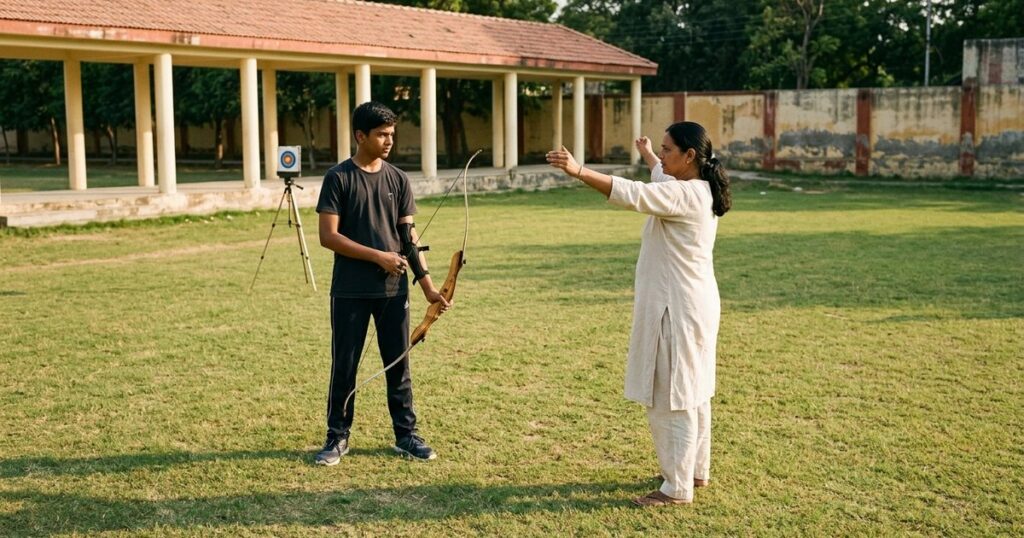
- Eklavya's learning was guided by Drona's example, structured practice, and a clear picture of excellence.
- Research finds minimal guidance less effective and less efficient for beginners.
- Exploration suits biologically primary knowledge better than reading, writing, algebra, and chemistry.
- Independent learning develops through modelling, supported practice, and gradually reduced guidance.
- AI can act as a coach by teaching small ideas, giving hints, and increasing freedom over time.
Here's a confession. I've spent years arguing that Indian education crushes children's independence. I still believe it. Our schools treat children like parcels to be delivered to the board exam, and our coaching industry treats them like machines to be tuned for a rank. I've built learning platforms on the idea that children should take charge of their own learning.
So this chapter was hard to write, because the research says something uncomfortable for people like me: leaving beginners to figure things out on their own is one of the worst ways to teach them.
Let me explain why, and why it doesn't mean what you think.
What everyone gets wrong
Every Indian child knows the story of Eklavya. Rejected by Dronacharya because he wasn't a prince, he went into the forest, made a clay image of Drona, and taught himself archery so well that he outshone Arjuna. We tell it as a story about self-learning, about talent that blooms without a teacher.
Read it again. Eklavya didn't discover archery from scratch. In many retellings, he had watched Drona train the princes from a distance. He chose a model, the best teacher of his age. He set up a structure, practising every day in front of that image. He had a clear picture of what excellence looked like and spent years closing the gap. That's not discovery learning. That's guided practice where the guide happened to be made of clay.
The science, in plain words
In 2006, Paul Kirschner, John Sweller and Richard Clark published a paper with a deliberately provocative title: "Why Minimal Guidance During Instruction Does Not Work." They looked at decades of research on discovery learning, problem-based learning and inquiry learning, all the methods where students explore and the teacher steps back. Their conclusion: for novices, these methods are less effective and less efficient than clear, guided instruction.
The reason goes back to Chapter 1. Exploring without guidance makes heavy demands on working memory. A beginner searching blindly for a solution is using all four seats in the rickshaw on the search itself, with no space left over for learning. The educational psychologist Richard Mayer reviewed the history of pure discovery methods in 2004 and suggested we need a "three strikes" rule: they keep failing, decade after decade, and we keep bringing them back with new names.
But what about the Hole in the Wall?
In 1999, Sugata Mitra put a computer into a wall in a Delhi slum in Kalkaji and walked away. Children who'd never seen a computer figured out how to use the mouse, open programs and browse the internet, teaching one another, without any adult help. It became one of the most famous education experiments in the world, and it's a lovely story.
But look at what they learned. Pointing, clicking, exploring a screen built to be explored. That's closer to how children learn to play a game or find their way around a new neighbourhood. The American psychologist David Geary has a useful way to think about this. Some knowledge is biologically primary: we evolved to pick it up without being taught, like speaking our mother tongue, recognising faces, or making friends. Other knowledge is biologically secondary: reading, writing, algebra, chemistry. These are recent human inventions, a few thousand years old at most. Our brains didn't evolve to absorb them by exposure. They have to be taught, explicitly, with effort.
Every child in India learns to speak without a single lesson. Almost none learns to read that way. That's the difference in one sentence.
Independence is the destination, not the vehicle
Here's where I land, and it's where the research lands too. Barry Zimmerman and Albert Bandura studied how people become self-regulated learners: people who can set goals, plan, monitor their own progress and adjust. Their work shows that this ability doesn't come from being left alone. It comes from knowledge plus skills that are modelled, practised with support and gradually handed over. Kirschner and Hendrick put it neatly: independent learning is not a good way to become an independent learner.
Think of learning to drive in an Indian city. No one sensible puts a 17-year-old in a car at Bandra signal and says "Go, discover driving." You start in an empty ground with an instructor, then quiet lanes, then traffic with someone beside you, then alone. The goal is complete independence. The path is guidance that fades.
So autonomy still matters. Children should have far more say in what they learn and why. But when they're beginners at how, they need someone to show them. The best self-directed learners I know, Eklavya included, were obsessive about finding good models.
|
TRY THIS TOMORROW Teachers: Before a project or "activity", teach the knowledge it needs. Exploration works best at the end of a topic, not the start. |
|---|
|
Parents: Freedom to choose is good. Freedom to flounder isn't. If your child wants to learn coding or guitar, find them a structured course or a mentor, not just YouTube. |
|
Students: Being independent doesn't mean doing it alone. It means knowing when to ask, whom to copy and how to check yourself. |
|
THE AI UPGRADE AI can be the clay Drona: a model you can consult any time. The trick is to ask it to guide, not to do. |
|---|
|
Sample prompt: "I want to learn basic Python on my own. Act as a coach. Teach me one small idea, show me a worked example, then give me a tiny task. If I get stuck, give me a hint, not the answer. Track what I've learned and tell me when I'm ready for the next idea." |
|
For self-learners: Ask AI to design a 30-day plan that starts with heavy guidance and gives you more freedom each week. |
CHAPTER 5
Frequently asked questions
Why does discovery learning often fail for beginners?
Beginners use much of their working memory searching for solutions, leaving less space for learning. Research found clear, guided instruction more effective and efficient for novices.
What is the difference between biologically primary and secondary knowledge?
Biologically primary knowledge, such as speaking, recognising faces, and making friends, is picked up without formal teaching. Biologically secondary knowledge, such as reading, writing, algebra, and chemistry, must be taught explicitly.
How can children become independent learners?
They need knowledge and skills that are modelled, practised with support, and gradually handed over. Independence is the destination, while guidance is the path.
How can AI help someone learn independently?
AI can act as a coach by teaching one small idea, showing a worked example, giving a tiny task, and offering hints instead of answers. It can also create a 30-day plan that gradually provides more freedom.