Part 8 of 17 in Jugaad Is Not a Strategy← Part 7Part 9 →
This chapter tests whether your idea matters to more than one customer and examines what could make it difficult for competitors to copy. It helps founders identify real early customers, define a Core, and compare their product with every alternative, including doing nothing.
- Meet ten named customers, show them the product, observe their actions, and ask for a small commitment.
- If customers do not care, revisit the beachhead or value proposition instead of building for eighteen months.
- Define a Core that competitors cannot easily copy, and distinguish it from temporary moats.
- Use a 2×2 chart based on customer priorities, including doing nothing as a competitor.
- Record ten customer commitments, state the Core in one sentence, and draw the competitive chart.
Up to now, you've designed everything around one person. That's deliberate. But one person can mislead you. This chapter checks your work against more customers, and then asks a harder question: why can't someone else copy you?
Step 9: Identify your next 10 customers
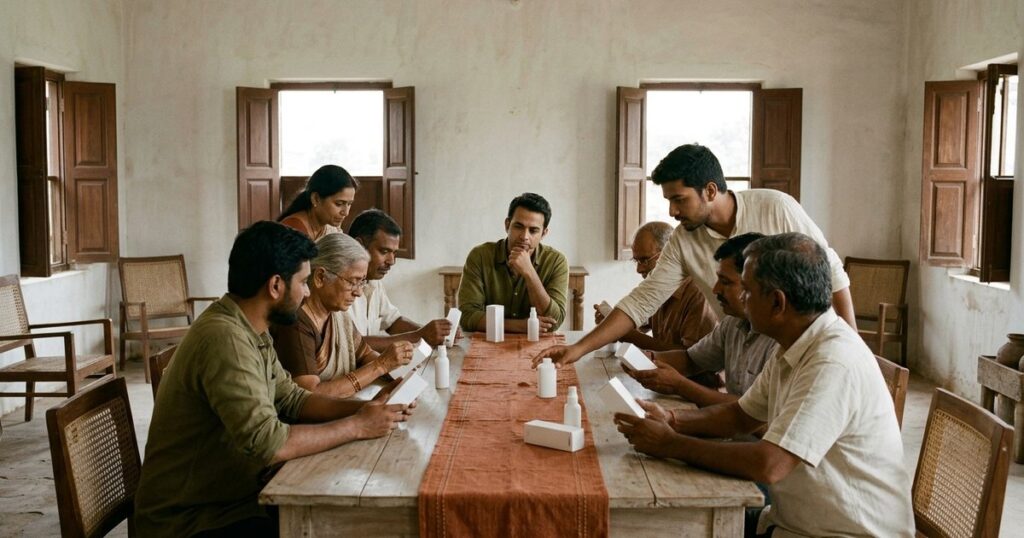
Write down ten real people (or businesses) in your beachhead, beyond your Persona, who fit your end user profile. Real names. Real phone numbers. Then go and meet them. Show them the use case, the sketch and the value proposition. Ask whether they'd buy it, and watch what they do, not just what they say. Ask for a small commitment: a letter of intent, a deposit, a pilot date, an introduction to their surgeon or boss.
If you can't find ten people who look like your Persona, your beachhead is too vague, or your Persona isn't typical. Go back to Step 2.
If eight of the ten don't care, your value proposition is wrong. Go back to Step 8. This is what the steps are for. Going back is not failure. Building for eighteen months and then discovering nobody cares is failure.
Indian story: Razorpay's first customers, and its hundred rejections
Razorpay's founders have said they were rejected by nearly 100 banks before one agreed to work with them. Their first customers came from the startup community around Startup Oasis, the incubator in Jaipur where they began. These were people the founders could meet, talk to, fix bugs for, and learn from directly. Mathur later advised young B2B founders to win their first 100 customers who love the product, because the rest follows. That's Step 9 in one line.
Step 10: Define your core
Bill calls this the hardest of the 24 steps, and he's right. Your Core is the one thing you'll do better than anyone else, which competitors will find very hard to copy. It's your crown jewel.
A Core is not a feature. Features get copied in weeks. A Core is usually one of these:
- Network effects: each new user makes the product more valuable for every other user, so customers stay with the biggest network.
- Customer service: service so good that customers won't leave, even if a cheaper rival appears.
- Lowest cost: a structure that lets you profitably charge less than anyone else.
- User experience: a product so easy and pleasant that everything else feels clumsy.
- Proprietary data or process: knowledge you accumulate that others can't buy.
You may not have your Core on day one. That's normal. But you must know what it will be, so that every rupee you spend builds it.
Then there are moats: things that buy you time while you build your Core. Patents, exclusive partnerships, regulatory approvals, a famous founder, being first in a city. Moats help. They rarely last.
Indian stories: Three Indian Cores
Lenskart built a centralised, vertically integrated manufacturing operation in Bhiwadi, Rajasthan, described in its IPO documents as one of the two largest of its kind globally for prescription eyeglasses. Owning the factory lets it control cost and delivery speed in a way a pure online store can't.
Zerodha, founded by Nithin and Nikhil Kamath in 2010, built a lowest-cost Core: flat fees, zero brokerage on delivery trades, and almost no advertising. Bootstrapped and never externally funded, it can afford prices that funded rivals struggle to match profitably.
PhysicsWallah began as Alakh Pandey's YouTube channel in 2016. Its Core is a teacher brand trusted by millions of students in smaller towns, combined with very low prices. That trust was built over years of free content, and no amount of venture capital can buy it overnight. The company listed on Indian stock exchanges in November 2025.
A warning about AI as a Core
Here's the contrarian part. If your pitch says "our Core is AI," you don't have a Core. Every competitor can call the same models you do, often by next week. Bill's 2024 edition makes a similar point: when a technology shift arrives, a Core built on doing things the old way can be wiped out. Generative AI is exactly such a shift. Your Core must be something AI can't commoditise: the proprietary outcomes data you collect from thousands of patients, the trust of a network of surgeons, a distribution channel nobody else has, or a deep understanding of a customer that took years to build. Use AI everywhere. Just don't mistake it for a moat.
Step 11: Chart your competitive position
Customers don't care about your Core. They care about the benefits it gives them. So now translate your Core into a simple picture.
Draw a 2×2 chart. The two axes are your Persona's top two priorities. For Mrs. Kulkarni, that's "independence from family help" and "confidence that I'm recovering properly." Place every alternative on the chart: home visits from a physio, going to the clinic, YouTube videos, the photocopied exercise sheet, and, most important of all, doing nothing.
In India, "do nothing" is the biggest competitor for almost every startup. The patient who just puts up with a stiff knee. The shop that keeps its accounts in a notebook. The school that keeps using the register. If your product isn't clearly in the top-right corner, with a big gap from "do nothing," you'll struggle.
Indian story: The Nano and the wrong axis
Tata Motors' Nano was a genuine engineering achievement, a car built to cost about one lakh rupees. But it was positioned on the axis of "cheapest," and Indian car buyers weren't buying a cheapest anything. A car is an aspiration and a status symbol. Ratan Tata later acknowledged that marketing it as the cheapest car was a mistake. The engineering was a Core. The competitive position was plotted on the wrong axes.
Do it better with AI
- Next 10 customers: use AI to research and draft personalised outreach messages to each of your ten, based on what you know about them. Send them yourself, from your own number.
- Core: "Here's my business. List 5 possible Cores. For each, explain how a well-funded competitor with the same AI tools could copy it, and how long it would take." The ones that survive this test are worth discussing.
- Competitive chart: ask AI to list every alternative your customers mentioned in interviews (including "doing nothing") and draft a 2×2 position for each. Then check every placement with real customers.
Your homework
Meet ten named customers and record what each one committed to. Write down your Core in one sentence. Draw your 2×2 with "do nothing" on it.
PART THREE: HOW DOES YOUR CUSTOMER ACQUIRE YOUR PRODUCT?
Frequently asked questions
How do I identify my next ten customers?
Write down ten real people or businesses in your beachhead who fit your end user profile. Meet them, show the use case, sketch, and value proposition, then ask for a small commitment.
What is a Core in a startup?
A Core is the one thing you do better than anyone else that competitors find very hard to copy. It may involve network effects, customer service, lowest cost, user experience, or proprietary data or process.
Is AI a startup moat?
AI alone is not a Core because competitors can often use the same models. A Core should be something AI cannot commoditise, such as proprietary outcomes data, trusted networks, unique distribution, or deep customer understanding.
What should a competitive 2×2 chart include?
Use your Persona's top two priorities as the axes and place every alternative on the chart, including doing nothing. Your product should be clearly in the top-right corner with a large gap from doing nothing.