Part 14 of 17 in Your Child Is Not a Marksheet← Part 13Part 15 →
This chapter explains how to test education ideas through small, measured experiments instead of dramatic promises. It helps families, teachers, schools and communities examine what children actually learn, who participates and what changes are needed before expanding a programme.
- Small pilots should measure changes in one learner over one month rather than rely on declarations or testimonials.
- Baseline tasks and weekly evidence can track reading, mathematics, explanations, projects, collaboration and lasting improvement.
- Evaluations should examine participation, equal access, digital attachment, cost, safety and whether anyone feels less capable.
- Different families and communities need different education models, so trustworthy options are better than one universal replacement for school.
- AI can help design a 30-day trial with safeguards, fallback plans, budgets and clear criteria for changing or stopping it.
An education revolution should begin with a modest experiment
Educational movements often begin with a dramatic promise. Every child will be a genius. Every school will be obsolete. One device will replace a hundred teachers. India has heard enough miracles. If we want lasting change, we should be less interested in declarations and more interested in what happens to one actual learner over one actual month.
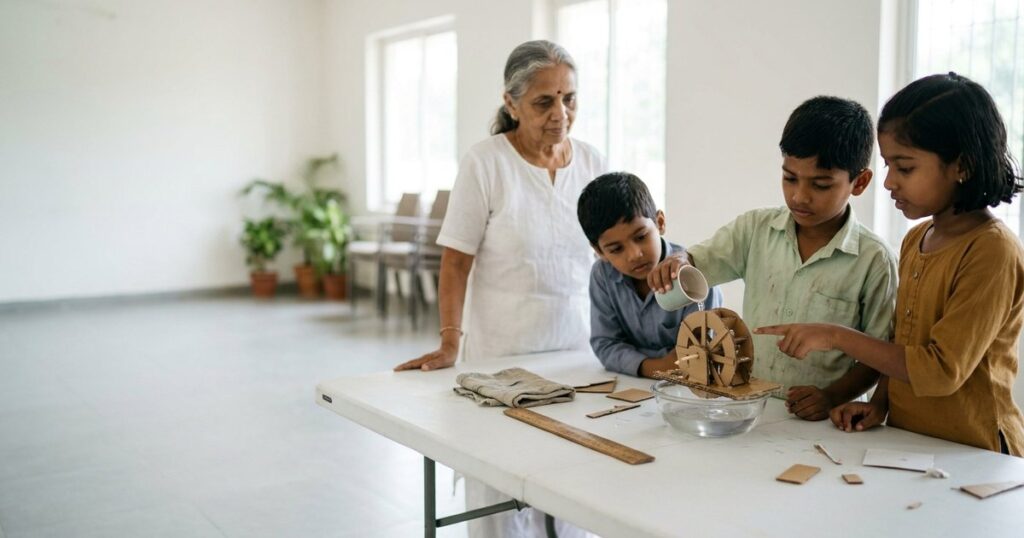
Suppose six families in a neighbourhood of Indore decide to try a Saturday learning group. They have one table, a cupboard of books, two inexpensive computers and a retired teacher willing to help. Their first question is not which logo to print on the wall. It is whether the children can read what they choose, explain what they discover and collaborate without an adult scripting every minute.
This is an illustrative design, not an account of an operating centre. In week one, the families record a simple baseline. Children try an age-appropriate reading task, a practical mathematics problem and a short explanation of something they care about. Each child proposes one project. Some choose a neighbourhood tree map; another wants to understand how the local milk cooperative works; another wants to write a bilingual picture book for younger children.
The adult coach creates a routine, not a miniature school timetable. The group begins with a check-in, works on projects, pauses for movement, practises one foundational skill and ends with a public explanation of what changed. AI may support explanations or generate differentiated questions. Books, outdoor observation and conversations with people remain equally important.
At the end of four weeks, the families ask tougher questions than the attendance sheet can answer. Can the child now solve a problem she could not solve before? Can she explain an idea without a screen? Does the improvement survive a week later? Are the quieter children participating? Do girls have equal voice and access? Is any child becoming overly attached to the digital tool? How much did the experiment cost per child, including adult time? Has anyone been made to feel less capable?
The strongest evidence would eventually come from comparing well-designed programmes with appropriate alternatives, not from collecting flattering testimonials. Small pilots can reveal practical failures; larger evaluations are necessary before confident claims about impact. This matters particularly when public money, school time or vulnerable children are involved. A movement that refuses measurement is not protecting children from exams. It is protecting its own theory from being tested.
India does not need one universal replacement for school. A government school in Bihar, a private school in Hyderabad, a migrant family in Surat and a homeschooling household in Bengaluru face different constraints. Some need better foundational teaching. Some need libraries and peer groups. Some need reliable transport and nutrition. Others need a more challenging curriculum. A menu of trustworthy models is more sensible than a new orthodoxy.
The most powerful reform may be cultural. A parent stops using shame as motivation. A teacher accepts an unexpected question. A school opens its workshop after classes. A business owner welcomes a supervised student project. A neighbourhood builds a shared shelf of books. A child discovers that mistakes are not crimes but clues. None requires a national announcement.
Use AI this week. Ask: “Help me design a 30-day trial for a small community learning group. Include baseline tasks, weekly evidence, child-safety safeguards, a no-internet fallback, a modest budget, and explicit criteria for stopping or changing the plan. Distinguish outcomes from activity metrics. Do not claim success before results are measured.”
I want India to be a country where parents ask not only, “Which school did you get into?” but also, “What can you learn to do on your own?” The second question may be the one that prepares children for a world none of us can predict.
Frequently asked questions
How can a community test a new learning programme?
Start with a small group, record a simple baseline, set projects and foundational practice, then collect evidence over four weeks. Compare what children can do before and after the trial.
What should a learning pilot measure?
It should measure problem-solving, explanations, participation, equal voice and access, lasting improvement, digital-tool attachment, cost per child and whether anyone feels less capable.
Why are small education pilots not enough to prove impact?
Small pilots can reveal practical failures, but larger evaluations and appropriate alternatives are needed before making confident claims about impact.
How can AI support a community learning trial?
AI may support explanations, generate differentiated questions and help design a 30-day trial. The plan should include child-safety safeguards, a no-internet fallback, a modest budget and criteria for stopping or changing it.