I have watched parents spend an entire piano lesson, cricket match, or school project preventing their child from making a mistake. They correct the grip, supply the answer, call the coach, email the teacher, negotiate with the school, and quietly complete the difficult part themselves. The child succeeds, at least on paper. The parent feels relieved. But the child has learnt something quite different: “I can cope only when an adult is standing next to me.”
My advice is simple, though not easy to follow: allow your child to experience small, safe failures; acknowledge the disappointment before offering solutions; then help the child examine what happened and decide what to try next. Do not rescue too quickly, and do not pretend that failure does not hurt. A child learns to handle failure by surviving it, understanding it, and trying again—not by being protected from it.
This is uncomfortable advice for Indian parents. We are surrounded by competition, anxious about school admissions, and convinced that one bad mark can close a door forever. Sometimes the consequences really are serious. But most of the failures we prevent are not serious. A forgotten notebook, a lost chess game, a poor test score, a rejected school application, or a missed selection trial is painful, but it is not permanent damage.
When we treat every small setback as a crisis, we deprive children of the practice they need for the large setbacks that adulthood will inevitably bring.
The comfortable belief that good parents prevent failure
Most parents, including me, want their children to succeed. That is not a bad instinct. I would be worried about a parent who was indifferent to a child’s suffering or opportunities.
The problem begins when “helping my child succeed” quietly becomes “making sure my child never fails”. These are not the same thing.
I see the difference in my work as an IVF doctor. Patients come to us after years of trying to have a baby. They are already frightened of bad news. Many want a guarantee before they begin treatment. They ask which protocol will definitely work, which test will eliminate uncertainty, and which doctor can ensure success. I understand the desire. But biology does not offer guarantees, and pretending otherwise leaves patients less prepared when the cycle does not work.
Children deserve the same honesty. Life contains uncertainty. Some efforts will fail despite preparation. Some people will reject them. Some examinations will expose gaps in their understanding. Some businesses, relationships, and plans will not work. A parent cannot remove this uncertainty. A parent can teach a child how to respond to it.
Over-helping has a hidden cost. If I correct every homework error before the teacher sees it, my child never learns to check the work. If I intervene whenever a child is excluded from a game, the child never learns to negotiate with peers. If I call the teacher after every disappointing mark, the child never learns to ask, “What did I misunderstand?”
The child may look successful while the parent is present. The fragility becomes visible when the parent is not.
The aim is not to raise a child who never fails. It is to raise a child who does not interpret one failure as a verdict on their worth.
How to teach a child to handle failure
There is a sequence that I find useful. It starts with emotion, not analysis.
-
Let the failure actually happen. Step in only when there is a genuine risk to safety, health, or a consequence that is disproportionate to the lesson being learnt. A child who forgets a water bottle can manage being thirsty for an afternoon. A child who has not studied cannot be saved by a parent arguing with the teacher. A child who loses a board game can lose.
-
Recognise the feeling. Say, “You are very disappointed. You wanted to be selected,” or “You worked hard and this mark hurts.” Do not immediately say, “It is okay,” when it plainly is not okay to the child. The result may be survivable, but the feeling is real.
-
Give the child time to settle. A crying or furious child is not ready for a lecture on learning. Food, sleep, quiet, or a hug may be more useful than a discussion. Emotional regulation comes before reflection.
-
Separate the event from the identity. “You failed this test” is very different from “You are a failure.” The first describes an event. The second attacks the person. I would not allow a child to speak to a younger sibling that way, and I would not allow the child to speak to themselves that way.
-
Review the process when the child is ready. Ask what happened, what was within their control, and what they might change next time. The goal is not to find someone to blame. It is to extract one useful lesson.
-
Choose the next small attempt. “Try harder” is not a plan. “Do ten algebra problems with the teacher tomorrow,” “practise the left-hand movement for fifteen minutes,” or “ask the coach what skill to work on” gives failure a next step.
The order matters. Parents often jump from the result directly to the plan. We say, “You did not get into the team? Fine, practise more.” The child hears, “Your disappointment is inconvenient. Stop feeling it and get back to work.” That does not build resilience. It teaches the child to hide distress until it emerges as anger, avoidance, or anxiety.
Do not celebrate failure too enthusiastically
I am wary of the fashionable instruction to “celebrate failure”. A child who has just lost a final match or failed an examination may not want a high-five. Telling them that failure is wonderful can sound as insensitive as telling a grieving adult to be grateful for the experience.
Failure is not automatically useful. It becomes useful when we reflect on it. A child can fail repeatedly without learning anything, especially if the child is using the wrong method, lacks instruction, or is simply being asked to do something beyond their current ability.
I prefer to celebrate honesty and learning rather than failure itself. I might say:
- “I am glad you told me you did not understand the chapter.”
- “You noticed that rushing caused the mistakes. That is useful.”
- “You went back and asked for help instead of hiding the paper.”
- “You tried a different approach today.”
This distinction matters. Otherwise, “failure is good” becomes another performance demand. The child now has to fail cheerfully, display a growth mindset, and reassure the parent that everything is fine. Real resilience is not perpetual optimism. It is the ability to remain engaged with reality, including disappointment.
Give children room to be responsible
Many parents say they want independent children but continue to manage every detail of their lives. The school bag is packed, the project is checked, the timetable is prepared, the teacher is contacted, the tuition is arranged, and the child is reminded five times. Then we complain that the child has no initiative.
Responsibility cannot be taught through speeches. It is learnt through consequences.
This does not mean abandoning a young child. It means transferring responsibility gradually. A six-year-old may need help remembering a school uniform. A twelve-year-old can be expected to prepare it. A teenager who forgets may have to face the embarrassment of arriving unprepared. The consequence should be proportionate and safe, but it should belong to the child.
The same principle applies to money. I have written about how much pocket money to give a child in India because money is a practical laboratory for decision-making. If a child spends the entire allowance on the first day, the lesson is not learnt when the parent immediately supplies more. Allowing the child to wait until the next allowance is uncomfortable, but it is a small and valuable failure.
Parents often intervene because the consequence is embarrassing to us. We do not want the teacher to think our child is careless. We do not want relatives to see a poor mark. We do not want another parent to believe that our child is not talented. In rescuing the child, we may be protecting our own image more than the child’s future.
Failure in school is not always a character lesson
I also want to be careful here. Not every failure should be met with “work harder”. Sometimes the child has been taught badly. Sometimes the workload is unreasonable. Sometimes there is a learning difficulty, attention problem, anxiety disorder, bullying, or family crisis. Sometimes the examination measures coaching rather than understanding.
A child who repeatedly fails despite genuine effort needs investigation, not moral judgement.
I have seen parents call a child lazy when the child is overwhelmed by the material. I have seen children labelled careless when they cannot sustain attention. I have seen exam fear become so intense that the child knows the answers at home but cannot retrieve them in the examination hall. My earlier piece on talking to a child about exam stress deals with this distinction: pressure can motivate, but excessive pressure can impair performance.
A useful review asks four questions:
| Question | What it helps us understand |
|---|---|
| Did the child understand what was required? | Whether the problem was unclear instruction rather than lack of effort |
| Did the child have enough practice and support? | Whether the task was appropriately taught |
| Was the child physically and emotionally able to perform? | Whether sleep, anxiety, illness, attention, or family stress played a role |
| What was within the child’s control? | What lesson can reasonably be carried into the next attempt |
This is one reason I dislike comparing children with one another. Two children can receive the same mark for entirely different reasons. One may have avoided studying. Another may have worked hard but need specialised help. The mark is information, not a complete diagnosis.
Parents who want to understand a child’s motivation may also find my thoughts on what to do if a child is not interested in studies relevant. Disinterest is sometimes laziness, but it can also be a signal that the child feels incompetent, bored, frightened, or unseen.
Model failure without making the child your therapist
Children listen to what we do more closely than to what we say. If I lose my temper whenever I make a mistake, I cannot credibly instruct my child to remain calm after a poor result.
I try to speak openly about my own mistakes in an age-appropriate way. I can say that I made a poor investment decision, misunderstood a founder’s needs, or gave advice before hearing the full story. I can explain what I would do differently. I should not turn the child into a confidant for adult financial or marital problems; that is unfair. But ordinary mistakes should not be hidden behind a performance of parental perfection.
In angel investing, I have learnt that the first version of a startup is almost never the final one. Founders test an idea, hear that customers do not want it, change direction, and try again. Some do this intelligently. Others keep repeating the same failed experiment while calling it persistence. The difference is not whether they fail. It is whether they learn.
Children need the same distinction. Perseverance is not continuing blindly. It is continuing with better information.
I might tell a child after a poor science project: “The project did not work. That does not mean you are bad at science. What did the experiment tell us? Did the design fail, or did we not follow the steps? What would we change?” This language preserves both accountability and hope.
Teach the difference between a bad result and a bad decision
Children also need to understand that a good decision can produce a bad result. A batsman can play the right shot and be caught. A student can prepare carefully and still face questions on a weak area. A founder can build a useful product and discover that customers are unwilling to pay for it.
The reverse is also true. A bad decision can produce a good result by luck. Guessing an answer correctly does not make guessing a sound strategy.
This distinction is particularly valuable in India, where marks and outcomes often dominate the conversation. If a child scores well by copying homework or memorising without understanding, praise for the mark alone sends the wrong message. If a child scores poorly after honest preparation, the right response is not humiliation. It is to examine the preparation and improve it.
I ask children to describe the decision before judging the result:
- What were you trying to do?
- What information did you have?
- What choice did you make?
- What happened?
- What do you know now that you did not know before?
These questions turn a failure from a verdict into evidence. They also teach intellectual honesty, which is more valuable than a temporary increase in marks.
When failure becomes fear
There is a difference between a child who is disappointed and a child who is paralysed by the possibility of disappointment. A child may stop trying new activities, refuse to submit work, become physically unwell before examinations, have repeated meltdowns, or attack themselves verbally for ordinary mistakes. An older child may avoid friends and opportunities because rejection feels unbearable.
At that point, “just try again” is not enough. The child may need help from a school counsellor, psychologist, or psychiatrist. Seeking help is not an admission that the parent has failed. It is a sensible response when fear is interfering with daily life.
I am especially concerned when parents respond to anxiety by making the child’s world smaller. They remove every difficult activity, demand that teachers award special treatment, or stop the child from competing altogether. This may provide immediate relief but can teach the child that anxiety is a reliable warning to escape. Support should make gradual participation possible, not permanent avoidance.
Of course, the child should not be pushed into situations that are dangerous or abusive. There is a difference between tolerating a disappointing audition and tolerating bullying. There is a difference between a demanding teacher and humiliation. Good parenting requires judgement, not a slogan about resilience.
What I would change at home
If I were advising a parent who asked me for a practical starting point, I would suggest one deliberate change: stop rescuing the child from consequences that are small, safe, and reversible.
Do not remind the child ten times about the project. Remind once, perhaps write the deadline where both of you can see it, and allow the child to own the result. Do not rewrite the assignment. Do not call the teacher to explain. Do not convert every poor mark into an evening of interrogation. Ask what happened and what the next attempt will look like.
At home, I would also establish a rule that mistakes can be discussed without ridicule. A child should be able to say, “I cheated,” “I forgot,” “I did not understand,” or “I am scared,” without expecting immediate character assassination. Accountability still follows. A safe conversation is not a consequence-free conversation.
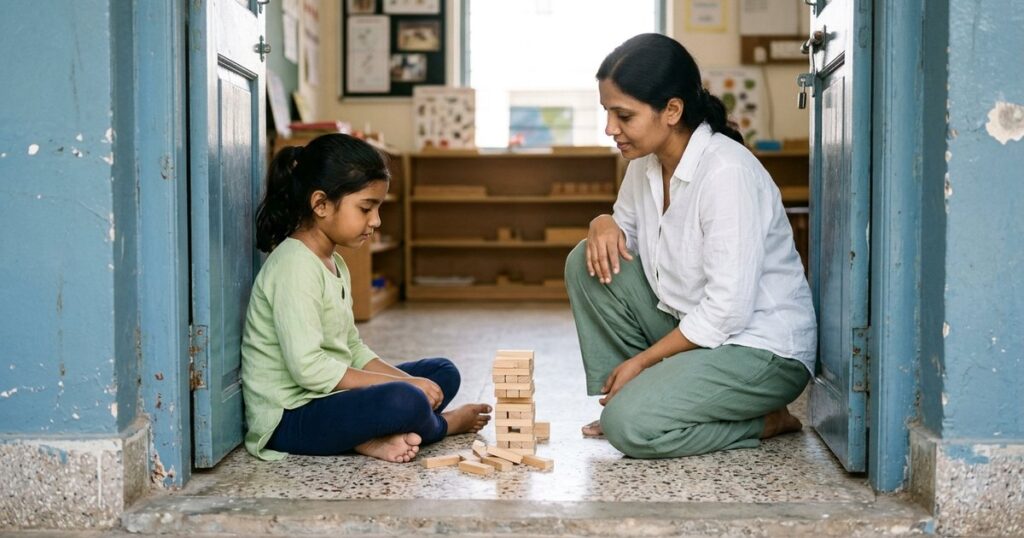
For younger children, ordinary games are enough. Let them lose at cards. Let them build a tower that falls. Let them try to tie their shoelaces badly. Resist the urge to take over because it would be faster. For older children, let them make choices with manageable stakes: a budget, a club, a project topic, a study schedule. The parent’s role is to remain available, not omnipresent.
One phrase I find useful is: “Would you like comfort, ideas, or help?” Sometimes the child wants a hug. Sometimes the child wants to think aloud. Sometimes the child genuinely needs instruction. Asking prevents me from imposing a solution when what is needed is simple companionship.
The most important failure is the one we prevent
Parents often believe that success builds confidence. I think the sequence is usually the other way around. Confidence comes from attempting something uncertain, experiencing difficulty, and discovering that one can remain standing after the result is disappointing.
That discovery cannot be gifted by a parent. It has to be lived.
I do not want my children to believe that every effort will succeed. That would be a cruel promise. I want them to believe that a failed effort can be examined, that help can be sought, that a different approach can be tried, and that one result does not settle the question of who they are.
The parent’s hardest task is often not teaching the child how to recover. It is tolerating the child’s temporary discomfort without rushing in to erase it. When my child comes home with a poor mark, I may be able to fix the immediate embarrassment by writing to the teacher. But if the child never learns to face the teacher, understand the gap, and prepare differently, I have solved the wrong problem.
The small failure I allow today—a forgotten book, a lost game, an unfinished project—may be the rehearsal that helps my child face a much larger failure at twenty-five without collapsing. I would rather endure my child’s tears over a lost chess match now than discover, years later, that I taught the child that losing was intolerable.