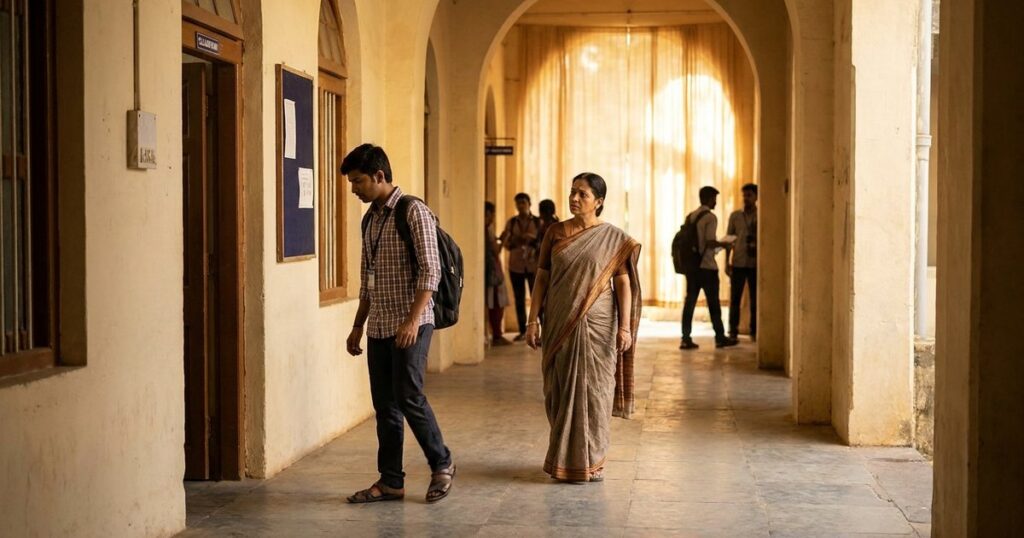
A few years ago, a young man came to see me with his mother. He had completed two years of engineering, had failed several subjects, and had stopped attending college. He wanted to study animation. His mother was furious. “Animation is not a career,” she told me. “We have already paid so much. At least let him complete engineering.”
Her son was not lazy. He was not incapable. He had simply been placed in a course he had never wanted to pursue.
Why do parents force engineering? Usually because they are frightened. They believe engineering is one of the few degrees in India that offers a respectable college, a reasonably clear career path, and some protection against an uncertain future. They are often not trying to make their child an engineer. They are trying to buy insurance.
I understand the anxiety. I do not agree with the prescription.
Parents are not always choosing engineering. They are choosing the college.
It is easy to mock Indian parents who insist that their child become an engineer. I have done so myself, especially when I see a bright student being pushed into a discipline for which she has neither interest nor aptitude. But caricaturing these parents as ignorant or authoritarian misses an uncomfortable fact: in much of India, engineering colleges have historically been among the few institutions that provide a reasonably structured undergraduate education.
The degree may be mediocre. The teaching may be poor. The laboratories may be decorative. But the student is at least likely to encounter a timetable, examinations, some technical subjects, and a peer group that is also expected to study. The college may offer hostel accommodation, campus placements, and a recognisable credential. That is more than many ordinary degree colleges provide.
The problem is not that parents have discovered a magical belief in thermodynamics. The problem is that they have very few trustworthy alternatives.
According to figures cited by the National Assessment and Accreditation Council, a very large majority of Indian colleges and universities were rated average or below average. The precise percentages have changed over time, but the underlying problem has not disappeared: India has expanded access to higher education much faster than it has improved its quality.
Many parents are not asking, “Will my child become a good engineer?” They are asking, “Which college is least likely to waste the next four years of my child’s life?”
That is a different question.
A parent comparing an engineering college with an undistinguished general degree college may reasonably conclude that the engineering college is the safer bet, even if the child has no intention of becoming an engineer. The parent is making a decision under incomplete information. There are few reliable rankings, little transparent information about teaching quality, and almost no counselling that families in smaller towns can trust.
When information is scarce, people use proxies. “Engineering college” becomes a proxy for discipline, employability, social status, and a possible escape from poverty. It is an imperfect proxy, but it is available.
The degree has become a family status symbol
There is another reason. In many Indian families, the word “engineer” carries status far beyond the actual work the graduate may eventually do.
Parents enjoy saying, “My son is an engineer,” even when he is still in his first year and has no idea what engineering involves. The label is a source of pride. It reassures relatives that the family has done well. In smaller towns, it signals that the child has entered the modern, respectable middle class.
Medicine has a similar status, but a medical seat is much harder to obtain and the training is longer. Engineering became the available substitute: prestigious enough to satisfy the family, accessible enough to be realistic, and broad enough to appear to keep many doors open.
This status pressure is not confined to parents. Children also absorb it. A sixteen-year-old may say she wants to study computer science because she loves technology, when what she really means is that everyone around her has told her computer science is the only sensible choice. Another student may choose mechanical engineering because his uncle says it is “a proper engineering branch,” although he has never seen a lathe or designed anything.
I have seen the same confusion in young founders. A founder tells me that he wants to build a fintech company, but when I ask what problem he has personally experienced, he has no answer. He has selected the category because it sounds attractive and because other founders are raising money in it. Students and founders often make the same mistake: they confuse a fashionable label with a genuine interest.
Why parents distrust other degrees
Parents are also influenced by the poor signalling value of other undergraduate degrees.
A degree in history, philosophy, sociology, psychology, or the pure sciences can lead to a rich and meaningful career. But the path is often indirect. The student may need postgraduate study, internships, examinations, apprenticeships, or several years of experimentation before finding a direction.
Most parents cannot explain these paths because they have never encountered them. They know what an engineer does, or at least they think they do. They know that an engineer can apply for software jobs, prepare for government examinations, pursue an MBA, or seek work abroad. They do not know what a graduate in anthropology does at age twenty-two.
That uncertainty matters. A middle-class family may be able to tolerate a child changing direction. A lower-middle-class family that has borrowed money for college may not. For such a family, “follow your passion” can sound like advice given by someone else with someone else’s money.
Parents are not wrong to ask whether a degree will improve their child’s chances of earning a livelihood. The mistake is assuming that engineering is the only degree that can do so.
There are good colleges in the liberal arts and sciences, but they are few, concentrated in major cities, and fiercely competitive. A student from a small town may find it easier to enter a mediocre engineering college than a good general college. The choice is then not between an excellent engineering programme and an excellent history programme. It is between a structured but ordinary engineering college and an unstructured degree course with uncertain teaching and even less career guidance.
That is why the solution cannot simply be to tell parents to stop forcing engineering. We need to give them credible alternatives.
The hidden cost of choosing the wrong course
The tragedy is that the engineering degree often fails at the very thing parents want from it.
A student without interest in the subject is unlikely to learn well. He may memorise enough to pass some examinations, fail others, and spend four years in a state of quiet resentment. He may stop attending lectures. He may prepare for unrelated competitive examinations. He may take a low-paid job merely because the family needs to say that he has been “placed.”
The financial cost is visible: tuition, hostel fees, coaching, transport, books, and the income the student could have earned or saved. The emotional cost is less visible. A young adult who spends four years being told that he is a failure may begin to believe it.
I have watched patients struggle with a similar pattern in fertility treatment. A couple arrives after spending years following advice that was never properly explained. They have paid for tests they did not need and treatments that were inappropriate for their situation. By the time they reach us, they are not merely poorer. They are exhausted and distrustful.
Education decisions can create the same damage. A family makes one large decision at seventeen, then keeps defending it because admitting the mistake feels unbearable. The child is forced to continue because “so much money has already been spent.” This is the sunk-cost fallacy dressed up as parental responsibility.
The money has already gone. The real question is whether spending more time and money will improve the child’s future.
Interest matters, but interest is not enough
I do not believe that every teenager knows what he wants to do. Most do not. A seventeen-year-old who says he wants to become a YouTuber or a professional gamer may be expressing a fantasy rather than a career plan. Parents are right to ask difficult questions.
But there is a difference between guidance and coercion.
Parents should ask:
- What does the child actually enjoy doing for sustained periods, without being pushed?
- Has the child explored the proposed field beyond watching videos or reading social media posts?
- What does the career path look like after the degree?
- What are the costs, risks, and fallback options?
- Which colleges teach well, rather than merely advertising placements?
A child who wants to study design should be asked to show a portfolio, speak to working designers, and understand the likely early years of the profession. A child who wants to study psychology should understand that an undergraduate degree may not be enough for clinical practice. A child who wants to study computer science should write some code before choosing the branch, not merely repeat that software jobs pay well.
Good parenting does not mean accepting every adolescent preference without examination. It means helping the child examine it seriously.
The child should have to do some work too. Freedom without responsibility is not maturity. A student who rejects engineering should be able to explain what she wants to study, why she wants to study it, which institutions offer it, what it costs, and what she might do if the first plan fails.
But the final choice should belong to the child. The parent can set financial limits and refuse to fund an obviously reckless plan. The parent cannot manufacture motivation by paying the fees for a course the child has already rejected.
Engineering is not one thing
Another source of confusion is the word “engineering.” It covers very different experiences.
| Choice | What it may offer | What parents often assume | What the student must check |
|---|---|---|---|
| Highly selective engineering institute | Strong peer group, demanding academics, wider opportunities | The degree itself guarantees a good career | Whether the student actually enjoys the work and can manage the academic pressure |
| Good regional engineering college | Reasonable teaching, local networks, some placement support | Any branch will lead to a software job | Faculty quality, laboratories, internships, and branch-specific outcomes |
| Weak private engineering college | A formal degree and a campus routine | The college will train the student for employment | Attendance practices, teaching quality, placement claims, and total cost |
| Engineering degree chosen without interest | A credential, if the student completes it | The degree will create motivation | Whether the student is willing to spend four years learning the subject |
The last category is the dangerous one. A poor but motivated student can improve. An uninterested student at a good college may still do well if the environment changes his mind. But a student who has been forced into a weak college and an unwanted branch is carrying two disadvantages at once.
Parents should also be suspicious of placement brochures. A college may advertise that a large percentage of students have been placed, without explaining the salary, the job role, the number of students who were eligible, or how many offers came from companies that hire in bulk for short-term training programmes. I have learnt as an angel investor that a headline number is often designed to end the conversation, not inform it.
Families should speak to current students, recent graduates, and employers. They should visit the campus if possible. They should ask to see the timetable, laboratories, faculty list, and placement details. A college that refuses ordinary questions is already providing an answer.
The problem begins much earlier than the admission form
By the time a child reaches Class 12, the family’s decision has often already been made. For years, the child has heard that mathematics and science are the only serious subjects. Arts is for weak students. Commerce is for those who cannot handle science. A child who enjoys drawing, writing, working with people, or observing nature learns to hide these interests because they do not count as achievement.
This is a failure of schooling, not just parenting.
Our schools rarely expose children to enough kinds of work. A student may spend hundreds of hours solving textbook problems but never meet an architect, nurse, journalist, product designer, social worker, laboratory technician, chef, farmer using technology, or small-business owner. Career counselling, where it exists, is often a personality questionnaire followed by a generic report.
We then expect a seventeen-year-old to make a sensible decision among hundreds of courses and occupations.
I have written earlier about why Indian students cheat in examinations. The same system that rewards marks over learning also makes parents overvalue degrees over capability. If the only visible measure of success is a rank, a college name, or a placement package, families will naturally chase the credential that appears safest.
We cannot ask parents to make better educational choices while giving them no reliable information about teaching, learning, and employment. Transparency would help. Colleges should publish audited placement data, student retention, faculty attendance, fees, and course outcomes. Schools should introduce children to real work rather than merely offering lectures about careers. Employers should stop treating a degree as a substitute for evidence of ability.
Until then, parents will continue to use engineering as a rough and sometimes irrational proxy for quality.
What should a child do when the decision has already been made?
This is the question I hear most often, though usually indirectly.
A student may be in the first year of engineering and already know that the course is wrong. The worst response is to disappear from college without a plan. The second-worst response is to suffer silently for four years merely to avoid an uncomfortable conversation.
The student should collect evidence. Speak to seniors. Try the actual work associated with the alternative career. Complete a short course, build a portfolio, volunteer, take an internship, or shadow someone in the field. A parent is more likely to listen to a serious plan than to a declaration made during an argument.
The conversation should include money. If the family has paid two years of fees, changing course may not be painless. The child should acknowledge this rather than pretending that the cost is irrelevant. At the same time, the parents should acknowledge that continuing a failing course has a cost too.
Sometimes the sensible choice is to complete the degree while building a different skill on the side. Engineering graduates move into writing, design, finance, teaching, sales, public policy, and entrepreneurship. A degree is not a life sentence. But this is sensible only when the student can tolerate the course and pass it without damaging his mental health.
Sometimes leaving is the better choice. A student who has failed repeatedly, stopped attending, and developed a deep aversion to the subject should not be kept in college simply because the family fears what relatives will say.
Relatives will not repay the education loan. They will not live with the consequences of a wasted decade. Their opinions should not decide the child’s life.
The surprising lesson for parents
The most important reason parents push engineering is not ignorance. It is a lack of trust.
They do not trust the education system to guide their children. They do not trust employers to value a non-traditional degree. They do not trust their child to make a good decision. They do not trust that an unconventional path will remain open if the first attempt fails.
So they choose the path that appears to close the fewest doors.
This is understandable, but it is also self-defeating. A course that keeps every theoretical door open but leaves the student disengaged may be less useful than a specialised course that builds genuine ability. The best protection against uncertainty is not a fashionable degree. It is the capacity to learn, communicate, solve problems, work with others, and recover from mistakes.
These are also the qualities I look for in founders. I do not invest in a young person merely because she has studied computer science. I want to know whether she has noticed a real problem, spoken to users, built something, learnt from rejection, and continued when the first plan failed. The college can help, but it cannot substitute for curiosity and persistence.
Parents should think about their children in the same way an investor thinks about an early-stage founder. A credential is useful evidence, but it is not the company. A degree is a signal, but it is not the person.
I would much rather have a child who has chosen a modest course thoughtfully and works hard at it than one who has been pushed into engineering, spends four years trying to escape it, and emerges with a certificate but no confidence in his own judgement.
Indian parents push their children into engineering because they are trying to protect them from a weak and uncertain education system. Their instinct is understandable. Their method is often wrong. The answer is not to abandon parental guidance, but to replace command with conversation, prestige with evidence, and fear with a serious examination of the child’s actual abilities.
I still meet parents who tell me proudly that their child has secured an engineering seat. I now ask a second question: “And does your child want to study engineering?” The pause that follows is often longer than the answer. That pause is where the real educational crisis lies.