I have never believed that Indian students cheat in exams because they are born dishonest. They cheat because marks have been made the price of admission to a better life, while our schools often fail to teach them well enough to earn those marks. Add frightened parents, poorly designed examinations, weak supervision and a culture that rewards the certificate more than learning, and cheating becomes a predictable response to a badly designed system.
That does not make cheating acceptable. It makes it understandable. And unless we understand the incentives, we will keep searching students’ socks while leaving the larger problem untouched.
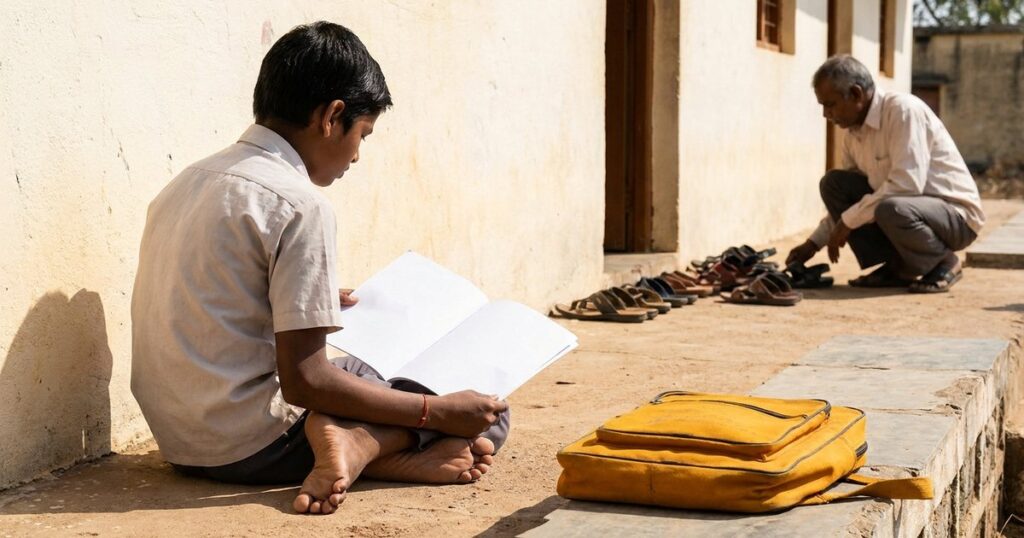
The image from Bihar is unforgettable: students appearing for their Class 10 examination being asked to enter the hall without shoes or socks, so that they cannot hide slips of paper containing answers. About 1.8 million students were expected to sit for the examination. Students would be searched, watched on video and refused entry if they arrived in footwear.
It sounds absurd. It is also a very accurate picture of our educational priorities.
We are willing to inspect a fifteen-year-old’s socks, but much less willing to ask whether the child has been taught properly, whether the examination tests anything worth remembering, or why one examination should determine so much of a young person’s future.
Why do students cheat in exams?
Students cheat when the perceived benefit of passing is much greater than the perceived cost of being caught. In India, passing an examination can determine access to college, employment, marriage prospects and family status. At the same time, many students are taught by rote, examined through memory-heavy papers and promoted by adults who communicate only one message: get the marks, by any means necessary.
Some students cheat because they have not studied. Some cheat because they are afraid of failing. Some are pushed by parents or teachers. Some see everyone else cheating and feel foolish for remaining honest. A few are simply willing to break rules for personal gain.
These are not the same cases. Treating them all as moral failures is both lazy and ineffective.
I have seen a similar distinction in medicine. When a patient does not take a prescribed medicine, I can scold the patient and write “non-compliant” in the case sheet. Or I can ask what happened. Perhaps the medicine was unaffordable. Perhaps the instructions were confusing. Perhaps the patient felt better and stopped. Perhaps the diagnosis was wrong.
Understanding the reason does not mean approving the behaviour. It is the beginning of treating the problem rather than expressing irritation about it.
The comfortable explanation is that Indian children have poor values
This explanation is popular because it is convenient. It allows adults to blame the child and avoid examining their own conduct.
But children learn from what adults do, not from what adults say during an annual moral-science lecture. A parent may tell a child that honesty matters, and then call a relative to obtain a leaked question paper. A teacher may warn students not to copy, while quietly allowing mass cheating because the school’s pass percentage affects its reputation. A politician may demand strict action against students, while using influence to protect examination fraud elsewhere.
The child notices the contradiction.
In 2013, more than 1,600 students in Bihar were expelled for cheating and around 100 parents were detained for helping them. In 2016, after a stronger crackdown, the state’s pass rate fell from above 70 percent to roughly 50 percent. The fall does not prove that every earlier pass was fraudulent. It does tell us that the earlier numbers were not measuring learning alone.
When a pass rate collapses after supervision improves, I do not conclude that the children suddenly became less intelligent. I conclude that the examination was previously measuring a mixture of knowledge, coaching, assistance and the ability to copy.
A high pass percentage is not evidence of learning unless the examination has enough integrity to distinguish learning from assistance.
Marks have become a ration card for opportunity
Indian parents are often criticised for being obsessed with marks. I understand the obsession better than the criticism does.
In a country where good colleges are scarce, where entry-level jobs can attract hundreds of applicants and where social networks still influence opportunity, marks are one of the few visible signals available to a family. A high score may open a door. A low score may close several doors before a child has had the chance to discover what she is good at.
That pressure is not imaginary. I have spoken to parents who treat a child’s examination result as if it were a medical report predicting the rest of his life. They spend years paying for tuition, transport and coaching. The child understands that failure will not merely produce disappointment. It may produce shame, comparison with cousins and a loss of trust at home.
When the stakes are inflated, cheating becomes tempting. This is particularly true when the examination is seen as unfair or disconnected from genuine ability.
A student who has understood a concept but writes slowly may score less than a student who memorises model answers. A student who is curious and capable may be punished by an examination that rewards repetition. A student who has been absent because of illness, family work or poverty may face the same paper as a child who has had private tutoring every evening.
We call the result merit. Sometimes it is. Often it is a record of preparation conditions.
Bad teaching creates a market for cheating
Cheating is not only a student problem. It is also a teaching problem.
Many children reach secondary school without being able to read fluently, write clearly or perform basic arithmetic. They are then expected to memorise large portions of a syllabus and reproduce them under examination conditions. If the teacher has not explained the material and the student has no support at home, the examination becomes a public exposure of everything the system failed to do.
At that point, a small piece of paper hidden in a sleeve can appear to be a solution.
I am not defending the solution. I am saying that we should not be surprised by it.
The worst schools often have the strongest incentive to conceal weak learning. A low pass rate may bring scrutiny, damage enrolment and anger local leaders. A high pass rate looks like success in the annual report. If the system rewards institutions for producing certificates rather than capable students, some institutions will find ways to produce certificates.
This is the same mistake investors make when they judge a startup only by the number of users reported in a pitch deck. If the metric determines funding, people will optimise the metric. They may acquire low-quality users, count registrations instead of active customers or offer discounts that cannot be sustained.
Students are not different. If marks are the only currency, they will optimise marks. If passing is rewarded and learning is invisible, learning will lose.
Why punishment alone does not work
India has tried punishment. Students have been expelled. Parents have been detained. Invigilators have been suspended. Laws have threatened fines and imprisonment. Examination centres have installed cameras. Students have been searched before entering the hall.
Some supervision is necessary. An examination without basic integrity is not an examination. A student who studies honestly should not be disadvantaged because others are allowed to copy.
But punishment has limits.
First, it is applied unevenly. The well-connected student may obtain help from outside the hall, while the poor student is caught with a handwritten note. The student who organises the cheating may escape while the frightened child who uses it is punished. When enforcement is arbitrary, it teaches cynicism rather than honesty.
Second, punishment does nothing to improve teaching. It can prevent a note from entering the classroom; it cannot put a good teacher in front of a child who has missed three years of foundational learning.
Third, excessive surveillance changes the emotional meaning of education. The child enters the examination hall as a suspected criminal. A camera watches, an invigilator searches, and a police officer stands outside. We may prevent copying, but we have not created curiosity, confidence or a love of learning.
There is a place for invigilation. It should be the last layer of a trustworthy system, not the system itself.
Cheating is also a symptom of a badly designed examination
We should ask what we are asking students to prove.
If the paper rewards the memorisation of paragraphs that can be found in a guidebook, students will memorise paragraphs. If every student receives the same predictable questions, leaked papers become valuable. If marks depend on reproducing the teacher’s preferred wording, independent thinking becomes risky. If one three-hour paper decides everything, the temptation to cheat rises sharply.
A better examination would ask students to explain, compare, apply and reason. It would include questions that cannot be answered by copying a sentence from a textbook. It would use multiple forms of assessment rather than pretending that a single sitting can measure a child’s ability, effort and potential.
I know the objection: continuous assessment can be manipulated too. Teachers may favour some students. Parents may pressure schools. Internal marks may become another market for influence.
That objection is valid. There is no perfect assessment. But the answer is not to cling to an imperfect examination merely because its defects are familiar. The answer is to use several independent signals and make each one less powerful.
| Assessment design | What it rewards | Main risk |
|---|---|---|
| One high-stakes final examination | Short-term preparation and recall | Extreme pressure and a large incentive to cheat |
| Frequent low-stakes tests | Regular study and retention | Test fatigue and excessive teaching to the test |
| Projects and oral explanation | Application and understanding | Unequal help from parents or tutors |
| Open-book and problem-based papers | Reasoning and use of information | Poor question design can make them another memory test |
| Teacher assessment | Longer-term observation | Bias, favouritism and inconsistent standards |
The answer is not to select one row and declare victory. It is to combine methods, reduce the stakes attached to any single score and audit the process honestly.
Parents are part of the examination system
It is easy to condemn parents who help their children cheat. I condemn the act, but I also recognise the fear behind it.
A parent who has never had a secure job may see a pass certificate as the child’s only escape from the insecurity the family has known. A parent who has paid for years of coaching may feel that failure is an unbearable waste. A parent who has been told repeatedly that the child is “weak” may panic when the examination arrives.
Still, helping a child cheat is not protection. It is a transfer of risk from the examination hall to the child’s future.
A false pass can allow a student to enter the next stage without the required foundation. The child then struggles in college, hides the struggle, seeks more shortcuts and becomes even more dependent on certificates. In medicine, I would never tell a patient that a reassuring report is useful if it is false. It delays the correct diagnosis. An inflated examination result does the same thing to a learner.
Parents should ask a different set of questions:
- What can my child actually do without help?
- Which basic skill is missing: reading, writing, arithmetic, concentration or language?
- What kind of work does my child enjoy enough to practise?
- Is the school measuring understanding or merely producing marks?
- What will happen if we discover a gap now, before it becomes expensive and embarrassing?
These questions are harder than asking for a leaked paper. They are also more useful.
Teachers need support, accountability and permission to tell the truth
A teacher cannot be expected to repair the entire system alone. If a class contains sixty children, if the syllabus is overstuffed and if the teacher’s performance is judged by pass percentages, cheating will remain attractive to the institution.
Teachers need time to identify what students understand. They need practical training in explaining concepts rather than dictating notes. They need simple tools for checking reading and arithmetic. They also need protection when they report pressure to inflate results.
At the same time, teachers cannot be excused indefinitely. An adult who supplies answers or permits mass copying is not showing compassion. The teacher is telling every honest student that effort is foolish.
The distinction I would make is simple: help students before the examination, and protect the examination during it.
Remedial teaching, extra practice, peer tutoring and accessible learning material are legitimate help. Whispering answers across the hall, allowing relatives to climb walls or circulating solved papers during the test are not.
Technology will not rescue a dishonest design
There is a tendency to respond to cheating with more technology: cameras, biometric attendance, software that detects suspicious patterns and artificial intelligence that flags copied answers.
Some of these tools may be useful. None can compensate for a system that has made the examination excessively important and the learning process excessively weak.
Technology can detect that thirty students wrote the same unusual phrase. It cannot tell us why they did so. It can record a student entering the hall without shoes. It cannot teach that student how to read a difficult passage. It can prevent one form of cheating and create another.
I see this in healthcare. A hospital can buy an expensive machine and still provide poor care if the doctor has no time to listen, the nurse is overworked and the patient cannot afford the treatment. Tools matter, but the design of the service matters more.
The same principle applies to education. Before buying surveillance equipment, we should ask whether the examination deserves the power we have given it.
What should we do instead?
I would begin with one uncomfortable but practical change: reduce the consequences attached to a single examination.
Let students retake important subjects without stigma. Report what they can do, not only a rank. Give colleges and employers more information than one aggregate percentage. Use examinations that test application as well as recall. Publish sample papers that reward reasoning. Provide remedial support before students reach the high-stakes years.
We should also make cheating harder in a fair and visible way. Invigilators must be trained. Rules must be applied consistently. Students should know in advance what counts as misconduct and what the penalty will be. Parents and school managers should not be allowed to turn enforcement into a negotiation.
Most of all, we should stop confusing a lower pass rate with educational failure. If a rigorous examination reveals that half a cohort has not learned the material, the correct response is to improve teaching, not to manipulate the pass percentage back to a comfortable number.
The purpose of an examination is not to make a school look successful. It is to reveal what a student knows, so that the next step can be chosen honestly.
There is a useful lesson here for founders as well. A startup can raise money by presenting flattering numbers, but the market eventually conducts its own examination. Customers do not care about the pitch deck if the product does not solve their problem. A founder who hides bad news may survive one investor meeting and fail later at much greater cost.
Students deserve the same honesty from us. They should not be pushed through one stage with a fraudulent certificate and then blamed when the next stage exposes the gap.
We should be careful about whom we call a cheater
There is another danger in this discussion. Once cheating becomes a public scandal, we may punish entire groups of students for the behaviour of some. A child who looks nervous is not necessarily dishonest. A student who comes from a poor school is not less deserving of trust. A low score is not proof of integrity, and a high score is not proof of learning.
Rules must be strict, but suspicion must not become humiliation.
I would rather see an examination system that catches fewer students because fewer students feel compelled to cheat than one that boasts of thousands of expulsions every year. The number of caught offenders is not a measure of the health of education. It may simply be a measure of how aggressively we searched.
We need to preserve the dignity of the honest student. That means making sure that honesty is not punished by an unfair paper, an indifferent teacher or a school that quietly helps everyone else copy.
The child is not the only one sitting for the examination
When a fifteen-year-old hides a note in a sock, the child is the visible participant. But the examination is being taken by the parent who has tied family honour to the result, the school that needs a respectable pass rate, the teacher who was unable to complete the syllabus, the board that designed a memory test and the society that offers too few routes to a decent livelihood.
The student still has responsibility. We should say that clearly. Cheating harms honest classmates and weakens the value of every genuine result.
But responsibility is not the same as blame. Blame ends the conversation. Responsibility tells each adult what must change.
I do not want Indian examination halls to become places where students are treated like criminals. I want them to become places where cheating is unnecessary because learning is real, assessment is fair and failure is recoverable.
Until then, we can ban shoes and socks, install cameras and detain parents. We may even improve the numbers on paper. But if a child can pass Class 10 without being able to read a paragraph, the cheating has not been stopped. It has merely been moved from the examination hall into the child’s future.