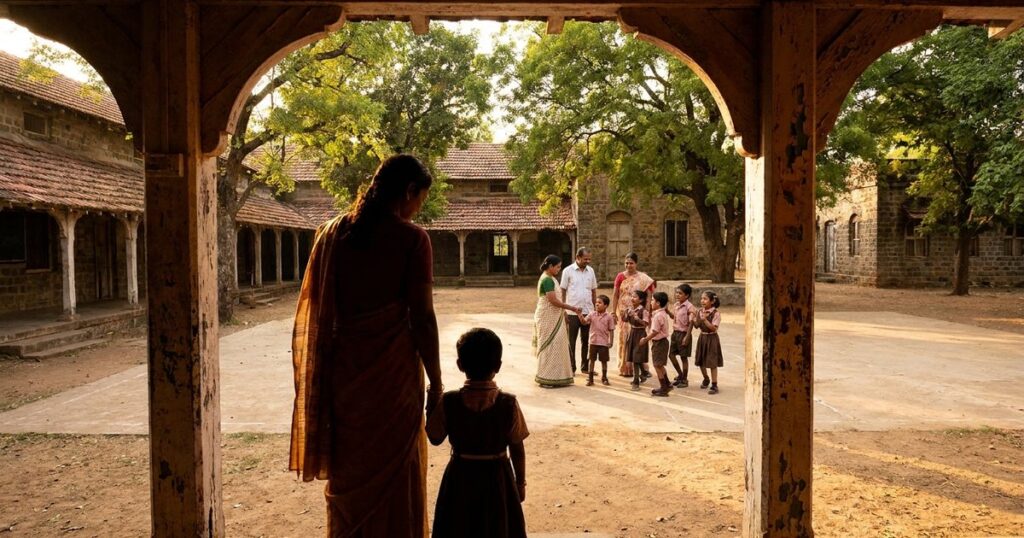
When parents ask me how to choose a school in India, I tell them to begin with one unfashionable question: what kind of child do you want your child to become? Not which board will produce the highest marks, which school has the largest swimming pool, or which institution appears most often in neighbourhood WhatsApp groups.
Then I ask them to visit the school, speak to current parents and teachers, observe how adults speak to children, calculate the daily travel time, understand the school’s response to failure and bullying, and assess whether the curriculum suits their particular child. The “best school” is not a national ranking. It is the school in which your child can learn, remain curious, make friends, recover from mistakes and grow into a reasonably decent, independent adult.
I have spent years watching adults make high-stakes decisions with incomplete information. In my IVF practice, patients sometimes choose a clinic because of a polished website or an impressive building, without asking the questions that actually affect their treatment. As an angel investor, I see founders choosing investors for the logo rather than the person they will have to call when things go wrong.
Parents make the same mistake with schools. They buy the brochure.
Start with your child, not the school’s advertisement
Every child is different. One may be academically quick but socially anxious. Another may be physically energetic and unable to sit still for long periods. A third may read voraciously but struggle with handwriting. A fourth may need additional learning support that a school is unwilling or unable to provide.
Yet parents often begin the search by asking, “Which is the top school?” This is an almost meaningless question. Top for whom? A school that suits a confident, competitive child may be miserable for a sensitive child who needs patient teachers. A school with a strong examination record may be a poor fit for a child who learns best through projects, discussion and practical work.
I would write down the following before visiting any school:
- What does my child enjoy doing without being forced?
- Where does my child struggle?
- Does my child need academic, physical, emotional or learning support?
- How much pressure is my family prepared to tolerate?
- What are our non-negotiables: distance, fees, language, religion, sport, inclusion or something else?
This exercise is useful because it prevents the school search from becoming a competition between parents. Your neighbour’s child may thrive in a highly regimented school. That does not mean yours will.
How to choose a school in India: the factors I would examine
I would not assign equal weight to every feature. A shiny laboratory is pleasant. A teacher who notices that a child has stopped participating is far more valuable.
1. The teachers matter more than the building
Parents naturally inspect classrooms, libraries, laboratories and sports grounds. They should. But infrastructure is easy to display and difficult to interpret. A school can have smart boards in every classroom and still teach through memorisation.
I would spend most of my time observing teachers. Do they listen to children? Do they explain patiently? Do they admit when they do not know something? Do they ask children to reason, or merely to repeat? How do they respond when a child gives a wrong answer?
During a school visit, I would ask to speak privately with two or three teachers who are not part of the admissions team. I would ask:
- How long have you worked here?
- How much freedom do you have in the classroom?
- What happens when a child falls behind?
- How much homework is normally given?
- What support is available for children with learning difficulties?
The answers may be more revealing than the official presentation. A teacher who says, “We never have weak students here,” is giving you useful information, though probably not the information intended.
I would also ask about teacher turnover. A school that constantly loses teachers may have management problems that parents cannot see during a thirty-minute tour.
2. Choose the board only after understanding its consequences
CBSE, CISCE, state boards and NIOS each have strengths and weaknesses. The board is not the school, but it affects textbooks, assessment, language, subject choices and the ease of changing schools later.
| Option | May suit a child who | Questions to ask |
|---|---|---|
| CBSE | May eventually pursue national entrance examinations or prefers a widely available board | Is teaching concept-based or mainly examination-oriented? How much time is spent on memorisation? |
| CISCE | Enjoys language-rich learning and a broad subject mix | Can my child manage the workload and assessment style? |
| State board | Needs continuity within a particular state or prefers the regional language | What is the quality of teaching in this specific school, rather than the reputation of the board? |
| NIOS | Needs flexibility because of sport, health, travel, work or a non-traditional learning path | Will my child receive adequate structure, mentoring and peer interaction? |
I have written separately about NIOS and CBSE for Class 10, because parents sometimes treat the board as a permanent identity. It is not. Children can change paths, though every change has a cost in time, paperwork and emotional adjustment.
If you expect to move cities, check how easily your child can transfer. If you are considering an international university later, ask what subject choices and counselling the school actually offers. Do not accept vague claims about “global exposure”. Ask for examples from the last two graduating batches.
3. Distance is an educational decision
A school forty minutes away may sound manageable when you are filling out an application form. It feels very different at 6.30 in the morning, during monsoon traffic, after a child has stayed back for football or a school play.
I would measure the commute door to door, at the actual school timings. A two-hour daily commute is ten hours a week spent in a vehicle. That is time taken from sleep, reading, unstructured play, family conversation and simply doing nothing.
A school that consumes your child’s childhood in traffic is not necessarily a better school because its prospectus is better.
Proximity also matters when a child is ill, when a parent needs to attend a meeting, or when the school requires repeated involvement. A nearby ordinary school with good teachers may serve your child better than a famous school across the city.
4. Look at the school’s attitude to failure
This is the question I wish more parents asked: what happens when a child fails?
Does the school shame the child, quietly push the child out, or work out what went wrong? Is a low mark treated as a character defect? Are children ranked publicly? Are teachers allowed to experiment, or are they punished if every class does not produce identical results?
My work with founders has made me unusually attentive to this. A young company learns through small failures. If every mistake ends the founder’s career, nobody takes an intelligent risk. Children need the same permission. They need to discover that a poor test score is feedback, not a verdict on their worth.
This does not mean that standards should disappear. A kind school can still be demanding. The distinction is whether the school demands effort and improvement, or merely compliance and high marks.
5. Discipline should produce judgment, not fear
Ask to see the written discipline policy. Do not be satisfied with “we maintain strict discipline”. That phrase can mean anything.
How does the school handle bullying? What happens when a teacher humiliates a student? Are punishments collective? Are children suspended for ordinary adolescent behaviour? Is physical punishment prohibited in practice, not just on paper?
Speak to older students if you can. Children will tell you whether the school feels safe. Watch what happens in corridors and during lunch. The official tour will show you the best classroom; the staircase will show you the real culture.
I am particularly wary of schools that confuse silence with learning. A classroom full of frightened children may look orderly. It is not necessarily educational.
6. Ask what “co-curricular” actually means
Every school brochure now promises sports, music, theatre, robotics, public speaking and community service. The words are cheap. The timetable is evidence.
How many periods each week are devoted to art, sport, music or library time? Are these activities available to every child, or only to the most talented? Can a child play football without being selected for the school team? Can a child sing without being auditioned?
Children need exposure before they can discover talent. A school should not turn every activity into another competition. I would rather see a school where every child has regular access to a playground and a musical instrument than one where a small group wins trophies while the rest watch.
The same applies to technology. A computer laboratory is not evidence of computer literacy. Ask what children create. Do they write, build, test, research and solve problems, or do they merely consume educational software?
7. Safety and inclusion are not optional extras
Ask about transport supervision, visitor access, fire drills, first aid, medical support and the process for reporting abuse. Ask who is responsible when a child is injured. Ask whether the school has a counsellor and whether that counsellor is available to students or merely listed on the website.
For a child with dyslexia, ADHD, autism, a physical disability or a chronic health condition, ask direct questions. Do not accept “we treat all children equally” as an answer. Equal treatment is not always appropriate treatment. A child who needs extra time, a scribe, a ramp, medication support or a quiet space requires a school that understands the difference.
Visit the toilets. Observe drinking water, cleanliness and supervision. Parents spend enormous energy comparing school logos and remarkably little time checking whether children can use the toilet without fear or embarrassment.
The admissions process is also a test of the school
Notice how the school treats you before it has your money. Are admissions staff transparent about fees? Do they explain transport, annual increases, meals, uniforms, books and activity charges? Or do these costs appear one by one after admission?
Ask for the complete fee schedule in writing. Include:
- Admission and registration charges
- Tuition fees
- Transport
- Books, uniforms and devices
- Trips and activities
- Examination or technology charges
- Expected annual increases
Do not stretch your finances merely to enter a prestigious school. Education is a long commitment. Fees may rise, a parent may change jobs, a second child may arrive, or medical expenses may appear. I have seen families take on damaging financial stress because they were afraid that a less expensive school would signal failure to their relatives.
It is not sensible to spend so much on schooling that there is no money left for books, travel, music lessons, therapy, or the occasional family holiday. A child learns from life outside school too.
Also read the withdrawal and refund clauses. Parents often assume that a school will behave reasonably when circumstances change. The contract may say otherwise.
Speak to current parents, but discount the gossip
Parent recommendations are useful and dangerous. A parent whose child is topping the class may praise a school that is making another child miserable. A parent whose child was denied admission may describe the institution as corrupt. Both may be telling the truth as they experienced it.
I would speak to at least five current parents, preferably with children in different grades. I would ask questions that invite examples:
- Tell me about the last time the school handled a serious complaint.
- What happens when your child is struggling?
- How often do teachers communicate with you?
- What do you dislike about the school?
- What additional costs surprised you?
The last two questions are the most useful. A parent who cannot name a single weakness is probably selling the school to you, consciously or otherwise.
I would also search for the school’s official recognition and affiliation status on the relevant board website, rather than relying on a brochure. For CBSE schools, the CBSE school directory is a sensible place to verify basic information. Accreditation does not guarantee good teaching, but lack of clarity about recognition is a warning sign.
Do not be seduced by rankings
School rankings are often based on surveys, advertising relationships, self-reported information or criteria that are impossible for a parent to verify. They may be useful for creating a longlist. They cannot make the final decision for you.
A school’s examination results are also incomplete evidence. Results reflect student selection, family support, private tuition and the school’s willingness to retain weaker students. Ask how many children entered Class 11, not only how many achieved high marks in Class 10.
Ask whether the school publishes information about students who leave. If children are quietly removed before board examinations, the reported results tell you less than you think.
This is similar to evaluating an investment fund. A return number without knowing the risk, the starting point and the selection process is not analysis. It is marketing.
A practical process for making the decision
I would shortlist three to five schools, not fifteen. Too many options create the illusion of diligence while making comparison harder. For each school, I would record the same information in a simple sheet:
| Area | What I would record | Weight in my decision |
|---|---|---|
| Teachers and culture | Teacher stability, classroom behaviour, response to mistakes | Highest |
| Child fit | Learning style, interests, support needs | Highest |
| Commute | Actual door-to-door travel time | High |
| Fees | Total annual cost and likely increases | High |
| Curriculum and board | Teaching style, subject options, transferability | Medium-high |
| Facilities | Usability, maintenance and access for all children | Medium |
| Reputation | Feedback from several current families | Low-medium |
Then I would visit each shortlisted school twice: once during a formal tour and once near the beginning or end of the school day, when the institution is less prepared for inspection. If possible, I would take my child along for the second visit, without allowing the child’s excitement about a swimming pool to dominate the decision.
After the visit, I would ask my child what they noticed. Did the teachers seem kind? Did the students look frightened? Was there somewhere to read? Did the school feel noisy, tense, friendly or dull? Children often notice the emotional temperature faster than adults do.
I would not make the child responsible for the decision. Adults must carry that burden. But the child deserves to be heard.
The school may not be the right fit forever
Parents sometimes treat school selection as an irreversible life decision. It is not. A child may begin in one school and move later. A family may discover that the promised teaching does not match the reality. A child’s needs may change.
Changing schools is disruptive, so it should not be done casually. But staying in a damaging environment merely because “we have already paid the admission fee” is the sunk-cost fallacy applied to childhood.
If your child is persistently anxious, refuses to attend school, develops unexplained physical symptoms, loses interest in everything or is repeatedly humiliated, investigate seriously. A school cannot be judged only by marks. In my medical practice, the body often speaks before the patient can explain what is wrong. Children are no different.
Parents should also resist the opposite mistake: changing schools every time a child receives a low mark or has a disagreement with a teacher. Children need the chance to solve ordinary problems. The question is whether the problem is part of growing up or evidence of a persistent failure of care.
What I would refuse to compromise on
If I were choosing a school today, I would compromise on the size of the campus, the age of the building and the number of trophies. I would not compromise on safety, teacher quality, honesty about fees, the handling of bullying, or the school’s attitude to children who do not fit its preferred mould.
I would also avoid a school that treats every child as an examination project. India has enough coaching factories. Children need to learn mathematics and language, of course. They also need to learn how to ask for help, disagree without cruelty, work with someone less talented than themselves and begin again after embarrassment.
These qualities are difficult to measure and easy to dismiss as soft. In medicine, however, I know that a patient’s ability to understand information, make decisions and persist through uncertainty often matters as much as the prescription. In startups, founders who can learn, listen and recover usually outlast those who merely present well. School should help children build these capacities.
My own rule would be simple: choose the school where the adults seem to like children, where teachers are trusted to teach, where failure is treated as information, and where your child will still have enough time and energy left to live outside the school gates.
Before paying the admission fee, sit in the car outside the school at dispersal time. Watch the children leave. Look at their faces, not their uniforms. Listen to how they speak to one another. That small observation will tell you more about the school than its prospectus ever will.