Part 11 of 19 in The Patient Owner: Charlie Munger’s Ideas, as Rakesh Jhunjhunwala Might Have Taught Them to an Indian Investor← Part 10Part 12 →
This chapter explores the investment philosophy of 'buy right, sit tight' as practiced by Rakesh Jhunjhunwala. It examines the importance of choosing the right businesses and the discipline required to hold them long-term.
- 'Buy right' involves selecting businesses that can thrive independently.
- 'Sit tight' requires patience and resisting the urge to frequently trade.
- Rakesh Jhunjhunwala's investment in Titan exemplifies this philosophy.
- True investment skill involves enduring boredom and avoiding unnecessary trades.
- The market often tempts investors with frequent trading options.
Aniruddha. This is the line everyone prints under your photograph. I want the unprinted half. What is ‘right’, and what is the sitting actually made of? Because sitting looks, from the outside, like doing nothing. Doctors are accused of the same thing when they wait.
Buy right and sit tight. — The line most associated with Rakesh Jhunjhunwala’s public philosophy
Rakesh. Right is not cheap. Right is a business that can survive your absence. A manager you would not be ashamed to be related to. A customer who returns without a discount. A reinvestment opportunity that does not require a prayer. Cheap without those things is a trap with a low P/E. Expensive with those things can still be a mistake if you pay a price that assumes heaven. The sitting is the part amateurs cannot copy, because sitting looks like indecision, and their social world punishes indecision.
Titan, told as a process and not as a miracle
The public record, which he was happy to have told plainly, is roughly this. He began buying Titan around 2002 to 2004, when the company was emerging from a hard stretch — weak demand, gold prices, labour trouble, a watch business that no longer excited anyone — and the share price was in the neighbourhood of ₹30. What he was buying, on his account and on the account of investors who later studied the holding, was not a watchmaker. It was a bet on brands, on the Tata culture of not embarrassing you, and on Tanishq as organised jewellery in a country that bought gold from a shop it had trusted for a generation and could not easily audit.
He did not sit as a statue. The record shows additions and trims over the years. By the time of his death in August 2022, the family holding was about 5 percent of the company and worth on the order of ₹11,000 crore, a very large share of the portfolio. Later reports put the family’s continuing stake near 5 percent and the value higher still, as the business kept compounding. Exact multiples depend on which lot, which split, which year. They are the wrong argument. The right argument is that very few of the people who could see the brand in 2003 were still holding it when the brand had become obvious.
Aniruddha. Raamdeo Agrawal has made that point in public — many bought, few sat. The scarce skill was not the first purchase.
Rakesh. The scarce skill was boredom. Titan was, for long stretches, a company that did not need you. No rescue. No brilliant trade. A jewellery business scaling into a trust deficit that the unorganised market could not close. Wedding demand. A design studio. A store a family could enter without feeling foolish. You can call that a moat if you like the word. I call it a reason not to sell when a man on television has found a faster horse.
Aniruddha. Munger called the style sit-on-your-ass investing. Find a few wonderful businesses, buy them, and let compounding work while you minimise fees, taxes and self-expression. You were noisier than Charlie in public. You were not noisier in the holding.
Rakesh. Noise is a hobby. The holding is the job. People mixed the two because I was willing to talk. Talking is not turnover. The sin is to let the talking become the portfolio. A man who needs a new idea every Thursday will find one, and it will be worse than Titan, because Titan cannot be found every Thursday.
What sitting feels like, so you can recognise it
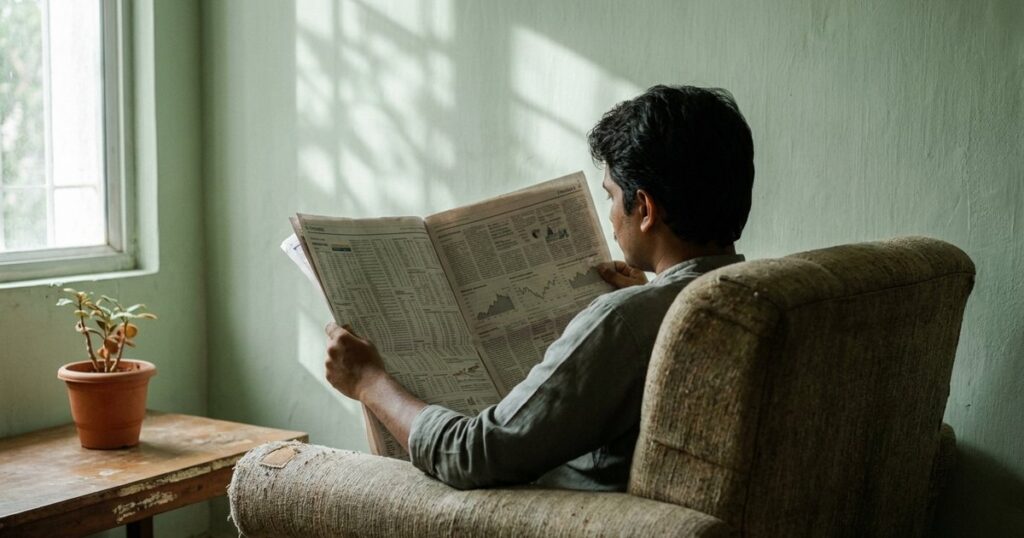
He described it without romance. Sitting feels like being early to a dinner at which the interesting conversation has not started. It feels like watching a quarter that is fine and a newspaper that is not. It feels like a relative asking why you still own ‘that watch company’ in a year when a new sector has a better adjective. The feeling is the cost. If you need the feeling to go away, you will pay for its absence with the future return.
Aniruddha. Patients hate waiting more than they hate a procedure. The procedure is a story. Waiting is a blank page. I have lost count of the treatments sold to fill the blank page.
Rakesh. The market is a hospital that sells procedures to fill the blank page. A churn product. A derivative. A thematic fund. An alert. Sit tight is a refusal to be operated on for entertainment. It is allowed only after ‘buy right’. Sitting tight on a bad business is not philosophy. It is stubbornness, which Charlie would have filed under inconsistency-avoidance: the mind’s refusal to update because updating would indict yesterday’s self.
Evening question. Of the shares you own, which would you be relieved to be forbidden from selling for five years, and which would horrify you under the same ban? The second group is not a portfolio. It is a queue.
Frequently asked questions
What does 'buy right, sit tight' mean?
It means choosing strong businesses that can succeed without constant oversight and holding them long-term without frequent trading.
How did Rakesh Jhunjhunwala apply this philosophy?
He invested in Titan, focusing on its brand and potential, and held his position for many years, allowing it to compound in value.
Why is patience important in investing?
Patience allows investors to benefit from compounding and avoid the costs associated with frequent trading and market noise.
What is the risk of frequent trading in the stock market?
Frequent trading can lead to higher fees, taxes, and the potential for poor decision-making driven by short-term market trends.