Part 11 of 12 in Don’t Finish the Book: The Smart Indian’s Guide to Active Reading← Part 10Part 12 →
This chapter shows how Indian readers use books selectively to serve practical goals. It helps anyone who wants to extract useful ideas without finishing every book.
- Ambedkar read selectively to prepare arguments, and his notes later supported speeches and the Constitution.
- An early Flipkart engineer read only technical chapters relevant to the company's current scaling problems.
- Reading circles turn individual ideas into local discussion, with books serving as inputs rather than the final product.
- Doctors, engineers, founders, and factory owners extract useful ideas, apply them, and revisit notes when needed.
Dr. B.R. Ambedkar's years in Columbia University libraries are often cited as an example of intense reading. What is less discussed is how selective and purposeful that reading was. He was not reading for the sake of completion; he was arming himself with arguments for the political and social battles ahead. The notes he made became the raw material for later speeches and the Constitution. Purpose drove selection.
In more recent times, many Indian founders describe a similar pattern. One early Flipkart engineer has spoken about reading only the chapters of technical books that matched the scaling problems the company faced that quarter. Completion was irrelevant; applicability was everything. Another founder in the education space re-reads a short set of parenting and learning books every year as her own children grow, extracting different lessons each time.
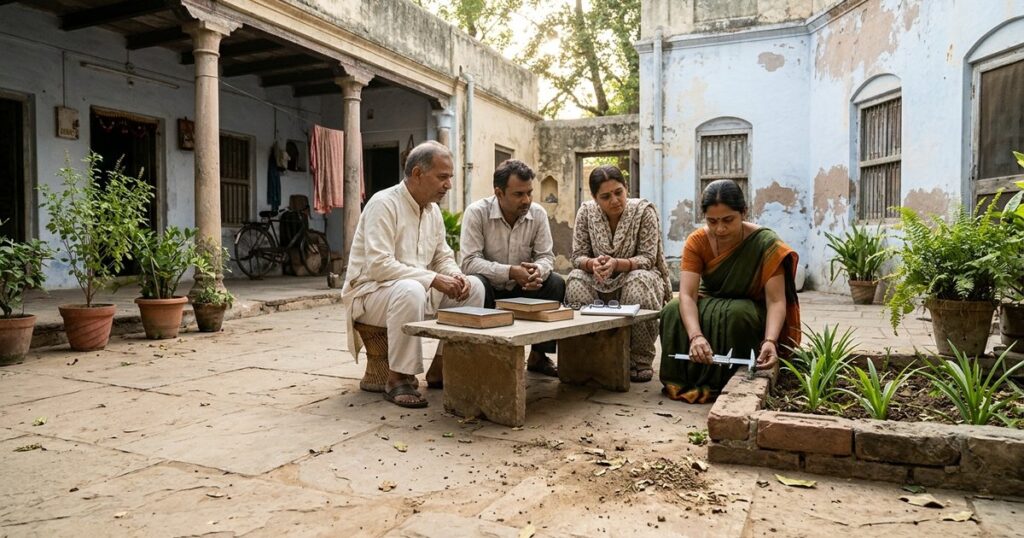
A less famous but equally instructive case is the neighbourhood reading circle that still exists in some Indian towns. Members do not all read the same book. Each person brings one idea from whatever they have been reading and the group discusses how it applies locally. The conversation is the product; the books are the inputs. This model scales easily with WhatsApp or monthly meetups and costs almost nothing.
These examples share a common thread: reading is subordinated to a real goal — a constitutional debate, a scaling problem, a child's development, a local discussion. When the goal is clear, the techniques of skimming, noting, sharing, quitting, and re-reading become natural rather than forced.
A modern parallel can be found in the way some Indian edupreneurs build their curriculum. Instead of assigning full textbooks, they assign short excerpts or specific chapters aligned to the student's current project. Students learn to extract, apply, and then move on. The result is higher engagement and better retention than the traditional complete-the-book approach.
Another case comes from a manufacturing cluster in Coimbatore. Several factory owners formed an informal group that meets monthly. Each owner is responsible for bringing one practical idea from a book or article they skimmed that month. Over two years the group has adopted dozens of small process improvements that none of them would have discovered alone. The books were secondary; the shared extraction and discussion were primary.
Consider also the quiet practice of many Indian doctors and engineers who maintain personal 'commonplace books' — notebooks of useful ideas extracted from papers and books over decades. When a difficult case or project appears, they consult their own notes first. The books themselves may be long gone; the distilled insight remains.
Frequently asked questions
How did Dr. B.R. Ambedkar use reading selectively?
He read with political and social goals in mind, using notes as raw material for later speeches and the Constitution.
Do successful Indian founders read entire books?
Not always. An early Flipkart engineer read chapters related to current scaling problems, while an education founder re-read selected books as her children grew.
How do Indian reading circles work?
Members bring one idea from whatever they have read and discuss its local application. They do not all need to read the same book.
What is a commonplace book?
It is a notebook where useful ideas from papers and books are collected. Doctors and engineers consult these notes when difficult cases or projects arise.