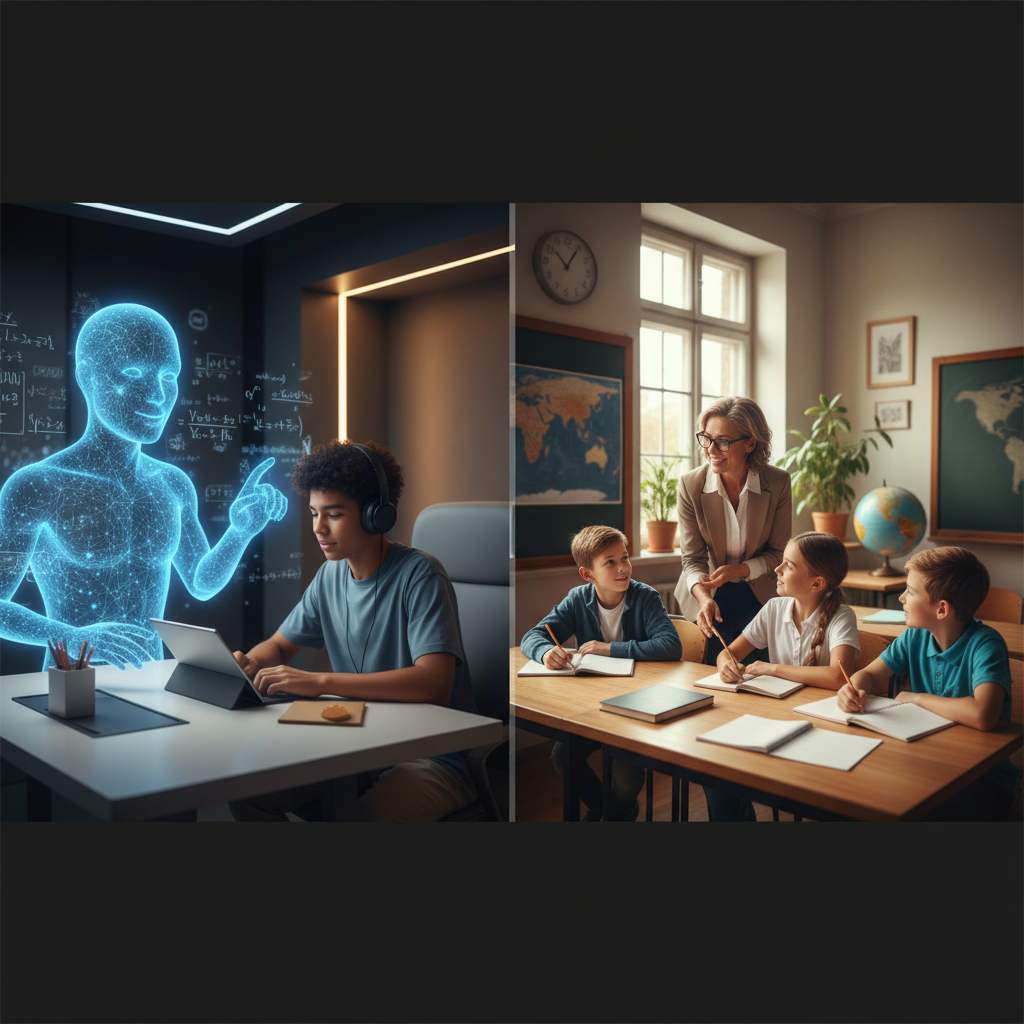
Q1. What’s fundamentally wrong with the current education system?
The biggest flaw in traditional education is something most people never question:
the artificial division of learning into primary, secondary, and higher education.
This structure was never designed for students.
It was designed for the convenience of teachers, institutions, and administrators — not for how human beings actually learn.
A child doesn’t suddenly change at age 10 or 15. Curiosity doesn’t magically reset when someone enters college. Yet our education system treats learning as a series of disconnected stages, each with its own rules, exams, and hierarchies.
The learner remains the same.
Only the bureaucracy changes.
Q2. Why was education divided this way in the first place?
Because it made management easier.
It allowed:
- Standardized syllabi
- Batch processing of students
- Predictable examinations
- Easy certification
- Administrative control
- But ease for institutions came at a cost to students.
Learning was broken into artificial compartments, while curiosity — which is continuous — was ignored. Education became something that happens to students, not something students own.
Q3. What’s the biggest casualty of this system?
Student agency.
Children start school curious, expressive, and full of questions.
By the time they reach higher education, many have become passive, fearful of mistakes, and dependent on authority.
Why?
Because the system rewards:
- Memorization over understanding
- Obedience over inquiry
- Marks over mastery
Students are trained to wait for instructions instead of exploring ideas. They learn to chase grades instead of meaning. That’s not education. That’s conditioning.
Q4. How does AI change this equation?
AI breaks the monopoly that institutions once had over knowledge.
For the first time in history:
- A student doesn’t need a teacher to explain concepts
- Learning is available 24/7
- Content can be personalized
- Doubts can be clarified instantly
- Pace can be self-directed
- AI makes it possible to return education to where it belongs — with the learner.
Q5. Does this mean teachers will become irrelevant?
Absolutely not.
But their role must evolve.
Teachers should no longer be: Information dispensers, Syllabus finishers and Exam trainers.
Instead, they should become: Mentors, Coaches or Thinking partners
Curators of learning paths
In an AI-powered world, the teacher’s value lies not in what they know, but in how they guide thinking.
Q6. What does “student-first education” really mean?
It means flipping the system.
Instead of asking: “What should we teach in Class 8?”
We ask: “What does this student want to learn right now?”
Instead of forcing uniformity, we allow:
- Different learning speeds
- Different interests
- Different learning styles
A student interested in coding should be allowed to go deep.
A student curious about history should explore freely.
A student who learns slowly should not be punished for it.
Education should adapt to the student — not the other way around.
Q7. How does AI enable lifelong learning?
Because AI removes dependency.
A student who knows how to: Ask good questions, Verify information, Use AI as a learning partner
Reflect on mistakes and …never becomes obsolete.
In the AI era, learning is no longer something you “finish” by age 21.
It becomes a lifelong habit.
This is crucial, because careers will change repeatedly. The only sustainable skill is the ability to learn continuously.
Q8. Isn’t this approach risky? Won’t students become lazy?
Only if we continue to measure success the wrong way.
Students become lazy when:
They see no relevance in what they’re studying
They’re forced to memorize
They have no control over learning
But when students are given autonomy, something remarkable happens:
- They become curious.
- They experiment.
- They take ownership.
Human beings are naturally wired to learn — unless we suppress that instinct.
Q9. What should education look like in the AI age?
It should be: Self-paced , Curiosity-driven , Project-based, AI-assisted and Mentor-supported.
Assessment should focus on: Understanding, Application, Creativity, Problem-solving and Not just marks.
Education should prepare students for life, not exams.
Q10. What is your vision for the future of education?
A world where:
- Learning never stops
- Students own their education
- AI is a partner, not a threat
- Curiosity is valued more than conformity
- Children grow into confident, independent thinkers
- We don’t need better textbooks. We need braver thinking.
- AI has given us the opportunity to finally put students first.
Now the question is:
Do we have the courage to change?