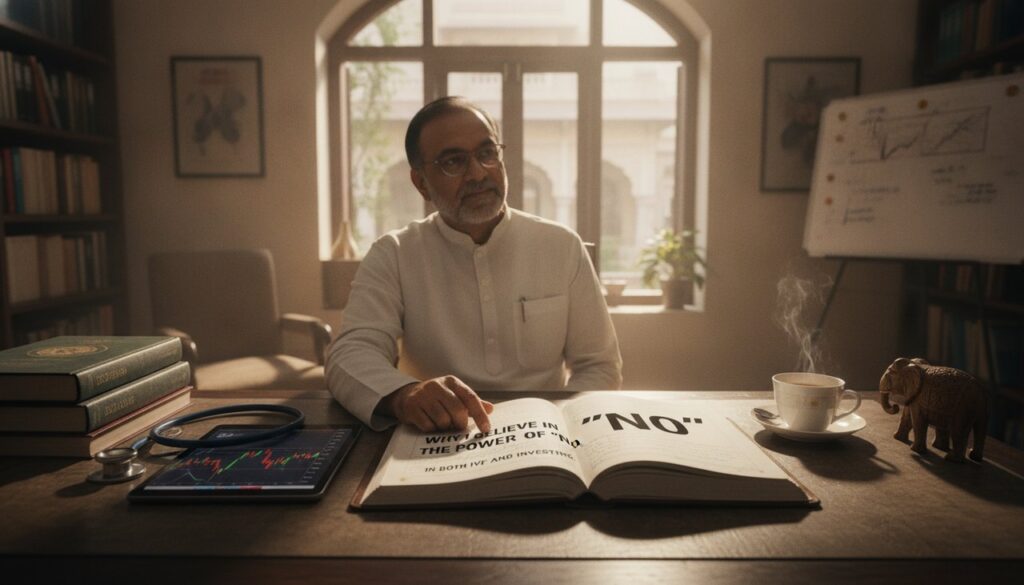
I remember a conversation with a young couple who walked into my clinic, their faces a mix of hope and trepidation. They had been through the rigors of unexplained infertility for years, and the emotional and financial toll was apparent. The husband, after detailing their long journey, asked me, “How can we be sure this will work?” The truth is, in both IVF and investing, certainty is a luxury we seldom have. That’s where the power of “No” becomes invaluable.
In the world of IVF, saying “no” is often about managing expectations and preserving the emotional well-being of patients. The temptation to try every new add-on, every unproven technique, is immense. Patients are desperate for results, and the industry is rife with promises. But not every option improves outcomes, and some can even be harmful. As an IVF specialist, it’s my responsibility to guide patients with candor, sometimes advising against interventions that lack solid evidence of efficacy. It’s not an easy conversation, but it’s a necessary one.
Similarly, in the world of angel investing, the ability to say “no” is a crucial skill. I remember being approached by a passionate founder with a seemingly brilliant idea. The concept was innovative, and the pitch was compelling, yet something didn’t quite add up in the business model. Despite the allure, I declined to invest. Months later, the venture faced significant setbacks that validated my initial reservations. In investing, as in medicine, saying “no” is often about trusting your instincts and understanding that not every opportunity, no matter how promising it appears, is worth pursuing.
In my practice, I’ve seen many patients who have been led astray by the promise of miracle cures. They come to me disillusioned after spending exorbitant amounts on unnecessary treatments with no tangible results. It reminds me of the startups that pivot endlessly, chasing trends without a clear strategy. Both are driven by a fear of missing out, a fear that often leads to poor decisions.
The influx of private equity into the fertility industry has only heightened the need for discernment. While investment can drive innovation and expand access, it also introduces a profit-driven motive that can compromise patient care. Clinics may be tempted to offer costly, unproven procedures under the guise of innovation. As a practitioner, I must remain vigilant, ensuring that medical decisions are driven by patient welfare rather than financial gain.
Investing in startups parallels this in many ways. As an angel investor, I meet countless founders, each with a dream of transforming their industry. It’s easy to get swept up in the excitement of being part of the next big thing. But successful investing requires a disciplined approach—evaluating the market potential, the team, and the execution plan critically. Saying “no” to a founder isn’t a reflection of their potential but rather a reflection of the fit for my portfolio and risk appetite.
The power of “no” is not about negativity or rejection; it’s about clarity and focus. It’s about understanding that resources, whether financial, emotional, or temporal, are finite. In IVF, this means guiding patients toward treatments that have the best evidence for success, even if it means fewer cycles or different approaches. In investing, it means aligning with ventures that resonate with my values and expertise, even if it means passing on potentially lucrative deals.
In both realms, I’ve learned that saying “no” is a form of respect—for the patient, for the founder, and for oneself. It demands honesty and transparency, qualities that are increasingly rare but immensely valuable. Patients deserve a clear understanding of what each treatment entails, just as founders deserve candid feedback on their pitches. It’s a philosophy that has shaped my practice and my investment strategy.
I’ve often said that the medical profession and entrepreneurship are not for the faint-hearted. Both require resilience, adaptability, and a willingness to make tough decisions. The power of “no” is a testament to these qualities. It’s a reminder that while we cannot control outcomes, we can control the integrity of our decisions.
In closing, the next time you’re faced with a decision, whether in medicine or business, consider the power of “no.” It’s not a door closing; it’s a path being defined. And sometimes, the most significant progress comes from knowing when to walk away.