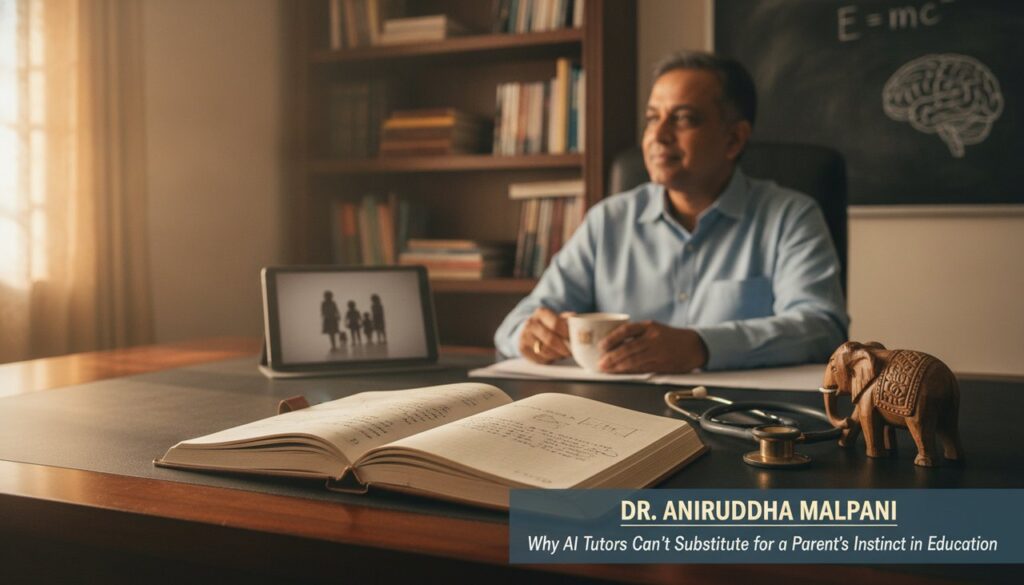
I’ve been thinking about my own journey as a parent and how it contrasts with the rise of AI tutors in education. As someone who has spent years in the medical field, particularly in IVF, I am no stranger to the complexities of human relationships and the instincts that guide us. These experiences shape my perspective on the limitations of AI in replacing the intrinsic nurturing and educational roles of parents.
A few weeks ago, I was speaking with a founder I backed who is developing an AI-based educational platform. He was enthusiastic about how AI could revolutionize learning by providing personalized tutoring at a fraction of the cost of human tutors. As someone who has invested in the promise of technology, I understand the appeal. But as a parent and a doctor, I can’t shake the feeling that we’re missing something fundamental.
The crux of the matter is this: AI tutors, no matter how advanced, lack the emotional depth and intuitive understanding that a parent brings to their child’s education. I remember a particular evening when my child came home frustrated with a math problem. He had been using an AI tutor app, which, while efficient, failed to address his growing anxiety about not understanding the concept. It wasn’t until we sat down together, and I explained the problem in a way that resonated with him, that he began to relax and engage with the material. This was not just about solving a math problem; it was about providing reassurance and understanding, something an AI tutor simply cannot replicate.
In my experience, the educational journey of a child is as much about emotional support as it is about academic achievement. Human tutors, with all their imperfections, offer something an algorithm cannot: empathy and real-time adaptation to a child’s emotional state. They can pick up on subtle cues, like a furrowed brow or a sigh of frustration, and adjust their approach accordingly. These are moments of connection that build a child’s confidence and curiosity, qualities that are often lacking in AI-driven interactions.
Having spent years mentoring startups, I know that instinct plays a crucial role in decision-making. Experienced investors often talk about having a “gut feeling” about where to place their bets. This isn’t just superstition; it’s the culmination of years of experience and subconscious processing of countless variables. Similarly, a parent’s instinct in guiding their child’s education is invaluable. It’s a complex synthesis of experience, emotional connection, and a deep understanding of their child’s unique needs.
Consider the cost and availability of traditional tutoring. The National Tutoring Association states that private math tutoring can cost between $70 to $120 per hour, a significant investment for most families. AI tutors, on the other hand, offer 24/7 availability at a lower cost, making them an attractive option for families. Yet, while AI tutors like StarSpark.AI promise personalized learning paths and instant feedback, they still fall short in areas that require human touch. They can deliver information but often miss the mark when it comes to fostering genuine curiosity and passion for learning.
This is where the educational reform I advocate intersects with my experiences in medicine. Just as in healthcare, where the patient’s emotional and psychological state can significantly impact recovery, a child’s emotional well-being is crucial to their educational success. AI may be able to identify where a student goes wrong in solving a problem, but it cannot feel the frustration or anxiety that may accompany those mistakes. It cannot celebrate the small victories or provide the encouragement needed when a child is on the verge of giving up.
The question is not whether AI can aid in education, but how it should be integrated without undermining the role of human interaction. In the realm of education, as I discussed in [AI in Education: Why My Child’s Curiosity Outperforms Algorithms](https://www.indianangel.in/ai-in-education-why-my-childs-curiosity-outperforms-algorithms/), AI can supplement but not replace the nuanced guidance that comes from human beings. The bond between a parent and a child, or a child and a caring tutor, offers a level of engagement that AI simply cannot match.
In the world of investing, I’ve learned that numbers and data tell a part of the story, but intuition often fills in the gaps. Similarly, AI tutors can provide data-driven insights and recommendations, but they cannot replace the instinctual guidance a parent provides. This is particularly true in formative years when children need more than just academic support—they need someone who understands their fears, joys, and unique quirks.
The allure of AI is undeniable, and its potential in education is vast. But as we embrace these technologies, we must also recognize their limitations. AI can process vast amounts of information and deliver precise feedback, but it cannot replace the human instinct that has been honed over generations. It cannot replicate the warmth and connection that comes from a parent sitting by their child’s side, guiding them through their educational journey.
As we move forward into an increasingly AI-driven world, we must remember that certain aspects of life—like education and parenting—are not just about efficiency and optimization. They are about connection, empathy, and understanding. These are qualities that cannot be coded into a machine, no matter how sophisticated the algorithms may be.
In the end, education is not a transactional process but a transformative journey. It’s about nurturing curiosity, fostering resilience, and instilling a love for learning. These are lessons that are best taught through human interaction, not artificial intelligence. As we continue to innovate and integrate AI into our educational systems, let’s not lose sight of the importance of human instincts. They are, after all, what make us uniquely human.