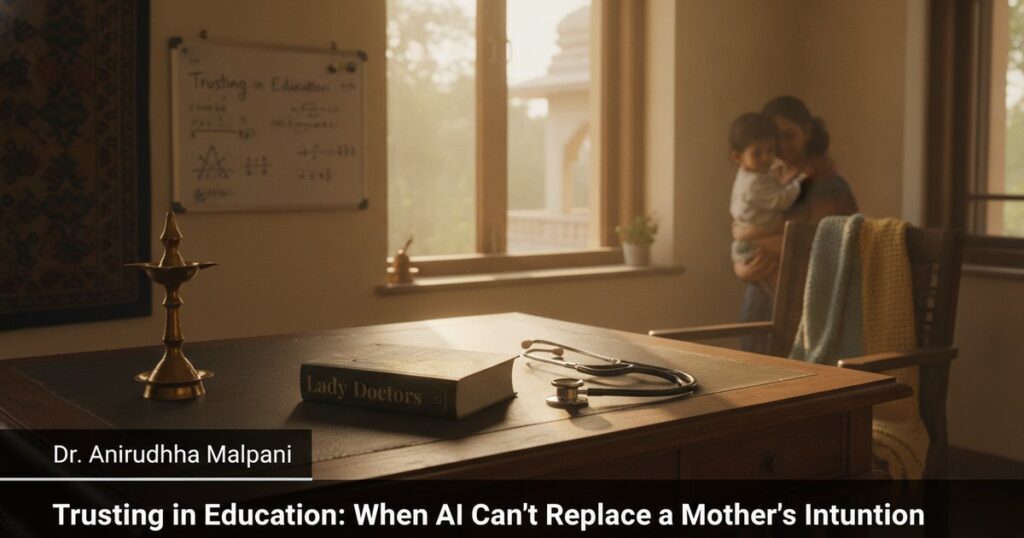
I’ve recently been reflecting on a rather humbling moment that took me back to the core of what it means to educate and nurture. It was a conversation with a patient, who, after years of trying, finally embraced motherhood. She recounted how she navigated the overwhelming deluge of information available online about parenting, trusting instead her intuition when it came to her child’s needs. It struck me then, as it does now, that no algorithm, no matter how advanced, can replace a mother’s instinct.
As someone who wears multiple hats—as an IVF specialist, angel investor, and education reform advocate—I often find myself at the crossroads of technology and human intuition. In the world of startups, I’ve seen founders who rely heavily on data analytics and AI-driven insights to make decisions. Yet, the successful ones are those who also trust their gut, who have a nuanced understanding of their business and market. A similar paradox exists in education.
I’ve backed a few ed-tech startups, and there’s a lot of talk about AI’s potential to revolutionize education. The promise is alluring: AI tutors that can adapt to a student’s pace, style, and needs. But I’ve learned that the history of education technology is littered with over-promises and under-deliveries. The reality is that while AI can be a powerful tool, it can’t replicate the nuanced understanding a teacher has of their students, much like a mother with her child.
Consider this: AI can analyze patterns, predict outcomes, and provide feedback. It’s fantastic at grading standardized tests or identifying gaps in a student’s knowledge. But can it truly understand the subtle signs of a student struggling with confidence or grappling with personal issues? Can it inspire a student to push beyond their perceived limits, or instill a love for learning? In my experience, it cannot. I’ve seen time and again that the human touch—a teacher’s encouragement, a parent’s praise—is irreplaceable.
We must also consider the issue of trust in education, a topic I find myself returning to frequently. Trust is the bedrock of any educational relationship. It’s what allows students to take risks, make mistakes, and ultimately learn. Yet, the surge of AI in classrooms has started to erode this trust. Students are wary of whether their teachers are using AI to grade their work, and teachers are skeptical of whether student submissions are genuinely their own effort. This degradation of trust is a real threat to the educational process.
The same issue of trust arises in my IVF practice. Patients often come in inundated with data from various online sources. They have apps that track ovulation, forums with anecdotal experiences, and AI tools that predict fertility windows. But at the end of the day, they sit across from me and ask, “What do you think, doctor?” They are looking for a human connection, for someone who understands their unique journey and can offer personalized advice. This is where intuition plays a pivotal role, something I’ve also explored in my piece on Trusting Intuition Over Data in IVF and Startups.
In startups, as in education, there’s a push for data-driven decision-making. It’s essential, no doubt. But data without intuition is like a recipe without a cook. Numbers can guide us, but they can’t make us understand the why behind those numbers. They can’t see the potential in a founder’s eyes or the determination in a student’s demeanor. This is why I often advise young entrepreneurs to balance data with their intuition.
The path forward, I believe, lies in recognizing the strengths and limitations of AI in education. AI can be an assistant, a tool to enhance learning, but it should never be the primary driver. We must keep the human element at the forefront. Teachers need to be empowered to use AI as a supplement to their teaching, not a replacement. Parents should see AI as a tool to support their child’s education, not a substitute for their guidance and involvement.
Moreover, we need to be cautious about the unintended consequences of AI in the classroom. The “AI tutor” that writes essays for students or solves complex problems at the click of a button might seem like a boon. But it’s fostering a dangerous dependency, stunting the development of critical thinking skills in students. This reminds me of a conversation I had with a student at a top university, who lamented how peers were using AI to complete assignments, eroding the value of their education.
In the same vein, I’ve written on how an AI tutor failed my child, teaching me invaluable lessons about the limitations of technology in education. We need to redefine the role of AI in education, ensuring it complements rather than competes with human intuition.
As an advocate for education reform, I am committed to exploring how we can integrate AI thoughtfully and responsibly. We must ask ourselves: What is the purpose of education in an AI-driven world? How do we prepare students for a future where technology is omnipresent but not omnipotent? These are the questions that keep me up at night, and they are the questions that should guide our approach to education reform.
In conclusion, while AI holds tremendous potential, it cannot replace the human instincts that are at the heart of teaching and nurturing. Just as a mother’s intuition is irreplaceable, so is the intuition of a dedicated teacher or an empathetic mentor. Let’s embrace technology, but let’s not lose sight of the human connections that truly drive learning and growth. After all, the most profound lessons aren’t always found in textbooks or algorithms—they’re found in the warmth of a shared human experience.