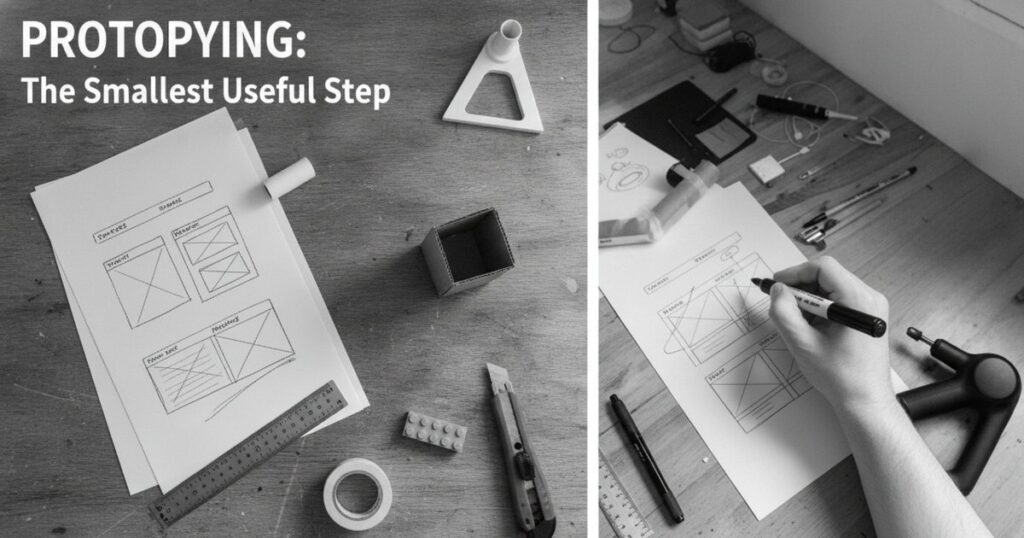
I’ve been reflecting on the notion of prototyping, particularly in the context of my experiences as both an IVF specialist and an angel investor. It strikes me that the process of prototyping is, in essence, about finding the smallest, most useful step forward. Whether in the operating room or the boardroom, this principle remains steadfast.
I recall a case from my clinic where a couple was grappling with infertility. They had tried numerous treatments, each one more complex and expensive than the last, with little success. It was a reminder that sometimes, the solution isn’t to do more but to do less — and to do it better. In their case, simplifying the treatment plan and focusing on one variable at a time led to a successful pregnancy. It was a humbling lesson in the power of simplicity, and it’s a principle I bring into my investing as well.
When I look at startups, the parallels are striking. A founder I backed recently approached me with a flashy prototype of their product. It was visually impressive but didn’t really answer the critical questions: Will it solve the problem it’s meant to? Will users find it valuable? In my experience, it’s easy to get caught up in the allure of a polished product, but a prototype’s real purpose is to test assumptions and learn, not to dazzle investors.
Think of prototyping as a diagnostic tool. Just as a doctor wouldn’t prescribe treatment based on an elaborate but irrelevant test, a founder shouldn’t develop a product based on a prototype that doesn’t address the core uncertainties. Asha, a founder I work with, illustrated this perfectly. She sketched out a simple workflow for her team to follow and observed where they hesitated, what information was missing, and who needed to authorize final decisions. This exercise uncovered more about the workflow’s limitations than any sophisticated software could at that stage.
In investing, I’ve learned that a prototype is not about proving that your idea is foolproof but about exposing its weaknesses. Much like in medicine, where a test’s value often lies in what it reveals you didn’t know, a prototype should be a tool for discovery. It’s a lesson I’ve seen founders struggle with time and again: the prototype is not the product. It’s a step in understanding what the product could be.
The trick is to choose the right kind of prototype for the questions you need to answer. If you’re uncertain about user experience, sketch it out. If it’s about navigation, create linked screens. If it’s about technical performance, conduct a focused test. In my practice, when a patient presents with a complex fertility issue, we don’t leap to the most advanced treatment. We start with the simplest, most revealing test — often something as basic as a hormone level check. It’s about finding that minimal intervention that gives you the maximum insight.
I see founders making the mistake of using prototypes to impress rather than to learn. A clickable demonstration might look convincing, but it doesn’t prove that customers will return next month. Similarly, a cardboard model might show how a product fits but says nothing about its durability. This is where the medical mindset of testing in stages becomes invaluable.
For instance, in my investments, I’ve seen the value of starting with a manual prototype. Asha, the founder I mentioned earlier, did just that with her order processing system. She manually processed orders using a structured worksheet, allowing her to learn which steps were predictable and which required judgment. The insights she gained were far more valuable than what an automated system could have provided at that stage.
A critical aspect of prototyping is honesty about its limitations. When I counsel patients, I am transparent about what a treatment can achieve and what it can’t. This honesty invites questions and often leads to a better understanding of the patient’s needs. Similarly, when developing a prototype, stating what works and what is simulated helps in gathering useful feedback. Users need to know what kind of response you need to make the prototype valuable.
In essence, the goal is to choose the prototype that answers the most significant question at the lowest cost. This approach not only saves money but also prevents the peril of falling in love with an untested idea. It reminds me of what I observed in the courage of IVF patients, which I wrote about in What IVF Patients’ Bravery Taught Me About Startup Failures. Their journey is a testament to the power of incremental progress and learning from each step, no matter how small.
In conclusion, prototyping, whether in medicine or startups, is about making assumptions visible enough to examine. It’s a practice of humility, a willingness to learn, and an understanding that not every step needs to be grandiose. Sometimes, the smallest, simplest step can be the most transformative. As I navigate the worlds of healthcare and investing, I find this principle to be a guiding light. It’s not just about moving forward; it’s about moving forward wisely.
Part of the Building Frugal Startups: Lessons from the Trenches series — read the full guide.