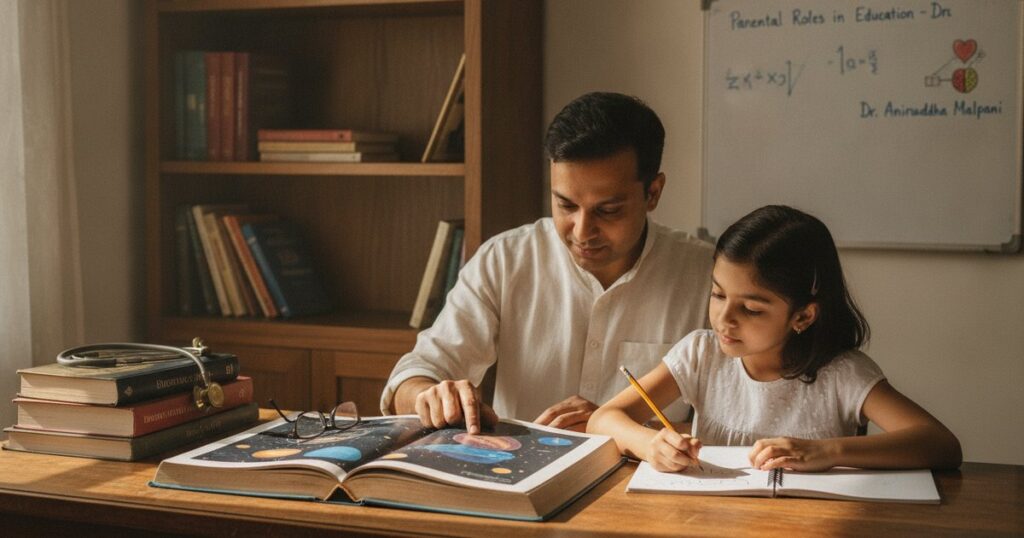
Part 5 of 17 in The Engaged Indian Teen
I’ve been thinking a lot about the roles we, as parents, unwittingly play in our children’s education. The other day, I found myself in a conversation with a fellow parent who was lamenting the pressure on his child to perform well in school. His child, like many others, was caught in the relentless cycle of school, coaching classes, and homework. This parent felt that paying for the best coaching was his duty, convinced that it would ensure his child’s success. But I couldn’t help but wonder if we’ve missed the point entirely.
In my experience, Indian parents are far from lazy. They’re exhausted and afraid. It’s a fear fueled by the relentless pressure to ensure their children succeed academically in a system that often seems rigged against genuine learning. Both parents working long hours, schools promising “holistic development” but teaching to the test, and societal expectations that place undue pressure on young children—this is the backdrop against which we operate. Into this fear walks a very Indian product: paid rescue. School will handle values; coaching will handle ranks. You will handle fees, transport, and anxiety.
This is where the problem begins. The education system, and our response to it, have turned a moral problem into a market problem. If the child isn’t learning, the solution seems to be to buy a better brand of education. If that fails, then it’s off to a residential program. And if that doesn’t work, the child is often blamed for not being “serious.” It creates an illusion of parental responsibility being fulfilled just because an invoice was paid.
The truth is, the home environment predicts how children learn more powerfully than we like to admit. And this is not because parents need to become subject teachers. It’s because children take their cues about what learning is from the people whose opinions they cannot escape. If home treats learning as a transaction—hours in, marks out—the child will treat it that way. But if home treats learning as a way of being alive in the world, the child stands a chance.
I see this in my own practice. Just as in healthcare, where the environment and lifestyle of a patient can have profound effects on their health outcomes, the educational outcomes for children are heavily influenced by their home environment. This isn’t about making parents feel guilty for not doing enough. It’s about recognizing the power they already wield and using it wisely.
A typical Indian classroom is overcrowded, with too many children and too little time. Teachers are judged by the exam results of their students, so the rational behavior is to cover the syllabus, set the expected questions, and keep the peace. Curiosity is expensive. A child who asks “but why?” twice in a row delays the lesson. A child who wants to connect photosynthesis to the family’s terrace garden is a disruption.
Good teachers fight this. Many do heroic work. They cannot, by themselves, give your child a personalized zone of challenge, the sweet spot where work is neither so easy that the mind checks out nor so hard that the mind shuts down. Lev Vygotsky called this the zone of proximal development. It’s why so many teenagers become passengers. They are sitting in rooms that are not pitched at them.
Coaching is not the correction we pretend it is. It’s often just school, only faster, denser, and more openly instrumental. The incentive is rank. The method is repetition plus pattern. The culture is comparison. For a handful of students who already have the Explorer muscle, a good coaching problem-set can be a gym. For the rest, it’s a second workplace that trains compliance and speed. It rarely trains the question, “What do I not understand, and how will I find out?”
Consider the story of Eklavya from the Mahabharata. Every Indian child knows it. Eklavya is turned away from Drona’s school. He builds a statue of the guru, practices in the forest, and becomes the better archer. We tell this story as a hymn to unpaid labor and loyalty. We should tell it as a hymn to self-direction. Talent was not the problem. Access was. And when access was denied, the boy invented a practice.
This is the opposite of what modern coaching sells. Coaching says: you cannot learn this without us. The Eklavya story says: a serious student can learn anywhere if the practice is honest. The job of an Indian parent today is to become, not Drona-with-a-fee, but the adult who protects the child’s right to practice, who makes sure the forest is not replaced by a hall of photocopied modules and shame.
This is why being “hands-on” does not mean sitting next to the child until 1 a.m. rewriting chemistry notes. It means refusing the story that education is a service you purchase. It means knowing the child’s modes. It means designing the home so that questions are safer than silence. It means using tools, including AI tutors built to question rather than to dump answers, as amplifiers of the child’s agency, not as a third outsourcing.
Let me share a story from Pune that illustrates this beautifully. Aarav and Ishaan are cousins in Class 11, both in the science stream, both enrolled in the same weekday coaching. Aarav’s father drops him, pays the fee, and asks only for test ranks. When ranks fall, the volume at home rises. Ishaan’s mother cannot help with rotational mechanics. What she does instead is sit twice a week and ask him to teach her one idea from the week, on a whiteboard stuck to the kitchen wall. She doesn’t correct the physics. She asks where he got stuck and what he tried.
Six months later, Aarav’s rank is still “average” and his sleep is worse. Ishaan’s rank has moved only a little. What has moved a lot is his speech. He can narrate his own confusion. He starts using an AI tutor at night not to fetch answers but to be questioned until the idea holds. The difference was not money. The difference was a parent who stayed in the learning, not just in the logistics.
This is the kind of environment we should strive to create. Just as in the fertility clinic, where I spend a great deal of time explaining the uncertainties and realities to patients, in education too, we must be honest about what truly matters. It’s not about buying the best coaching or school. It’s about nurturing an environment where learning is valued for its own sake. Where questions are encouraged, and where failure is seen as a stepping stone to understanding rather than a mark of shame.
In the end, education reform, much like fertility treatment, requires a dose of honesty. We need to confront the uncomfortable truths we’ve been avoiding. The real cost of our current approach is not merely financial. It’s the cost of stifled curiosity, of untapped potential, and of children who grow up believing that learning is a transaction rather than an exploration of the world.
As parents, we have more power than we realize. We can choose to be part of the solution by shifting the focus from mere academic achievement to genuine learning. By valuing curiosity over compliance, by embracing the unknown with our children, and by being present in their learning journeys, we can help them become not just successful students, but lifelong learners.