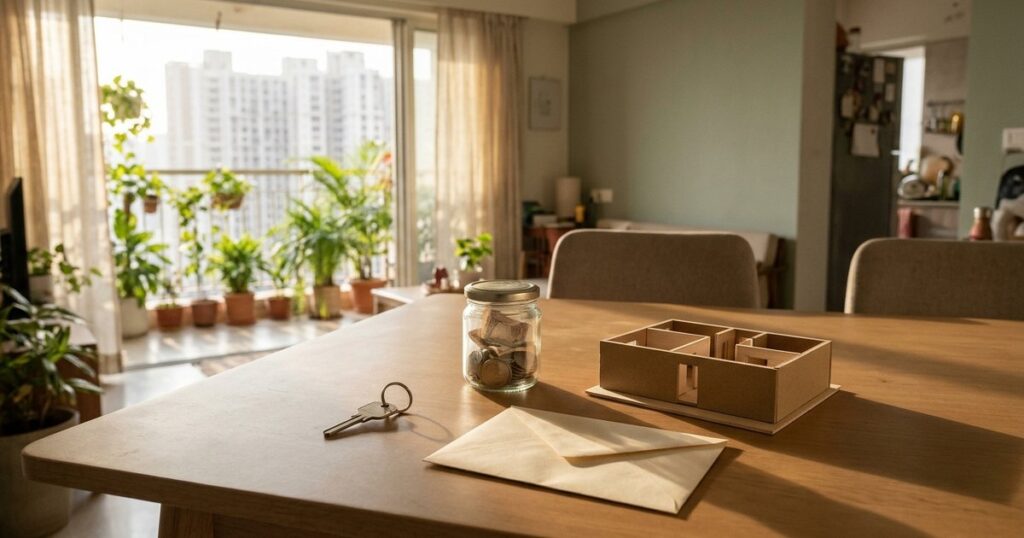
I have watched intelligent people make poor housing decisions because they fell in love with a sample flat, a sea view, or a broker’s promise that “prices will only go up”. My short answer is this: buying a house in Mumbai is worth it if you expect to live there for at least seven years, have a stable income, can fund the down payment and costs without exhausting your savings, and can still sleep comfortably after paying the EMI. If you may move within five years, or if the purchase leaves you financially stretched, renting is usually the wiser choice.
Mumbai is an expensive city in which to make an emotional mistake. A wrong restaurant choice costs a few thousand rupees. A wrong flat can trap a family for twenty years.
My answer to “Is it worth buying a house in Mumbai?”
I would not begin by searching property listings. I would begin by asking whether buying suits the buyer’s life.
This sounds obvious, but the sequence is usually reversed. A couple sees a well-designed two-bedroom flat in Powai, Bandra, Thane, or Navi Mumbai. They calculate whether the bank will approve the loan. They do not calculate whether they will still want to live there when one spouse changes jobs, when a child starts school, when an ageing parent needs care, or when the monthly EMI becomes tiresome rather than exciting.
For me, the decision has five tests:
- Will I remain in the same broad location for at least seven years?
- Is my income stable enough to carry a long loan through a bad year?
- Can I pay the down payment, transaction costs and an emergency reserve?
- Does the EMI leave room for saving, investing, children’s education and ordinary life?
- Is this particular property legally clean, fairly priced and physically suitable?
If the answer to any of these is no, I would wait, rent, or buy something smaller. I would not allow the fear of “missing out” to decide a twenty-year financial commitment.
A house is not an investment merely because it is expensive. It is first a place to live, then a large illiquid asset, and only sometimes a good investment.
The first decision is not Mumbai versus elsewhere
The first decision is whether I am buying a home or buying an asset.
These are different purchases. A home gives me stability, control over my living space, and freedom from a landlord’s decisions. It may allow children to remain in one school and make a long commute manageable. These benefits are real, even though they do not appear in a spreadsheet.
An investment property is judged differently. I need to examine rent, vacancy, maintenance, taxes, liquidity and the possibility that prices remain flat for years. A flat bought for self-use can be a sensible decision even when its rental yield is unimpressive. A flat bought purely as an investment needs a much higher standard of proof.
Mumbai makes this distinction especially important. A family may buy in a location they love because they want to live there, then justify the purchase by saying that the property will appreciate. That is backwards. If I want a home, I should admit that I am paying for convenience and belonging. If I want an investment, I should not pretend that a beautiful lobby is a financial thesis.
How long do I need to stay?
Buying has a large entry cost and a slow payback. Stamp duty, registration, brokerage, legal fees, parking, deposits, furnishing and moving costs arrive immediately. Selling also costs money and may take time. The property cannot be sold as easily as shares in a listed company.
I therefore use seven years as a practical minimum for most Mumbai home purchases. It is not a law of nature. Someone may get lucky and make money after three years; someone else may lose money after ten. But a short expected stay should make me very cautious.
A job transfer from Lower Parel to Navi Mumbai can change the calculation. So can a growing family. A flat that feels generous for a newly married couple may feel cramped after the arrival of a child and a live-in parent. A daily commute that seems tolerable during a Sunday site visit may become unbearable after six months of monsoon traffic.
Renting has an option value. It lets me learn a neighbourhood before committing. I can discover whether the railway station is really fifteen minutes away, whether water supply is reliable, whether the building’s lifts work, and whether the sound of construction starts at 7 a.m. That information is worth paying for.
In modelling published by Gulmohar Atlas, using median prices and rents across five Indian cities in October 2026, buying overtook renting after roughly five to twelve years under assumptions of 7% annual property appreciation and an 8% return on the renter’s savings. With slower price growth, buying often did not overtake renting within thirty years. These are modelled outcomes, not promises, but they illustrate the central point: the holding period matters more than the sales pitch.
The EMI is not the only monthly cost
People often compare rent with EMI. This is an incomplete comparison.
My monthly cost of owning includes the EMI, maintenance, property tax, insurance, repairs, parking-related costs and the opportunity cost of the down payment. A buyer also gives up flexibility. A renter can move when a job changes. An owner needs a buyer, a broker, legal paperwork and time.
I would run the household budget in two versions:
| Monthly commitment | What I would include | What it tells me |
|---|---|---|
| EMI only | Principal and interest | What the bank is willing to collect |
| True housing cost | EMI, maintenance, taxes, insurance and repairs | What ownership actually costs each month |
| Stress-tested cost | True housing cost after a 20% income fall | Whether the family can survive a bad year |
My rule is simple: if the household cannot continue paying the EMI after a temporary 20% fall in take-home income, the loan is too large. This is not pessimism. In my work with founders, I have seen how quickly income assumptions can change. A salaried employee can lose a job, face a medical emergency, or move to a lower-paying role. An entrepreneur’s income can fluctuate even more sharply.
The bank’s approval is not a personal affordability certificate. The bank is protecting its loan, not my children’s education or my retirement.
The uncomfortable cheque before the first EMI
For a ₹1 crore flat, a buyer may imagine that a ₹25 lakh down payment is enough. It is not.
As an illustration, suppose I pay 25% upfront, borrow ₹75 lakh, and pay 7% towards stamp duty and registration. At 9% for twenty years, the EMI is approximately ₹67,479. If I also retain six months of essential outgoings and EMI as a reserve, the cash requirement can approach ₹39.6 lakh before furnishing and moving expenses.
The exact stamp duty varies and the lender’s terms will differ. The point is not the precise number. The point is that the property price is not the purchase price in cash terms.
The Reserve Bank of India’s housing-finance rules limit the proportion of a property’s value that a lender may finance, and stamp duty and registration are generally not financed as part of the property value. The down payment is therefore not optional, and the emergency reserve should not be treated as optional either.
I would not empty my mutual funds, sell all my shares, or borrow from relatives merely to reach the registration date. A house that leaves me with no liquidity is not security. It is a large fixed liability with a nice front door.
Location is really a time decision
When people say they are choosing between South Mumbai, the western suburbs, the central suburbs, Thane and Navi Mumbai, they are really choosing how to spend the next decade.
I would compare locations on the following practical questions:
- How long is the weekday commute in actual traffic, not on a Sunday afternoon?
- Is there reliable access to a railway station, metro or major road?
- Are schools, hospitals, groceries and basic services close enough for ordinary life?
- What happens during the monsoon?
- Is the surrounding area likely to remain pleasant after nearby construction is completed?
- Will the flat remain attractive to a future buyer or tenant?
Connectivity can increase demand, but projected infrastructure is not the same as operating infrastructure. I would not pay a large premium today for a metro line that exists only in a brochure. I would verify the status, the route, the station access and the likely effect on traffic and noise.
I would also visit the property at three different times: a weekday morning, a weekday evening and a weekend. I would speak to residents rather than only the sales team. I would ask about water pressure, lift failures, power backup, parking disputes, society charges and construction quality. A five-hour inspection is cheap compared with a twenty-year loan.
Ready possession or under construction?
Ready-to-move homes cost more in some locations, but they remove a large category of uncertainty. I can inspect the actual flat, the building, the neighbours, the approach road and the surrounding development. I can also move in without paying rent and pre-EMI for a home that is not yet usable.
Under-construction projects may offer a lower entry price or newer amenities. They also expose me to delay, changes in specifications, financing costs and the developer’s ability to complete the project. A reputed developer reduces risk; it does not eliminate it.
Before paying a serious amount, I would:
- Verify the project on the MahaRERA portal, including registration, promised possession date, litigation disclosures and project updates.
- Ask an independent property lawyer to examine title, development rights, encumbrances, approvals and the agreement.
- Check the sanctioned plan and compare it with what is being sold.
- Understand the carpet area rather than comparing only the super built-up area.
- Read the cancellation, delay, possession and maintenance clauses before signing.
- Pay only through documented banking channels and retain every receipt.
I would not rely on a lawyer recommended by the developer for a transaction in which my family’s savings are at stake. Nor would I pay a token amount merely because the salesperson says another buyer is waiting. Genuine urgency is rare; manufactured urgency is common.
Do not confuse amenities with value
A swimming pool, gym, clubhouse and landscaped garden are pleasant. They are not free. Their cost appears in the purchase price, maintenance charges and future repair bills.
I have seen families stretch their budgets for a larger clubhouse while ignoring the twenty-minute walk to the station. They pay for a view they may rarely enjoy and accept a commute that steals two hours every day. I would rather buy a smaller, well-built flat in a location that works than a larger flat in a project whose main attraction is the brochure.
The most important amenity is a building that is well managed. A functioning lift matters more than a decorative entrance. Reliable water matters more than a rooftop party area. A society with transparent accounts matters more than imported tiles.
What if I am buying as an investment?
I would be even more conservative.
Rental yields in expensive residential markets can be modest. After maintenance, vacancy, brokerage, taxes and repairs, the net return may look very different from the rent divided by the purchase price. Capital appreciation is possible, but it is not guaranteed and may take years to arrive.
An investment flat should have a clear reason for future demand: proximity to employment, a university, a hospital, a transport interchange or a dense established neighbourhood. “The area will develop” is not a thesis. I would ask who will rent the flat, why they will choose it, how much they can pay, and what competing supply is coming.
I would also compare the property with simpler alternatives. A diversified financial portfolio is liquid and does not require dealing with tenants, society disputes, leakage or redevelopment negotiations. A house may still be right for me, but I should not call concentration and illiquidity diversification.
This is similar to angel investing. A founder may tell me that the market will be huge in five years. I ask what evidence exists today, what can go wrong, and how much capital is needed before the claim can be tested. I would apply the same discipline to a property brochure.
When buying is clearly sensible
I would be comfortable buying in Mumbai when the following are true:
- I expect to stay in the city and location for seven years or longer.
- The EMI and other housing costs remain manageable after ordinary expenses and savings.
- I can fund the down payment, stamp duty, registration, legal costs and furnishing without destroying my emergency reserve.
- The property works for my actual commute and family needs.
- The title, approvals and RERA records are satisfactory.
- The price is reasonable compared with similar nearby properties, not merely justified by the developer.
In that situation, buying can provide stability and protect me from rent increases. It can also serve as a form of forced saving, although I would not depend on forced saving as a substitute for sensible investing.
When renting is the better answer
I would rent if my career or family situation is unsettled, if I may leave Mumbai, if the down payment would consume most of my savings, or if the EMI would prevent me from investing for retirement and education.
I would also rent if I could afford only a property far from my work and support network. A cheap flat that creates an exhausting commute is not cheap. It is paid for with time, health and family life.
Some people worry that rent is “wasted”. I do not accept that framing. Rent buys shelter and flexibility. The money is wasted only if I pay it without learning anything, saving anything, or making a deliberate choice. A renter who invests the difference and retains liquidity may be in a stronger position than an owner with a large EMI and no reserve.
How I would make the decision
I would write down the decision before visiting properties. I would not allow a broker, a relative, or a sample flat to create the criteria after the search has begun.
- Fix the life decision. Decide whether I am likely to remain in Mumbai and the chosen area for at least seven years.
- Fix the safe budget. Use the EMI that remains comfortable after a 20% income fall, not the maximum amount a bank offers.
- Protect liquidity. Keep a reserve for at least six months of essential expenses and EMI after paying the upfront costs.
- Shortlist locations. Rank commute, schools, hospitals, transport and neighbourhood quality above cosmetic amenities.
- Inspect several properties. Compare carpet area, all-in price, construction, society finances and nearby alternatives.
- Verify before paying. Use an independent lawyer, check MahaRERA and read the agreement carefully.
- Sleep on it. If the decision cannot survive a week’s reflection, it should not survive a twenty-year loan.
My final answer remains conditional. Yes, buying a house in Mumbai can be worth it. It is worth it for a stable household buying a suitable home for the long term, with enough cash left over to handle illness, unemployment and ordinary surprises. It is not worth it for a young professional buying the largest flat a lender will approve, in a location chosen mainly because prices are expected to rise.
I have spent my professional life helping patients make decisions under uncertainty. The best decision is rarely the one that promises the biggest upside. It is the one that leaves enough room when reality refuses to cooperate.
If buying a Mumbai house requires every rupee I have, every optimistic assumption about my income, and every promise about future appreciation to come true, I am not buying a home. I am taking a twenty-year bet on a brochure.