Part 9 of 26 in What I Want to Tell My School Teacher: An Indian Adaptation of Letter to a Teacher← Part 8Part 10 →
This chapter describes the concrete teaching practices at Barbiana and the purpose behind them. It helps readers understand how schools can support children who arrive behind through sustained learning, peer teaching, real-world discussion, and shared responsibility.
- Children stayed with a skill until they mastered it, without automatic promotion or rejection.
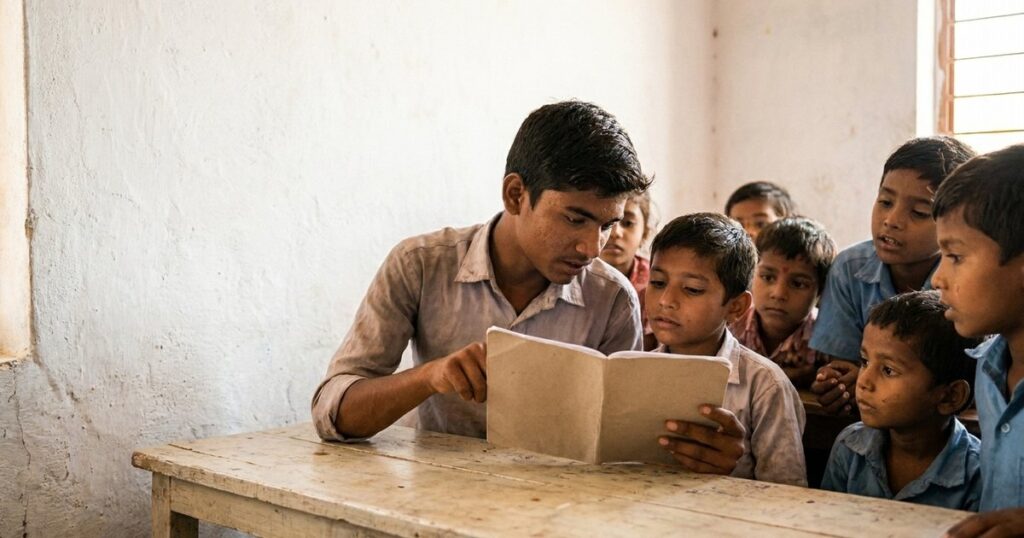
- Older students taught younger students, and children worked together with limited books.
- Students revised collective writing until it became clear and forceful.
- Daily newspapers connected schoolwork with politics, economics, and world events.
- The goal was to form sovereign citizens guided by the motto “I care.”
It is useful to recall the concrete practices, not only the critique.
They did not fail children. A child who had not mastered a skill stayed with it until mastery occurred. Promotion was not automatic, but neither was rejection. They ran long hours because the children needed the time; many came after work in the fields. Older students taught younger ones for substantial parts of the day. There was only one copy of many books; children crowded around it. They practised collective writing: drafts were read aloud, criticised, and revised until the prose was clear and forceful. They read the newspaper daily and discussed politics, economics, and the events of the world. They taught languages with seriousness, including languages useful for work abroad. They swam, they skied, they treated the body as part of education. The explicit goal was the formation of “sovereign citizens” who could understand and be understood, and who would use that power in the service of others.
The motto painted on the wall was “I care.” It was offered as the opposite of the fascist-era slogan “I don’t care.” School was not a private investment. It was a preparation for responsibility.
India already possesses fragments of this approach: dedicated teachers who stay late, organisations focused on foundational literacy, experiments with mother-tongue instruction, peer-learning programmes, and the rhetorical commitment in policy documents to moving beyond rote learning. What is missing at scale is the refusal to let children exit without having learned, the systematic use of peer teaching, the daily connection to the real world through newspapers and local issues, and the cultural decision that the school’s primary client is the child who arrives behind.
Frequently asked questions
What did Barbiana do when a child had not mastered a skill?
The child stayed with the skill until mastery occurred. Promotion was not automatic, but rejection was not automatic either.
How did students learn from one another at Barbiana?
Older students taught younger ones for substantial parts of the day. Children also worked together around the limited copies of books.
What was the purpose of reading newspapers at school?
Students read the newspaper daily and discussed politics, economics, and events in the world.
What does the Barbiana motto “I care” mean?
It expressed responsibility and was presented as the opposite of the fascist-era slogan “I don’t care.”