Part 10 of 15 in How to Find a Job: Stop queuing on portals. Show an employer the value you can add.← Part 9Part 11 →
This chapter focuses on the importance of providing proof of your skills and achievements to potential employers, rather than making promises. It is part of the series 'How to Find a Job: Stop queuing on portals. Show an employer the value you can add.'
- Employers doubt due to inflated credentials; proof is needed to gain trust.
- Proof should answer five questions about the work and its impact.
- Imran's real-world project demonstrated his skills and secured him a job.
- The best proof is work used by others, followed by real artefacts and practice pieces.
- Always seek permission before naming people or businesses in your proof.
Indian hiring has a trust problem, and graduates did not invent all of it. Inflated internships, bought projects, and identical final-year reports have trained employers to doubt. Your task is to be the person whose claim survives a phone call. Proof is how you do that. A promise is a sentence about the future. Proof is a trace of the past that a stranger can inspect.
The anatomy of one proof
Each item on the site, and each story in an interview, should be able to survive five questions.
- Where did this happen, and can I understand the place?
- What was worse before you touched it?
- What exactly did you do, as opposed to what the team did?
- What changed, in a number, a time, a complaint, or a quote?
- Who else saw it, and may I speak to them, or see the artefact?
You will not always have a dramatic number. “The owner stopped calling me on Sundays to find an invoice” is a result. “I learnt a lot” is not. If you did only part of the work, say which part. Partial truth is stronger than complete fog.
Imran’s shops
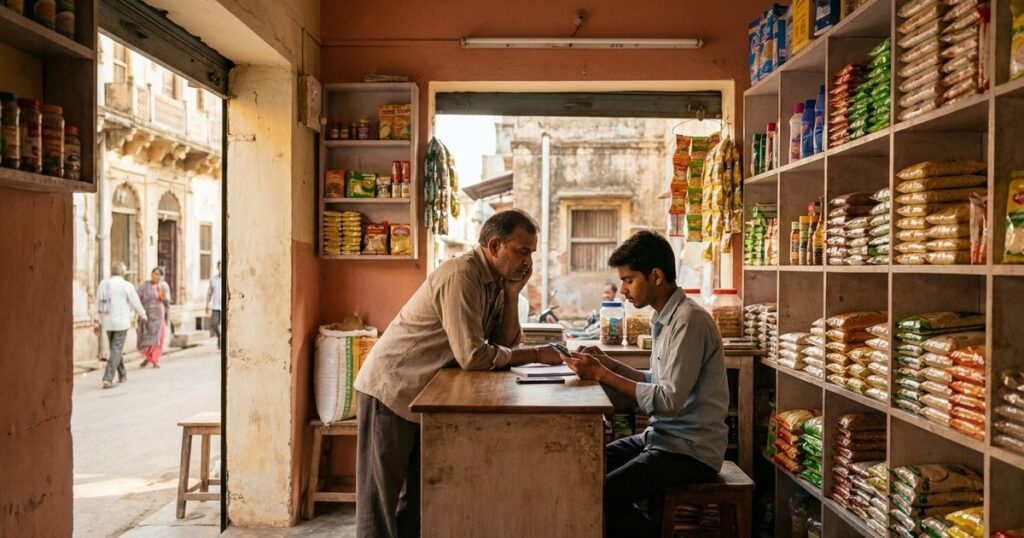
Imran studied computer science in Aurangabad. Service-company tests rejected him, mostly on the timed sections he had not drilled. He was good at sitting with people and bad at pretending a tutorial project was a product. Three kirana shops on his lane took orders on WhatsApp and lost them when the phone changed hands at the counter. He built a plain tracker: a form the helper could fill, a list the owner could see at night, a daily total. He ran it for a month. Missed orders, by the owners’ own count, fell. He put screenshots on his site, with the shop names shortened, and a note that the owners would confirm the work.
A retail-tech startup in Pune did not need another graduate who had cloned a to-do app. They needed someone who would sit in a store and not be frightened by the owner. Imran’s page made that obvious. His title became implementation associate. His Python was average. His proof was not.
What counts, in descending order
The best proof is work someone used, with their consent to say so. Next is work you did on a real artefact that you can show redacted: a cleaned sheet, a translated brochure, a fixture, a lesson plan that was taught, a reconciliation, a small tool. Next is a serious practice piece, clearly labelled as practice, built on public data or on a problem you documented yourself. Last, and almost useless alone, is a certificate of attendance.
College projects can rise in this list if you remove the padding. A project that was four friends and a downloaded report should not be on the page. A project where you can show your module, the failure you hit, and the fix, can stay. Label the group work honestly. Interviewers in India ask “what was your part?” within the first ten minutes, because they have met the other kind.
Numbers without fiction
Measure something, even if it is small. Time on a task before and after. Errors per twenty invoices. Calls that no longer come. Pages a reader can finish. Scrap on one step. If you do not have a before, start the measurement now and let the proof grow. Do not borrow a number from a case study you read. The person across the table may have read it too.
Sana and the jewellery counter
Sana’s proofs were sentences. She published the eight rewritten descriptions, with the owner’s permission, next to the older text, and a short note on what she had refused to claim about the stones. She added a one-page voice guide: words the counter used, words it should not use, how to answer “is this real?” without insulting the buyer. A Gurgaon brand selling into the same kind of customer found the page through a mutual college senior. They did not need a strategist. They needed someone who would not embarrass the product. Sana worked remotely, with two days a month in the city. Her family had wanted a bank exam. She kept sitting the exam, and she also had an income and a page that got stronger every month. The page made the dual path possible. A resume alone would have forced a false choice.
Permission
Ask before you name a shop, a patient, a client or a classmate. Offer to show them the paragraph. Most owners agree if you offer to hide the name. A refusal is a no. Build the next proof somewhere else.
Frequently asked questions
Why is proof important in job applications?
Proof is important because it builds trust with employers who are skeptical due to inflated credentials and identical projects.
What makes a strong proof of work?
A strong proof includes work used by others, real artefacts, or well-documented practice pieces, and can answer key questions about its impact.
How did Imran secure his job?
Imran secured his job by showcasing a real-world project he completed, which demonstrated his practical skills and problem-solving ability.
Can I use college projects as proof?
College projects can be used if they are free of padding and clearly show your contribution, challenges faced, and solutions implemented.