Part 5 of 14 in How Social Impact Startups Build on Success: A Positive Deviance Guide for Indian Founders← Part 4Part 6 →
This chapter shows how positive deviance can improve education, farming, women’s livelihoods, dairy cooperatives and energy access in India. It helps startups find effective practices already working within communities and adapt them for wider use.
- A school-based programme improved meal quality, vegetable use, storage, teacher monitoring and handwashing without additional budget.
- Positive Deviance helped redesign Bihar farming systems using locally practised combinations of crops and livestock.
- Successful rural women entrepreneurs used communication, networks, negotiation and storytelling practices that others could replicate.
- Amul scaled farmer-owned dairy practices, while SELCO built energy access around financing, service and customer needs.
- Across sectors, studying people already achieving better results can guide solutions that work within local constraints.
Mid-Day Meal Programme in Urban Schools
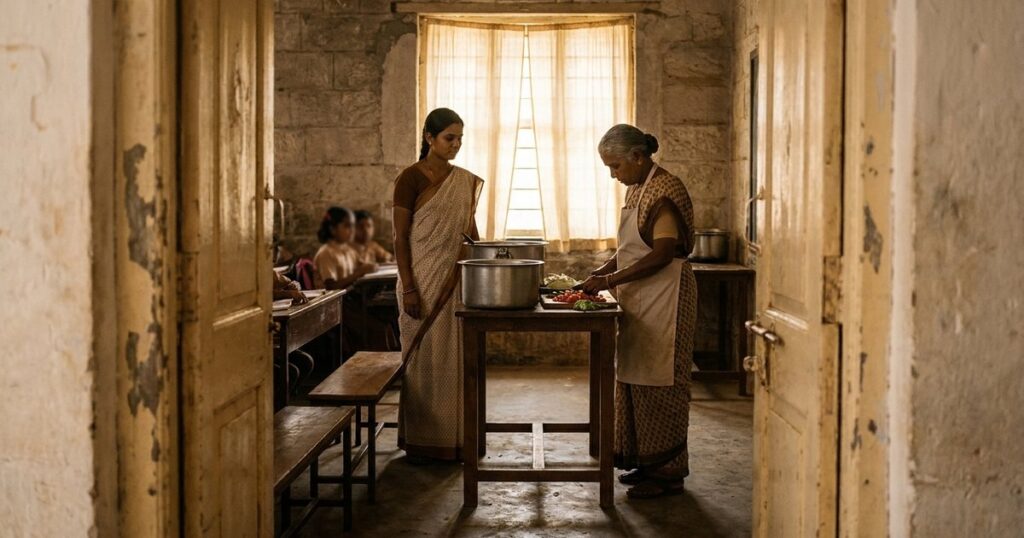
In an urban Indian city, researchers studied the Mid-Day Meal Programme across government-aided primary schools. They identified positive and negative deviant practices related to food handling, menu quality, vegetable use, storage, sanitation, hygiene and teacher monitoring. One school scored highest on ideal practice measures and was treated as the positive deviant.
A behaviour change communication package based on the positive deviant practices was delivered to the other schools over two months, involving teachers, mid-day meal staff and students. Post-intervention improvements were observed in menu quality (86 percent), usage of vegetables (71 percent), good storage practices (57 percent), monitoring by teachers (42 percent) and handwashing prior to meals (42 percent). The approach required no additional budget. It used practices already present in one school and made them visible and practicable in others.
Farming Systems in Bihar
A study of smallholder farms in Bihar used a Positive Deviance approach to inform farming systems redesign. Researchers surveyed 43 farms and looked at operating profit, soil organic matter balance, water use and dietary energy production. Positive deviant farms and practices were identified and then recombined into redesigned farm systems in consultation with farmers.
Outstanding performance on all indicators required integrating higher livestock density with an optimal combination of crop practices. The redesigned systems outperformed all real farms on the assessed indicators. Farmers confirmed the viability of the redesigns in focus group discussions. Because all the component practices were already practised locally, they were accessible, affordable and recognisable. The study demonstrated that Positive Deviance can be used not only for nutrition but for redesigning entire farming systems under resource constraints.
Rural Women Entrepreneurs in Uttar Pradesh
From an initial pool of more than 21,000 rural women who received microloans for income generation, researchers used successive rounds of focus group conversations with over 1,100 women to identify 24 positive deviant entrepreneurs who succeeded against overwhelming odds. Their uncommon communicative practices included specific ways of building networks, negotiating with family and customers, and using storytelling and persuasion techniques that worked in their context.
These practices were discoverable within the same community of women entrepreneurs and were judged to be replicable by others who faced the same constraints. For startups working on women’s livelihoods, SHG strengthening or micro-enterprise, this study shows that the communication and relationship practices of successful women entrepreneurs are a rich source of locally grounded solutions.
Amul and the Cooperative Model
While not a formal Positive Deviance project, the Amul story illustrates the same underlying principle at scale. In 1946, dairy farmers in Anand, Gujarat, facing exploitation by middlemen, created a cooperative that bought all the milk its members produced every day and returned a high share of the consumer price to the farmers. The three-tier Anand pattern — village societies, district unions, and a state federation with professional management — combined farmer ownership with commercial competitiveness.
Amul and the broader Operation Flood programme turned India into the world’s largest milk producer. Farmers receive roughly 75–85 percent of the consumer rupee, far higher than typical private dairy chains. The practices that made the difference — daily purchase of all milk, transparent fat-based pricing, veterinary and feed services, and separation of ownership from professional management — were developed and owned by the farmers themselves. Other states later adapted the model (Nandini, Verka, Milma, Saras). The lesson for startups is that when producers own the solution and practise it collectively, the results can scale nationally.
SELCO and Energy Access
SELCO India, founded by Harish Hande in 1995, is another Indian example of an organisation that succeeded by focusing on what works for poor households rather than importing standard energy models. SELCO built a for-profit social enterprise that sells, installs and services solar home systems and productive-use appliances, financed through local banks and microfinance institutions. Poor customers repay the loans. Local energy service centres provide after-sales support.
The model rejected free or heavily subsidised systems that go unmaintained. It treated the poor as customers who can pay for assets that generate income or improve quality of life. Over more than two decades SELCO and its foundation have reached hundreds of thousands of households and institutions. The practices — patient capital, local service networks, financing linked to cash flows, and customised small-scale solutions — were developed in response to what actually worked for rural customers in India. Startups in energy, livelihoods and productive-use technology can study SELCO’s positive deviant customers and partners to understand which financing and service practices enable sustained adoption.
Across education, agriculture, women’s entrepreneurship, dairy cooperatives and energy access, the pattern holds. Somewhere inside the constrained environment are people and organisations already achieving better results. Studying them and creating processes for others to practise their approaches is more powerful than designing solutions from the outside.
Frequently asked questions
How did Positive Deviance improve India’s Mid-Day Meal Programme?
Researchers identified effective food handling, menu, storage, sanitation, hygiene and monitoring practices in one school. Other schools adopted them through a two-month behaviour change communication package without additional budget.
How was Positive Deviance used in Bihar farming systems?
Researchers studied 43 farms, identified positive deviant practices and combined them into redesigned systems with farmers. The redesigns outperformed all assessed real farms on operating profit, soil organic matter balance, water use and dietary energy production.
What can startups learn from rural women entrepreneurs in Uttar Pradesh?
Researchers identified 24 successful entrepreneurs from more than 21,000 microloan recipients. Their network-building, negotiation, storytelling and persuasion practices were locally grounded and judged replicable by women facing similar constraints.
What do Amul and SELCO show about scaling social impact?
Amul shows how collective producer ownership and professional management can scale nationally. SELCO shows the value of patient capital, local service networks, cash-flow-linked financing and customised small-scale energy solutions.