Part 3 of 14 in How Social Impact Startups Build on Success: A Positive Deviance Guide for Indian Founders← Part 2Part 4 →
This chapter explains the six-step Positive Deviance process and how Indian startups can adapt it while keeping community ownership central. It helps founders identify locally available practices that lead to better outcomes and support communities in adopting them.
- Define a specific, measurable problem that the community recognises as important.
- Document common behaviours and use existing data to establish a shared baseline.
- Find positive deviants who achieve better outcomes without extra resources or clear advantages.
- Observe positive deviants closely to discover accessible, uncommon practices.
- Create community-led spaces for practising successful behaviours, then monitor, celebrate and share results.
The classic Positive Deviance process has six steps. Indian startups can adapt them without losing the core logic of community ownership.
Step 1: Define the Problem Clearly
Make it specific, measurable and widely felt. “Child undernutrition in our blocks is high” is better than “poverty is bad.” “Only 30 percent of girls in these villages complete Class 8” is actionable. “Loan repayment rates in these SHGs are below 80 percent” gives a clear target. The problem must be one that the community itself recognises as important. If the community does not care, the process will not generate ownership.
Good problem definitions for Indian startups include: low exclusive breastfeeding rates in specific blocks; high dropout of girls after Class 5 in tribal areas; low adoption of recommended complementary feeding practices; high default rates among first-time borrowers; low yield of a particular crop under rainfed conditions; poor handwashing compliance in Anganwadi centres; low utilisation of government health services by high-risk pregnant women.
Step 2: Determine Common Practices
What do most people do? Document the dominant behaviours around feeding, school attendance, handwashing, fertiliser use, repayment, healthcare seeking, or whatever the problem domain is. This sets the baseline against which deviance is measured. Use existing data where possible (ICDS registers, school attendance, loan records) and supplement with rapid community mapping or focus group discussions.
The goal is not a perfect scientific baseline. It is a shared understanding of “what most of us do here.” That shared understanding makes the uncommon practices of positive deviants visible and surprising.
Step 3: Identify Positive Deviants
Use existing data or simple community mapping to find individuals, families, teachers, ASHAs, farmers, SHG leaders or even entire villages that achieve better outcomes without extra resources. In nutrition, look for children who are normal weight-for-age in communities where most children are underweight. In education, look for teachers whose students show higher learning gains with the same materials and class sizes. In agriculture, look for farmers who maintain better soil health or higher yields under the same rainfall and land constraints.
Exclude anyone who has clear advantages. The mother whose brother is a doctor, the farmer with an extra acre of irrigated land, the teacher who received special training from an NGO — these are not positive deviants for the purpose of this method. The practices must be accessible to neighbours who share the same constraints.
Step 4: Discover Uncommon Practices
This is done through careful observation and conversation, not through questionnaires alone. Spend time with the positive deviants. Watch what they do. Ask “how” and “why” repeatedly. The practices must be accessible to others — no extra land, no special education, no extra money, no outside expertise.
In the Vietnam case the practices were collecting shrimp and crabs, using sweet potato greens, and feeding more frequently. In Indian nutrition studies the practices have included earlier initiation of breastfeeding, avoidance of prelacteals, thicker complementary foods, active feeding, and specific hygiene behaviours. The discovery process must be open. Do not go in with a list of practices you expect to find.
Step 5: Design a Community Process for Practice
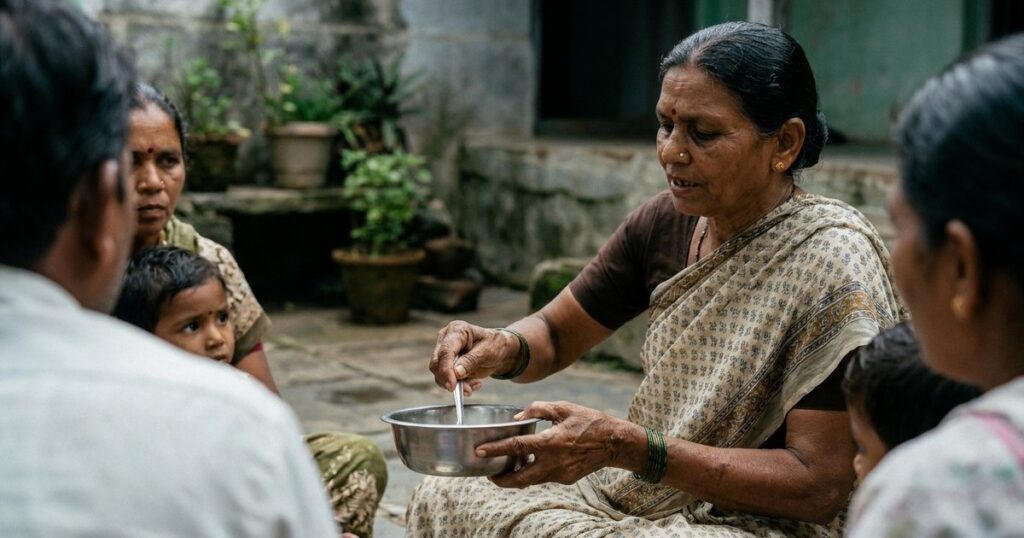
The community must discover and practise the behaviours themselves. The classic tool is the “Hearth” model for nutrition: mothers of malnourished children cook and feed together using the positive deviant practices for 12–15 days, while learning from the successful mothers. Ownership is the key. The external organisation facilitates the space and the process; it does not teach the solution.
Indian adaptations include teacher circles where positive deviant teachers demonstrate classroom practices, farmer field days organised by positive deviant farmers, ASHA peer groups, and SHG meetings where successful members share their repayment or livelihood practices. The form should fit the community’s existing social structures.
Step 6: Monitor, Celebrate and Amplify
Track results using the same measures used to identify the problem. Celebrate early wins publicly inside the community. Help the community teach others. Do not let the external organisation become the permanent owner of the solution. The goal is that the community continues the process after the startup or NGO steps back.
The golden rule: The community must own the discovery and the practice. If the startup becomes the expert who “teaches” the solution, the method fails. The technical practices are necessary but not sufficient. The social process of discovery and practice is what creates lasting change.
Frequently asked questions
What are the six steps of the Positive Deviance process?
The steps are defining the problem, determining common practices, identifying positive deviants, discovering uncommon practices, designing a community practice process, and monitoring, celebrating and amplifying results.
How do you identify positive deviants?
Use existing data or community mapping to find people or villages achieving better outcomes without extra resources. Exclude those with clear advantages that neighbours do not share.
What is the Hearth model in Positive Deviance?
Mothers of malnourished children cook and feed together for 12 to 15 days using positive deviant practices while learning from successful mothers.
Why is community ownership important in Positive Deviance?
The community must discover and practise the behaviours itself. If the startup becomes the expert teaching the solution, the method fails.