Part 2 of 12 in Career Counselling: A Free Guide for Indian Students← Part 1Part 3 →
Career choices in India are often shaped by family expectations, financial concerns, and social comparisons. This chapter helps students and families consider newer career options and test possible paths through practical, low-risk experiments.
- Indian families often treat career decisions as collective matters shaped by security and social respect.
- Traditional career advice has not kept pace with newer fields such as product management, UX design, and data science.
- Passion often develops after gaining competence and seeing the real-world impact of work.
- Testing several possible futures can be more useful than waiting for one clear passion.
- Rohan used courses, freelance projects, and conversations with designers to move from engineering toward UX design.
The Indian Career Reality
In most Indian middle-class and upper-middle-class families, career choices are treated as collective family matters rather than purely individual ones. Parents who themselves navigated financial or social constraints often prioritise security and social respect for their children. Relatives compare board examination marks, entrance ranks, and placement packages with remarkable intensity. Coaching institutes invest heavily in marketing the prestige of certain institutions and streams. The cumulative effect is that large numbers of students enter colleges and courses they did not actively select for themselves.
This system is not entirely wrong. Parental concern is genuine, and economic security continues to matter in a country where many families have limited safety nets. At the same time, the landscape of work has expanded faster than traditional advice has kept pace. Beyond conventional government and corporate jobs, new fields have become viable: product management, user experience design, data science, climate and sustainability roles, educational content creation, freelancing, and startup careers. Many of these paths were not visible or did not even have clear names when today’s parents were choosing their own careers.
Moving Beyond Find Your Passion
Burnett and Evans argue that waiting to find your passion is an unreliable strategy for most people. Very few teenagers possess a single clear passion that maps cleanly onto a specific occupation. Passion more often emerges after a person becomes reasonably competent at something and begins to see the real-world impact of their work. A more effective approach is to design several possible futures and test them through small, low-risk experiments rather than betting everything on one assumed path.
Case Study: Rohan from Indore
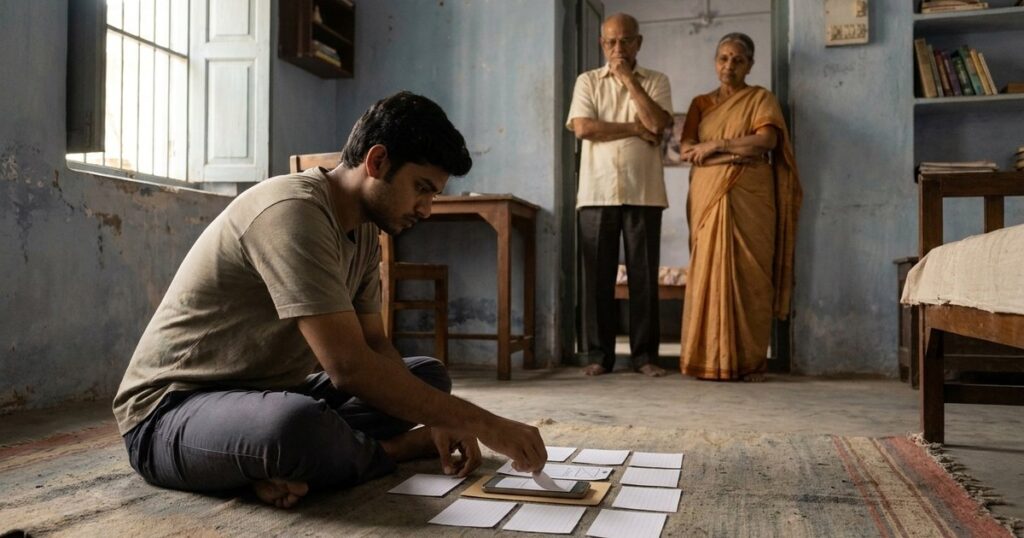
Rohan scored 94 percent in Class 12 and joined a reputable private engineering college because, as he put it, that is what everyone does after science. By his second year in mechanical engineering he felt increasingly disengaged. He had long enjoyed visual storytelling and explaining ideas through sketches, yet he had never treated these interests as career-relevant. When he began prototyping—completing free design courses, taking small freelance projects for local businesses, and speaking with working designers—he discovered a direction that combined his technical background with creative work. He now works as a UX designer in Bengaluru. The shift did not come from a sudden revelation of hidden passion. It came from deliberate, low-risk testing of a possible future while he was still in college and gathering real evidence that he could share with his family.
Frequently asked questions
Why are career choices treated as family matters in India?
Parents often prioritise security and social respect because they have faced financial or social constraints. Relatives and coaching institutes also influence choices through comparisons and prestige.
Is waiting to find your passion a reliable career strategy?
Burnett and Evans argue that it is unreliable for most people. Passion often emerges after someone becomes reasonably competent and sees the real-world impact of their work.
How can students test a possible career without taking a major risk?
Students can use small experiments such as free courses, small freelance projects, and conversations with people working in the field.
How did Rohan become a UX designer?
Rohan tested design through courses, freelance projects for local businesses, and conversations with working designers. He combined his technical background with creative work and now works as a UX designer in Bengaluru.