Part 2 of 19 in Why Schools are Broken: and How to Fix Them← Part 1Part 3 →
This chapter examines how compulsory schooling can keep young people in classrooms without giving them useful learning. It helps readers understand the educational, economic and psychological costs of long schooling in India.
- Compulsory attendance can extend schooling beyond the point where formal instruction helps students.
- Schools may sort students, delay entry into work and teach obedience rather than useful knowledge.
- Ramesh attends a government school but mainly copies notes and memorises definitions without understanding concepts.
- Time spent in an unproductive classroom can replace learning trades, practising skills or becoming economically independent.
- Constant ranking can make students feel inadequate and discourage them from asking questions.
Too Much Schooling, Too Little Learning
Paul Goodman observed that American society had come to require far more schooling than was necessary for young people to become competent adults. Compulsory attendance laws, he wrote, kept teenagers in classrooms long after the point at which further formal instruction stopped helping them and began harming them. The same pattern is now visible across India.
In India, the Right to Education Act made elementary education free and compulsory. Secondary enrolment has risen sharply. College enrolment has exploded. On paper, this looks like progress. In classrooms, the picture is different. ASER reports have shown for years that a large fraction of Class 5 children cannot read a Class 2 text or do basic arithmetic. The same children are expected to stay in school for another decade.
Goodman argued that much of this extra schooling serves functions other than education. It keeps young people off the streets and out of the labour market while the economy cannot absorb them. It sorts them into ranks that employers can use as a cheap screening device. It trains them in habits of obedience and punctuality that large organisations value. Indian parents recognise these functions immediately. The board exam is less a test of knowledge than a sorting machine. The degree is less a certificate of skill than a filter that tells employers the candidate has endured the system.
An Indian Story: Ramesh in a Government School
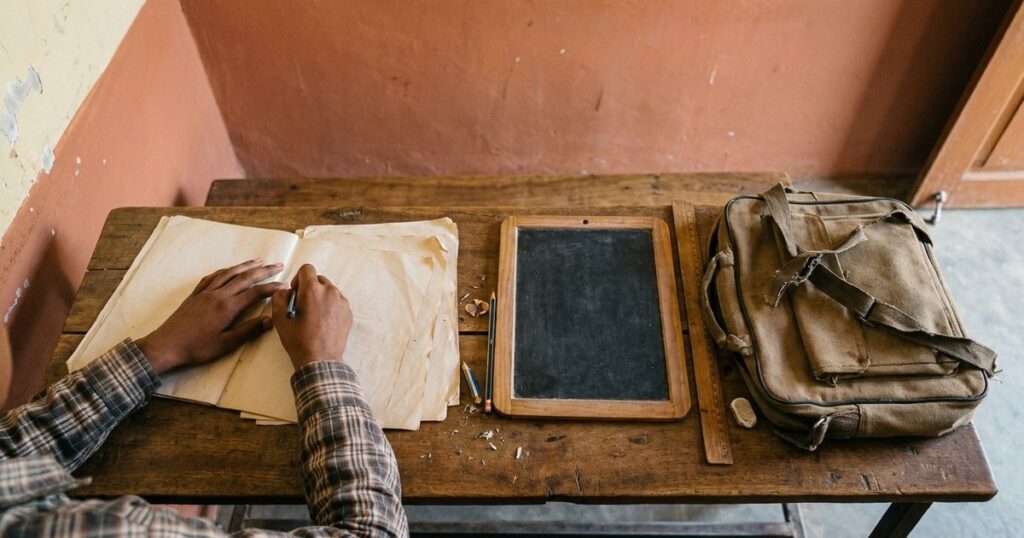
Ramesh lives in a small town in Uttar Pradesh. He is 14. He attends a government secondary school. The teacher is often absent. When present, the teacher reads from a textbook or writes notes on the board while students copy. There is almost no discussion. Ramesh can recite definitions but cannot explain concepts in his own words. His parents keep him in school because a Class 10 certificate is required for most formal jobs, and because they fear that if he leaves school he will be seen as a failure.
Ramesh is not learning much that he values. He is, however, being kept off the labour market for several more years. His parents are spending money on books, uniforms and private tuition that could have been used differently. Goodman would have recognised this situation at once. The school is performing its institutional function; it is not performing an educational one.
The Opportunity Cost
Every year a young person spends in a classroom that teaches little is a year not spent learning a trade, starting a small business, reading widely, or practising a skill under a master. In a poor country, this opportunity cost is especially high. A 16-year-old who can read, write and calculate can already be useful in many family enterprises or local workshops. Forcing that 16-year-old to continue in an unproductive classroom delays the moment when he or she becomes economically independent and confident.
Goodman proposed letting some young people leave school earlier, or attend only part-time, provided they had other worthwhile things to do. In India, legal and social barriers make this difficult. Yet the underlying logic remains sound. Compulsory long schooling is not the same thing as education. It can be its opposite.
The Psychological Cost
Beyond lost time, compulsory schooling that does not engage young people exacts a psychological cost. Children who spend years being told, explicitly or implicitly, that they are slow, or that their questions are irrelevant, or that the only measure of worth is a mark, often internalise a sense of inadequacy. This is especially damaging for children from poorer backgrounds who already face other disadvantages. Goodman saw this as a form of institutional violence against the spirit of the young.
In Indian classrooms, the constant ranking of students creates winners and losers from an early age. The top few are praised; the rest learn to hide. Many stop asking questions by Class 6 or 7. The system has succeeded in producing quiet, compliant students. It has failed to produce confident learners.
Frequently asked questions
How does compulsory schooling affect learning in India?
It can keep students in school for years even when they are not gaining basic reading, writing or arithmetic skills.
Why do Indian parents keep children in school despite poor learning?
A Class 10 certificate is required for most formal jobs, and leaving school may be seen as failure.
What is the opportunity cost of long schooling?
Time in an unproductive classroom could instead be spent learning a trade, starting a small business, reading widely or practising a skill under a master.
What psychological harm can compulsory schooling cause?
Students may internalise inadequacy, stop asking questions and learn to hide when constant ranking makes them feel like losers.