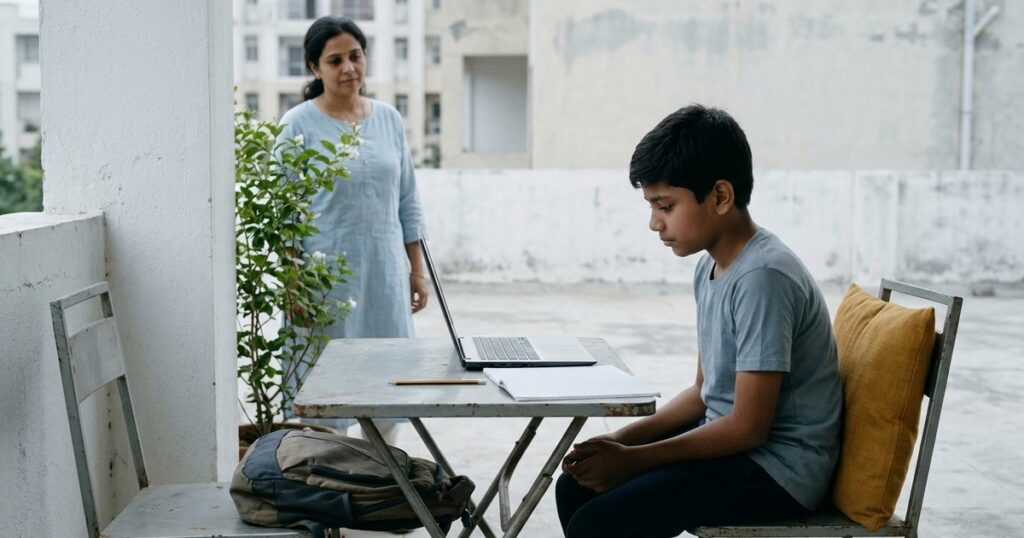
A parent told me recently that her son was finishing his mathematics homework in fifteen minutes. Earlier, the same worksheet had taken him nearly an hour.
She was pleased at first. Who would not be? The child was less frustrated, the parent had fewer arguments to endure, and the homework was submitted on time. Then she asked him to solve one of the questions again, without the laptop.
He could not.
He had not learnt mathematics faster. He had learnt how to obtain an answer faster.
This distinction matters. I have spent much of my professional life watching people confuse a good outcome with a good process. In my IVF clinic, a pregnancy test is not the same thing as a healthy pregnancy, and a healthy pregnancy is not the same thing as a healthy baby. Each apparent success needs to be examined more carefully. Education is no different. A completed worksheet may conceal a child who is becoming less capable of thinking independently.
I am enthusiastic about AI tutors. I think they can do something a classroom teacher often cannot: give a shy child a private place to admit, “I don’t understand.” But I am increasingly worried that we are measuring the wrong thing. We are asking whether the child got the answer. We should be asking whether the child noticed the moment when she did not know how to get there.
The most dangerous AI tutor is not the one that gives a wrong answer. It is the one that gives a correct answer so quickly that the child stops noticing her own confusion.
The quiet disappearance of questions
Young children ask questions continuously. They ask why the sky changes colour, why a lizard can climb a wall, why a brother gets more mango, and why a parent is allowed to use a phone during dinner. Their curiosity is inconvenient, repetitive and alive.
Then, somewhere around middle school, many children become quieter. They may still be curious, but they stop displaying it publicly. In a classroom, a teacher asks whether everyone has understood. A few hands go up. Most children look down at their notebooks.
This does not mean that most children have understood. It often means that they have understood that asking a question has a social price.
The child may worry that the question is foolish. She may believe that everyone else has understood. She may not want thirty classmates turning around to look at her. She may have asked once before and received an impatient response. Or she may simply need more time than the lesson allows.
Research on the spotlight effect shows that people overestimate how much other people notice and judge them. In a classroom, this feeling is powerful even when it is objectively misplaced. A child who thinks, “Everyone will know I am stupid,” does not care that her classmates are probably worrying about themselves.
There is another odd classroom effect. If nobody asks a question, each child assumes that she is the only one who is confused. The room becomes silent because everyone is independently hiding the same uncertainty.
I see a similar pattern in medicine. A patient may nod through an explanation about ovarian stimulation, embryo quality or a medication schedule because she does not want to appear ignorant. Later, she misses a dose or follows the instructions incorrectly. When I ask why she did not stop me, she often says, “I thought I was the only one who had not understood.”
Silence is not evidence of understanding. It is often evidence that the person does not feel safe enough to reveal uncertainty.
Why an AI tutor can be genuinely helpful
This is where an AI tutor has a real advantage. A child sitting alone with a screen does not have to raise a hand. There is no classmate watching. There is no teacher who has already explained the same thing twice. The child can ask the same question in five different ways.
“Why do I carry the one?”
“Why cannot I add the denominators?”
“What does this word mean?”
“Can you explain it like I am in Class 5?”
These are not trivial questions. They are the raw material of learning.
A good tutor also has patience. A human teacher managing forty students cannot always pause for every child who is lost in fractions. A private tutor may be unaffordable. An AI system can repeat an explanation without embarrassment or irritation.
I have written earlier about what I would look for in an AI tutor. The central test is not whether it can produce a polished solution. It is whether it can help the child produce the solution herself.
That distinction separates a tutor from an answer engine.
An answer engine rewards the child for asking, “What is the answer?” A tutor should help the child ask, “What do I know? What do I not know? What should I try next?”
The first interaction feels efficient. The second builds a mind.
The trap of fast homework
Parents are understandably vulnerable to speed. Indian school life is crowded with worksheets, tuition, tests, projects and examinations. When a child completes homework in fifteen minutes instead of forty-five, it feels like a small household miracle.
But speed is ambiguous.
| What the parent sees | What may actually be happening | What I would check |
|---|---|---|
| Homework is completed quickly | The AI has supplied the method or answer | Can the child solve a similar problem without help? |
| The child makes fewer mistakes | The child is copying rather than reasoning | Can she explain why each step was used? |
| The child asks fewer questions | The child may have stopped noticing confusion | Does she volunteer questions when the AI is unavailable? |
| The worksheet looks neat | The thinking has moved off the page and perhaps out of the child’s head | Is there working on paper that belongs to the child? |
| Grades remain steady | The child may be dependent on assistance that examinations do not provide | Can she perform under timed, AI-free conditions? |
The most revealing test is simple. Take a question the child solved with AI assistance. Change the numbers, alter the wording, or ask her to explain the first step. Then put the device away.
If she can explain the reasoning, the AI probably helped. If she remembers only the final answer, the AI did the work while the child watched.
This is not a moral failing. Children naturally choose the path of least resistance, especially when adults reward completion rather than understanding. I would do the same if someone offered to prepare my tax return, write my emails and explain the result only if asked.
The problem is that education is not a transaction in which the answer is the product. The thinking is the product.
The dangerous moment is not when the child asks for help
There is a subtle mistake in how we talk about AI dependence. We worry when a child asks the AI for help. We should worry more when the child no longer knows what help to ask for.
A child who types, “I do not understand why this is a quadratic equation,” has noticed a gap. That is healthy. A child who types the entire question and accepts the answer without examining it may not even know that a gap exists.
This is why I chose the title of this post. An AI tutor can respond to a question, but it cannot reliably notice the question that has disappeared.
It can see that the child has been inactive for three minutes. It can see that she has copied a problem into the chat. It can see that she has requested a solution. But it cannot always know whether she is quietly confused, bored, embarrassed, distracted or simply trying to finish before dinner.
It may infer these things from patterns, but inference is not observation. A teacher who knows a child over months may notice that her eyes have glazed over, that she has stopped making her usual jokes, or that she is copying from the board without writing anything of her own. A parent may recognise the particular silence that means, “I am lost but I do not want to say so.” An AI sees text, timing and clicks. Those are useful signals, but they are not the child.
I have seen the same limitation in clinical decision-support systems. A machine may flag an abnormal hormone value, but it does not see the patient’s face when I explain what it means. It does not notice that a couple has stopped asking questions because they are overwhelmed. The numbers matter, but the unspoken response matters too.
How I would use an AI tutor at home
I would not ban AI from homework. That would be as sensible as banning calculators because some children use them before learning arithmetic. I would change the rules of use.
The order matters.
-
The child attempts the problem first. Not a performance of effort, but a real attempt. She should write down what she knows, what she tried and where she became stuck. For a simple problem, this may take two minutes. The point is to make the child encounter the problem before outsourcing it.
-
The child asks for a hint, not a solution. The prompt should be, “Give me one clue,” or “Ask me a question that will help me continue.” If the tutor immediately provides the complete answer, I would change the tool or its settings. A system that cannot withhold the answer is not suitable for independent learning.
-
The child works on paper. The AI can be on the screen, but the reasoning should appear in the child’s handwriting. This is not nostalgia. Writing forces the child to commit to a step, making it easier for both parent and child to see where the reasoning went wrong.
-
The child explains the solution afterwards. Once the problem is complete, I would ask, “Why did you choose this method?” Not, “What is the answer?” The explanation is the examination. If the child cannot explain it, the question is not finished.
-
The child solves a related problem without AI. This need not become another exhausting test. One similar question is often enough to reveal whether the first solution was understood or merely obtained.
I would also keep one regular period of AI-free practice. Not because technology is bad, but because dependence is easy to miss when the technology is always available. A child should occasionally experience the productive discomfort of being stuck and then learn to work through it.
My rule would be: AI may provide a hint, but the child must provide the working, the explanation and the final check.
Parents should watch the questions, not just the marks
Most parents monitor grades. Grades are visible, comparable and easy to discuss with relatives. Curiosity is harder to measure.
I would ask different questions.
Does my child still ask “why” when the answer is not immediately available? Does she challenge an explanation? Does she notice when two answers conflict? Does she attempt a problem before searching for a solution? Can she say, “I do not understand this part,” with enough precision to receive useful help?
These are signs of an active learner.
The opposite signs are also visible. Homework becomes suspiciously quick. The child resists writing working. She becomes anxious when the device is removed. She can reproduce an answer but cannot explain it. She asks the AI to rewrite a paragraph but cannot discuss the paragraph. She stops making mistakes in homework and then performs poorly in an examination.
That last pattern should not surprise us. Mistakes are not merely errors to eliminate. They are information about the child’s thinking. If an AI corrects every mistake before the child has had time to inspect it, the child loses the chance to learn how errors arise.
In my clinic, I do not reassure a patient by hiding an inconvenient test result. I show her what is happening and explain what it means. A child also needs to see the imperfect working, the crossed-out attempt and the wrong turn. A spotless worksheet can be less educational than a messy one.
The design question for founders
I meet many founders building products for children, and I often ask them what their tutor optimises for. Is it completion? Session length? Correct answers? Parent satisfaction? Test scores?
These are not interchangeable.
If the product is rewarded for making homework disappear, it will eventually discover that the fastest way to satisfy the user is to do the homework. If it is rewarded for keeping the child engaged, it may become entertaining without being demanding. If it is rewarded for correctness, it may avoid allowing the child to struggle.
The founder’s real job is to decide which difficulty must remain.
A useful tutor should remove the social difficulty of asking a question while preserving the intellectual difficulty of answering it. That is a delicate balance. The child should feel safe, but not be allowed to remain passive. The tutor should be patient, but not indulgent. It should explain, but not perform the child’s thinking.
I would like to see systems that occasionally pause and ask:
“What part of this do you think you understand?”
“Which step feels uncertain?”
“Can you solve a similar example before I show you more?”
“What would make you change your answer?”
These prompts are less impressive than a beautifully formatted solution. They are also more likely to produce learning.
A tutor should also be candid about its own limits. I have written about why an AI tutor should explain its mistakes rather than pretending to know everything. A child who is learning to question an AI is learning a useful habit for life. A child who assumes that fluent language means truth is learning a dangerous one.
What schools should not do
Schools will be tempted to respond to AI by banning it, policing it or asking children to produce more handwritten work. Some of that may be necessary during examinations, but it will not solve the underlying problem.
A child who has learnt to hide confusion will hide it with or without AI.
Teachers need time to ask children to explain their reasoning. They need permission to value a good question even when it interrupts the lesson. They need classrooms where “I do not understand” is treated as useful information rather than as a delay.
The teacher’s role becomes more important, not less, when a private AI tutor is available. The teacher is the person who can connect one child’s confusion to the learning of the whole class. If six students are separately asking an AI why denominators cannot be added, the teacher should know that the class has a conceptual problem, not six individual homework problems.
Schools should also assess explanation, transfer and unaided performance. If every assessment rewards the final answer, students and tutors will optimise for the final answer. Ask a child to solve a new problem, compare two methods, identify a mistake or teach the concept to somebody else. These tasks make shallow learning visible.
I am not arguing that every child must struggle alone. That would be cruel and inefficient. Good teaching has always involved assistance. The question is whether assistance leaves the child more capable or more dependent.
The test I would use
When I evaluate an AI tutor, I would not begin by asking whether it can solve a difficult problem. That is now a low bar. I would watch what happens after the child makes a mistake.
Does the system simply replace the wrong answer with the right one? Does it ask the child to locate the step where the reasoning changed direction? Does it give one hint and wait? Does it notice repeated requests for answers? Does it ask the child to close the chat and try independently? Does it tell the parent that the child is completing work quickly but showing little evidence of understanding?
Most importantly, does it help the child become better at asking questions?
That is the measure I care about. Not how many questions the AI answers, but how many better questions the child asks next week.
I have written elsewhere about the need to build for the child in the back row. The child in the back row is not always inattentive. She may be frightened of being exposed. A private AI tutor can give her a first voice. But if we are careless, it can also give her a quiet way to disappear from her own education.
That is the paradox we need to hold in our heads. The best AI tutor may be the one that makes the child ask more questions, not the one that makes homework finish sooner.
When I ask a child to explain a problem, I do not need a perfect answer. I want to see the hesitation, the uncertainty and the moment when she says, “Wait, I think I made a mistake here.” That sentence is evidence that learning is happening.
If the AI has made the worksheet perfect but has removed that sentence, it has not taught the child. It has merely hidden the patient from the doctor.