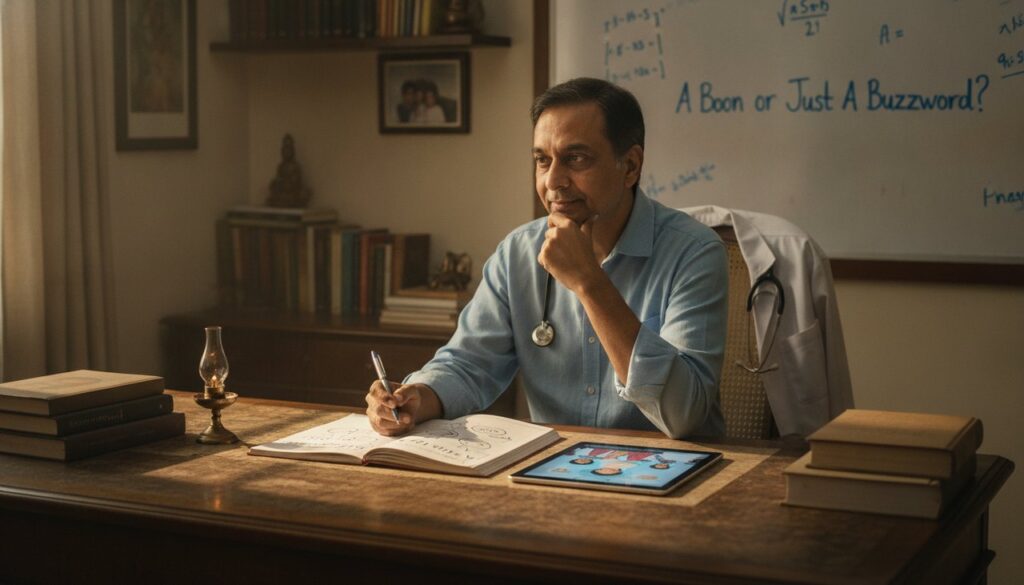
Title: AI in My Kids’ Classroom: A Boon or Just a Buzzword?
I was sipping my morning chai while sifting through a slew of emails when my daughter burst into the room, bubbling with excitement about a new AI tool her school had introduced. It struck me then how AI had quietly crept into our lives. As both an IVF specialist and an angel investor, I’ve always straddled the line between science and technology. But this intersection of AI and education caught me by surprise.
As a father, I find myself both intrigued and cautious. It’s not every day that your child’s classroom becomes a testing ground for technology that even adults are grappling to fully understand. Here, I find myself asking: Is AI truly a boon for education, or just another buzzword that’s being bandied about with more enthusiasm than substance?
The optimistic view is crystal clear. Imagine AI as a tireless assistant, ready to personalize learning experiences for each student. The idea of AI as a “personal tutor” is appealing—who wouldn’t want their child to have access to a mentor with infinite patience and adaptability? It brings to mind Bloom’s 2 Sigma problem, where students with personal tutors outperformed their peers. AI promises to bridge this gap, providing tailored educational experiences without the prohibitive costs of one-on-one human tutoring.
But here’s the rub: does AI truly understand the nuanced needs of a child? Can it replicate the irreplaceable human touch that a teacher brings into a classroom? I can’t help but draw parallels to my work in IVF. The science is robust, and the technology is cutting-edge, yet the human element—the empathy, the support, the understanding—is what truly makes a difference in a patient’s journey. This is why I always say, “Every IVF journey is a team effort—it’s not just about the science.”
In the same way, I wonder whether AI can ever fully substitute the intuition and emotional intelligence that a good teacher brings to the table. AI can certainly assist, but should it lead? I remember a conversation with a startup founder I backed, who was riding high on the AI wave. He was convinced his AI model could predict market trends with uncanny accuracy. Yet, when the market behaved unpredictably—something it has a knack for doing—his AI was as clueless as the rest of us. This experience taught me that while AI can analyze past data, it struggles to account for the unpredictability of human behavior, much like how students don’t always follow predictable learning paths.
Now, let’s talk about the elephant in the room: academic integrity. The advent of AI tools raises the specter of students using them to cut corners rather than genuinely engage with the material. The risk of AI being misused for cheating is real. I’ve seen the same risk in the startup world, where founders might be tempted to present an overly optimistic picture to investors. However, just as I emphasize transparency and honesty with the entrepreneurs I mentor, educators need to instill these values in students as they navigate this new AI landscape.
A point often overlooked is the accuracy of AI outputs. AI systems can and do err. In my field, a misdiagnosis based on AI analysis can have serious implications. Similarly, in education, relying blindly on AI-generated information without cross-verifying can lead to misinformation. We need to teach our kids not just how to use AI, but how to critically assess and validate the information it provides. It’s akin to what I’ve learned in investing: due diligence is key. You can’t take everything at face value; you must dig deeper.
So, where does that leave us? Should we embrace AI in the classroom or approach it with caution? I lean towards a middle path—one of cautious optimism. AI has immense potential to enhance educational experiences, but it should complement, not replace, the human elements of teaching. As parents and educators, our role is to guide our children in using these tools responsibly and ethically.
In closing, I find myself reflecting on what my children have inadvertently taught me about startup culture. Their ability to adapt and embrace new challenges is something I admire. AI in education is undoubtedly a challenge, but it’s also an opportunity—for us to rethink, reimagine, and redefine what learning can be. But let’s not get carried away by the allure of shiny new tools. Instead, let’s focus on building a balanced educational ecosystem where AI and human insight coexist and complement each other. Only then will we truly harness the potential of AI in education, making it more than just a passing buzzword.
So, is AI in the classroom a boon or just a buzzword? Perhaps it’s a bit of both. But like any good investment, the real value will emerge over time, shaped by how we choose to wield it.