Part 1 of 26 in What I Want to Tell My School Teacher: An Indian Adaptation of Letter to a TeacherPart 2 →
This note introduces What I Want to Tell My School Teacher, an Indian adaptation of Letter to a Teacher. It explains how the School of Barbiana inspired the book and why its concerns about unequal education matter to teachers, parents, and students in India.
Quick Summary
-
Letter to a Teacher was written by eight students of the School of Barbiana under Don Lorenzo Milani.
-
The Barbiana students argued that schools rejected poor children and called for more time, patient teaching, and shared responsibility.
-
India has education guarantees and support schemes, but caste, class, language, location, and coaching costs still shape outcomes.
-
The book addresses Indian teachers, parents, and students through direct, collective chapters adapted for serial publication.
-
A dedicated chapter considers how artificial intelligence could provide sustained attention for children who need it.
This book is written in the spirit of Letter to a Teacher (Lettera a una professoressa), the 1967 collective work of the students of the School of Barbiana in Tuscany, Italy. Under the guidance of the parish priest Don Lorenzo Milani, eight boys—sons of poor mountain peasants who had been failed by the state schools—wrote a clear, angry, and rigorously argued letter to the teachers who had rejected them.
They showed, with statistics and with lived experience, that the Italian school system functioned like a hospital that treated the healthy and turned away the sick. It privileged the children of professionals (whom they called “Pierino, the doctor’s son”) and systematically pushed out the children of peasants and workers. Their remedy was radical in its simplicity: do not fail the child; give more time; teach until the child has learned; make older children teachers of younger ones; connect learning to real life and to the duty of caring for others. Their motto was “I care.”
India in 2026 is not Italy in 1967. We have constitutional guarantees, the Right to Education Act, mid-day meals, scholarships, and reservations. Primary enrolment is high. Yet the deeper pattern remains. The children who arrive already speaking the language of the school, already possessing books, quiet rooms, and parents who can help, succeed. The others are left behind, slowly or quickly. Caste, class, language, rural-urban location, and the ability to pay for coaching all function as the modern equivalents of the class barriers the Barbiana boys described.
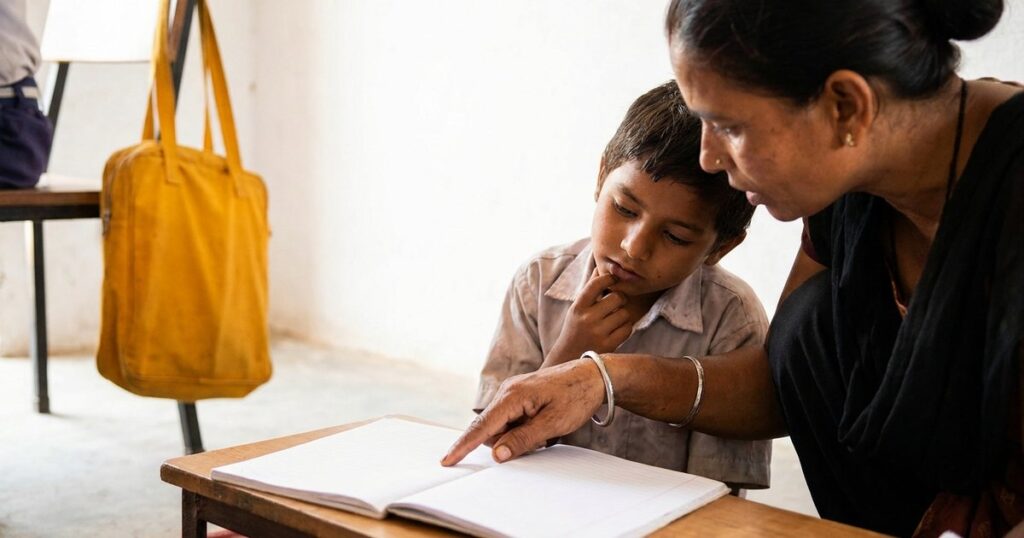
If you are a teacher, read this as a plea from the children you may be losing. If you are a parent or a student, read it as evidence that the difficulty is not yours alone, and as a call to organise. The boys of Barbiana wrote for the parents of the Italian poor. This is written for the parents, teachers, and students of India.
Frequently asked questions
What is Letter to a Teacher about?
It is a 1967 collective work by students of the School of Barbiana in Tuscany, Italy. The students criticised schools that pushed out children of peasants and workers.
Why is this book adapted for India?
India in 2026 is not Italy in 1967, but caste, class, language, rural-urban location, and coaching costs still affect who succeeds in school.
Who is What I Want to Tell My School Teacher written for?
It is written for the parents, teachers, and students of India. Teachers can read it as a plea from children they may be losing.
How does artificial intelligence relate to the book?
A dedicated chapter explains how artificial intelligence can help provide sustained, patient attention for every child who needs it.