Part 14 of 16 in The Rupee Trap: Stop Chasing Crores. Start Building a Rich Life.← Part 13Part 15 →
This chapter explores how money can support a life shaped by values, relationships, freedom and enjoyment. It helps readers think beyond wealth as a bank balance and assess what their spending actually makes possible.
- Wealth cannot quickly replace neglected relationships, hobbies, skills or curiosity.
- Money matters greatly for essentials, but it should serve life rather than become proof of success.
- After essentials and protection, ask what improvement each additional rupee will buy.
- A gratitude ledger can record what money enabled and what cost almost nothing.
- Rank discretionary purchases by the pleasure, connection, convenience or freedom they produced.
There is something tragic about becoming rich enough to stop working, then discovering you have forgotten what you enjoy doing.
THE INDIAN STORY
A successful founder in Bengaluru sells his company. For years, his answer to every invitation was 'after the next funding round'. Now there is no next funding round. There is also no hobby he has kept alive, no weekday lunch with friends, and no habit of spending an unstructured afternoon with his parents. The bank balance is excellent. The calendar looks deserted.
This fictional founder is not ungrateful. He has simply discovered that a life cannot be assembled overnight from spare money. Relationships need time. Skills need practice. Curiosity needs room. Generosity needs a recipient who is more than an entry in an annual report.
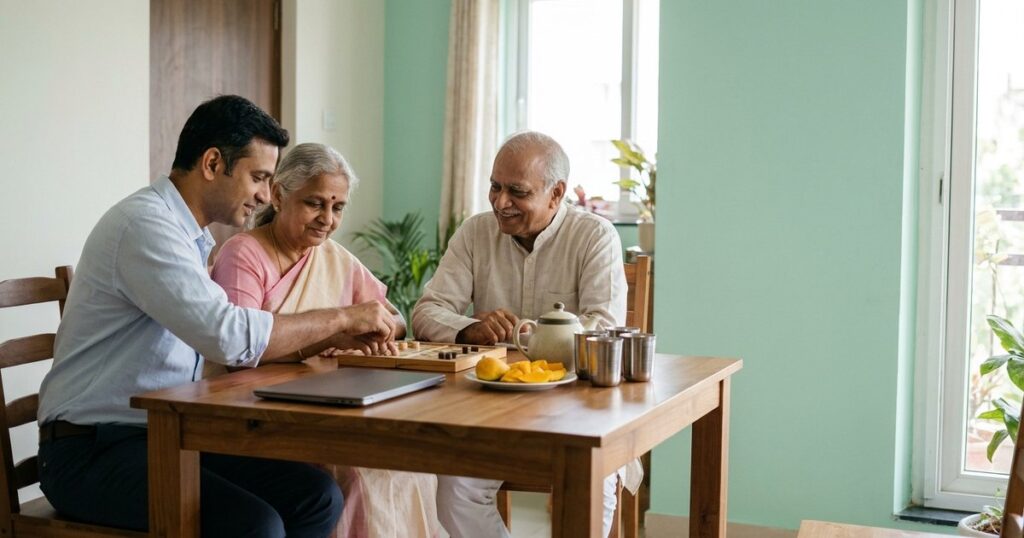
The purpose of wealth is not to prove that you beat your classmates. It is to enlarge your ability to make choices consistent with your values. That may mean funding a child's education, giving a parent dignity, reducing hours at work, supporting a local library, backing a deserving young entrepreneur, or enjoying an excellent mango in the middle of an ordinary afternoon.
Original sketch #96, “Buy Happiness” — Carl Richards, Your Money (2025). © Carl Richards.
THE MONEY LESSON
This does not mean money is unimportant. For a family struggling with food, rent or healthcare, more money can be transformative. It is easy to preach simplicity when your own needs are met. The humane lesson is not 'money does not matter', but 'money should be in service of life'. Once essentials and sensible protection are covered, the next rupee deserves a question: What improvement in life will this buy?
Research on spending and wellbeing is more nuanced than a single slogan. Different people gain from security, experiences, relationships and freedom in different ways. Your task is to notice your own pattern without confusing someone else's aspirational advertisement for evidence.
Wealth can also create responsibility. The history of Lijjat and SEWA Bank suggests how resourcefulness, mutual trust and local institutions can expand choices for people who are excluded from conventional opportunities. You need not become a philanthropist with a foundation to contribute. You can mentor, support an apprentice, fund a useful project, pay a worker fairly or give a younger founder the benefit of an honest warning.
Try keeping a gratitude ledger next to the financial one. Record three things money helped make possible this month and three that cost almost nothing. A ledger that contains only money is an incomplete account of a rich life.
TRY THIS TONIGHT
List your last five discretionary purchases. Rank them by the pleasure, connection, convenience or freedom they actually produced—not their prices. Use that ranking to guide one decision next month.
COPY-AND-PASTE AI PROMPT
“Help me design a 'rich-life budget'. Ask what gives me meaning, whom I care for, and what I want more time to do. Using only hypothetical or rounded amounts, suggest ways to protect essentials while spending more intentionally on valued experiences, relationships and opportunities to help others.”
Frequently asked questions
What is the purpose of wealth according to this chapter?
The purpose of wealth is to enlarge your ability to make choices consistent with your values, such as supporting family, reducing work hours or helping others.
How should I decide what to spend my next rupee on?
Once essentials and sensible protection are covered, ask what improvement in life the spending will buy.
What is a rich-life budget?
It protects essentials while directing more spending toward valued experiences, relationships and opportunities to help others.
How can I evaluate my discretionary spending?
List your last five discretionary purchases and rank them by the pleasure, connection, convenience or freedom they actually produced, not their prices.