Part 7 of 16 in The Rupee Trap: Stop Chasing Crores. Start Building a Rich Life.← Part 6Part 8 →
A one-page household financial plan can help families connect their money with their priorities, prepare for risks and make decisions when circumstances change. This chapter of The Rupee Trap helps households replace scattered financial products with clear purposes, goals and rules.
- Different families need different plans, but they face similar questions about priorities, savings, risks and documents.
- Buying financial products without a clear purpose creates a collection that may not achieve anything specific.
- A useful one-page plan has six boxes: purpose, today, safety, goals, rules and review date.
- Plans should be revisited when income, family needs, careers or markets change.
- Families should complete the exercise before seeking product-specific advice from a properly registered professional.
The financial industry loves complicated plans. Your family needs a plan it can find when the Wi-Fi fails.
THE INDIAN STORY
A retired teacher in Nagpur, a software professional in Chennai and the owner of a kirana shop in Indore do not need identical financial plans. They do need answers to surprisingly similar questions: What is important to us? What are we saving for? What could go wrong? Who knows where the documents are? What will we do next month?
Many people reverse the order. They buy a tax-saving product in March, a mutual fund because a friend mentioned it in April, gold because the family insists in May, and an insurance policy because an agent called in June. By December they possess an assortment of products but cannot explain what the collection is meant to achieve.
That is not planning. That is a cupboard full of financial souvenirs.
Think of a family with two schoolchildren. The parents believe they are 'saving for education'. What does that phrase mean? Undergraduate fees in India or abroad? Three years away or twelve? Fully funding the cost, or contributing part of it? Without a definition, every new investment promise sounds relevant and every market dip feels terrifying.
Original sketch #21, “A One-Page Plan” — Carl Richards, Your Money (2025). © Carl Richards.
THE MONEY LESSON
A useful one-page plan has six boxes. First, purpose: name the lives and opportunities the money should support. Second, today: write approximate income, essential expenses, assets and debts. Third, safety: identify emergency liquidity, insurance and critical documents. Fourth, goals: list the next three major uses of money, each with a timeframe. Fifth, rules: record a few behaviours you can actually follow, such as saving on payday or avoiding borrowing for status. Sixth, review date: decide when you will look again.
Do not mistake the plan for a prediction. Your salary may change, your child may choose a different career, a parent may need help, and markets will certainly surprise you. A plan is valuable because it gives the family a way to decide when the future changes. It should be revisited, not worshipped.
The Reserve Bank of India's financial education material emphasises budgeting, saving, responsible borrowing and consumer protection. Notice how unglamorous this is. The most useful financial habits seldom come with a launch event or a celebrity endorsement.
If you need product-specific advice, consult a properly registered professional and check the fees, conflicts and suitability. But do the one-page exercise first. An adviser can help you travel; only you can decide where you want to go.
TRY THIS TONIGHT
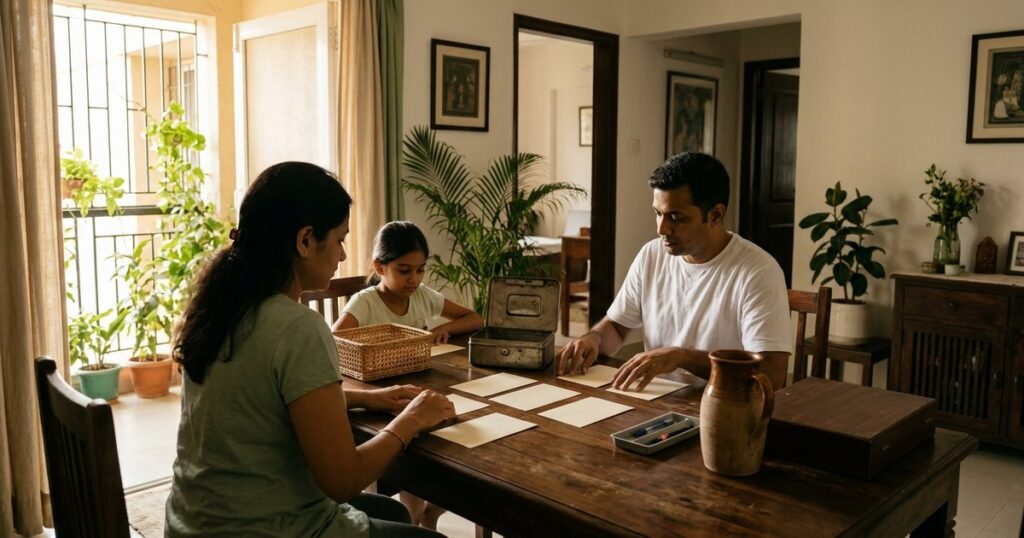
Put six headings on one sheet: Why, Today, Safety, Goals, Rules, Review. Fill each in pencil with your family. Leave blank anything you do not know, and assign someone to find out before the next meeting.
COPY-AND-PASTE AI PROMPT
“Create a one-page household financial-plan template using six boxes: purpose, current position, protection, goals and deadlines, money rules, and review date. Ask me for estimates rather than account identifiers. Flag missing information; do not suggest named financial products or claim that projections are certain.”
Frequently asked questions
What should a one-page household financial plan include?
Use six headings: Why, Today, Safety, Goals, Rules and Review. These cover purpose, current finances, protection, major uses of money, practical behaviours and the next review date.
How do I define what I am saving for?
Specify the opportunity, timeframe and amount you intend to fund. For example, education planning should clarify whether the goal is undergraduate fees in India or abroad, how soon it is needed and whether you will fund all or part of it.
Should I choose financial products before making a plan?
No. Complete the one-page exercise first, then seek product-specific advice if needed. Check a professional's registration, fees, conflicts and suitability.
How often should I review a household financial plan?
Choose a review date on the plan and revisit it when circumstances change. Salary, family needs, career choices and markets may all change.