Part 3 of 16 in The Rupee Trap: Stop Chasing Crores. Start Building a Rich Life.← Part 2Part 4 →
Your relationship with money is shaped by family experiences, fears, and expectations that often began before you earned a salary. This chapter helps readers identify inherited money rules and consider which ones still support their future.
- Money can represent security, freedom, fear, affection, or independence, depending on personal history.
- Family experiences can create financial rules that remain influential long after circumstances change.
- Inherited beliefs such as never borrowing or property always wins may not apply universally.
- Honest conversations about childhood money memories can reduce conflict between couples and families.
- Writing one belief to keep and one to test can help examine your money story.
The most expensive financial advice in India is often delivered free, at the family dining table.
THE INDIAN STORY
When I ask people what money means to them, the answers are rarely about interest rates. One says security. Another says freedom. A third says fear. An entrepreneur says it is the ability to walk away from a bad investor. A parent says it means never having to tell a child that school fees must wait. The numbers may be identical; the feelings are not.
Consider Meera, a fictional composite of many Indian middle-class childhoods. Her father kept a notebook of every household expense. He was not miserly; he was frightened by the memory of a time when work vanished without warning. Years later, Meera earns an excellent salary in Bengaluru. She has six months of expenses in the bank, yet every restaurant bill produces a stab of guilt. Her husband grew up in a family where festivals meant generous gifts. To him, the same bill represents affection. To her, it resembles danger. Neither is irrational. Each is obeying a script written long ago.
This is why personal finance can become intensely personal. The argument about a holiday is seldom just about a holiday. It may be about whether one partner deserves pleasure, whether the other fears dependency, and whether both believe tomorrow can be trusted.
Original sketch #1, “Money = Feelings” — Carl Richards, Your Money (2025). © Carl Richards.
THE MONEY LESSON
Carl Richards begins Your Money by treating money as a human question before treating it as a mathematical one. In India that distinction matters enormously. Our financial memories can include a parent's business failure, a relative's medical bill, a wedding financed by loans, a plot of land that rescued the family, or a grandmother who always wanted a little gold. These experiences are valuable evidence about our history. They are poor substitutes for a plan about our future.
The goal is not to diagnose your parents. They did the best they could with their circumstances. The goal is to notice which inherited rules still serve you. 'Never borrow' may protect you from consumer debt, but it may also make you refuse an affordable loan to grow a sound enterprise. 'Property always wins' may reflect one family's good fortune rather than a universal law. 'Children are our retirement plan' can create a debt of obligation nobody discusses honestly.
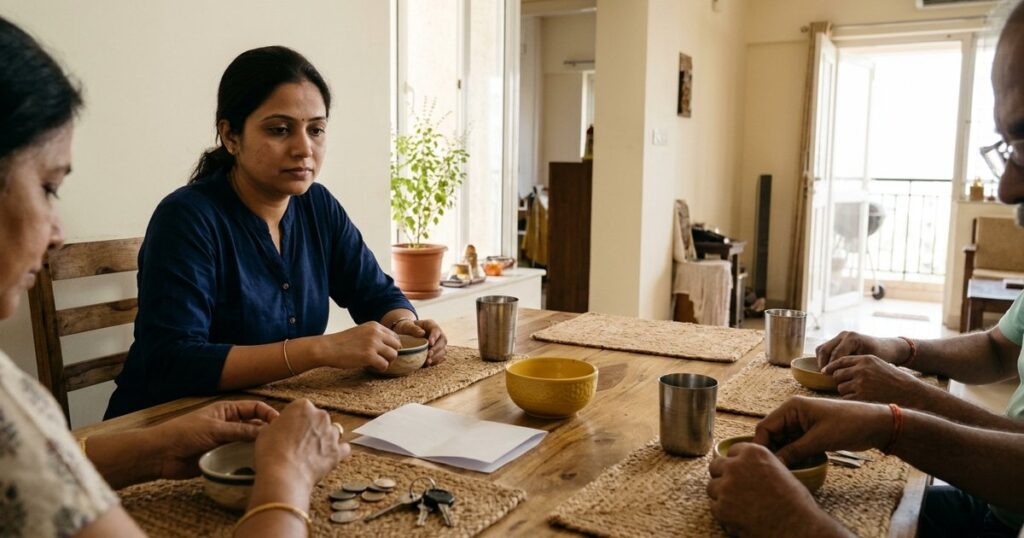
A useful family conversation starts with three questions: What did money feel like when you were ten? Which money decision still hurts? What do you want money to make possible during the next five years? Listen without correcting the answers. Couples who discover different money memories can stop treating disagreement as disloyalty.
The rule for readers of this book is simple: do not begin with a product. Begin with a person. Your bank statement records what happened; your money story helps explain why.
TRY THIS TONIGHT
Tonight, ask each adult at home to complete the sentence: 'In our family, money was always ____.' Compare answers without debating who is right. Write down one belief you want to keep and one you want to test.
COPY-AND-PASTE AI PROMPT
“Act as a non-judgmental money-journaling coach. Ask me eight questions, one at a time, about my earliest money memories, family expectations, spending guilt and financial hopes. Reflect possible patterns without diagnosing me or recommending investments. End with three beliefs I could test.”
Frequently asked questions
How does childhood affect the way I handle money?
Early experiences, such as financial insecurity, medical bills, business failure, or family generosity, can shape how you view spending, saving, and risk.
Why do couples argue about spending?
A disagreement about spending may reflect different money memories, fears about dependency, or beliefs about whether pleasure and security can be trusted.
What questions should families ask about money?
Ask what money felt like at age ten, which money decision still hurts, and what money should make possible during the next five years.
How can I examine inherited money beliefs?
Write one belief you want to keep and one you want to test. Compare family answers without debating who is right.