Part 14 of 16 in Ratta, Riyaz & Robots: How Learning Really Happens← Part 13Part 15 →
This chapter explains how AI can either support learning or replace the thinking that makes learning happen. It helps students, parents and teachers use AI as a tutor, coach and practice partner rather than as a source of ready-made answers.
- A randomised trial found that plain ChatGPT improved practice results but harmed exam performance without AI.
- Guarded AI tutoring improved practice and produced exam results similar to students who used no AI.
- Learning happens when the learner thinks, retrieves information and explains ideas, not when AI does the work.
- AI can provide tutoring, diagnosis, practice, feedback and lesson planning when designed around sound teaching methods.
- Families should require an initial attempt, use AI for questions and quizzes, check facts and protect sleep.
Okay so here's the most important experiment on AI and learning so far, and its result should worry every Indian parent who has handed a child a phone with ChatGPT on it.
In 2023, researchers led by Hamsa Bastani at the University of Pennsylvania ran a randomised trial with nearly a thousand high school maths students in Turkey. One group practised with a standard ChatGPT-style assistant. A second group practised with an AI tutor designed with guardrails: it gave hints and guided students but wouldn't simply hand over answers. A third group had no AI.
During practice, the plain ChatGPT group did about 48% better than students without AI. The guarded tutor group did about 127% better. Impressive, right?
Then came the exam, with no AI allowed. The plain ChatGPT group scored about 17% worse than students who'd never used AI at all. The guarded tutor group scored about the same as the no-AI group. The researchers' conclusion: generative AI without guardrails can harm learning, because students use it as a crutch.
ChatGPT used carelessly is like a gym where a machine lifts the weights for you. You'll set personal records every day. Your muscles won't notice.
The one rule that matters
Everything in this book comes down to one idea: learning happens when the learner does the thinking. Working memory processes it, long-term memory stores it, retrieval strengthens it. If AI does the thinking, the child gets the answer and the AI gets the practice.
So the question isn't "should children use AI?" They will, whatever we decide. The question is: will they use it as a lifter or as a spotter? A spotter stands beside you, lets you struggle, and steps in only when you're about to drop the bar.
Why I'm still optimistic
Remember Bloom's two sigma problem from Chapter 5. For forty years, the best teaching method we knew, one-to-one tutoring with mastery learning, was too expensive for anyone but the rich. In India, private tuition is exactly that: a luxury that widens the gap between children who can afford it and those who can't.
AI changes the economics. A well-designed AI tutor can do much of what Bloom's tutors did, in almost every Indian language, for the cost of a cheap phone and some data. Mindspark showed, long before ChatGPT, that adaptive technology built on sound teaching methods can produce large gains for children who are behind. Pratham's TaRL showed that teaching each child at their level transforms results. AI can do that diagnosis and adaptation for every child, every day.
The whole book, upgraded with AI
Here's how each chapter's idea maps to good AI use:
- Working memory (Ch. 1): ask AI to break ideas into small steps and wait for you.
- Prior knowledge (Ch. 2): ask AI for analogies from things you already love, and for a check of what you need to know first.
- Novice vs expert (Ch. 3): ask for worked examples that fade, step by step.
- Guidance before independence (Ch. 4): ask AI to coach, hint and question, never to solve.
- Teaching at the right level (Ch. 5): let AI diagnose your real level and start there.
- Rosenshine's playbook (Ch. 6): teachers can plan structured lessons in minutes.
- Retrieval and spacing (Ch. 7): make AI quiz you, track your errors and schedule reviews.
- Motivation (Ch. 8): use AI for private practice where mistakes are free and progress is visible.
- Feedback (Ch. 9): ask for feed up, feed back and feed forward, not rewrites.
- Apprenticeship (Ch. 10): ask AI to narrate expert thinking, then coach you through your own.
- Myths (Ch. 11): use AI to find evidence, then check it.
Teach the robot
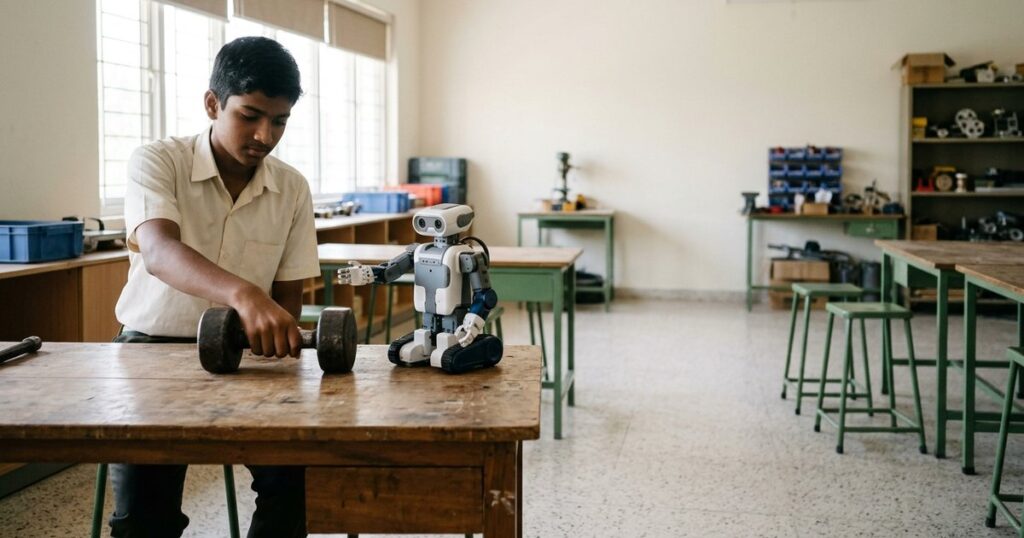
One more technique, maybe the most powerful of all. Flip the roles. Ask the AI to play a confused student and make you explain the topic to it. Teaching forces you to retrieve, organise and fill the gaps in your understanding. When the "student" asks a question you can't answer, you've found exactly what you need to study next. Psychologists sometimes call this the protégé effect, and with AI, every child can have a protégé who never runs out of questions. It also gives parents and teachers something better than a mark: a record of what the child can explain.
|
PROMPTS WORTH SAVING The guarded tutor (students): "You are my tutor. Never give me the final answer. Ask me questions, give one hint at a time, and make me do each step. If I ask you to just tell me, remind me that I learn by doing it." |
|---|
|
Teach the robot (students): "Pretend you're a Class 8 student who knows nothing about photosynthesis. I'll explain it to you. Ask me the kinds of questions a curious, slightly confused student would ask. At the end, tell me which parts of my explanation were unclear or wrong." |
|
Diagnose and plan (parents): "Test my child's level in English reading with short tasks, starting easy. Tell me where she is, what's missing, and give me a 15-minutes-a-day plan for four weeks." |
|
Lesson planner (teachers): "Plan tomorrow's Class 6 maths lesson on fractions for 45 students at three different levels. Include a 5-minute review quiz, a worked example, a 'we do' example, three levelled practice sets, and a slate-based check for understanding." |
Rules for families
- No AI for homework until the child has tried first, on paper.
- AI is for questions and quizzes, not answers.
- Every AI session ends with the child explaining what they learned, to a human, without the screen.
- Check facts. AI makes mistakes with complete confidence.
- Keep the phone out of the bedroom at night. Sleep consolidates memory. No app can do that for you.
EPILOGUE
Frequently asked questions
Can ChatGPT harm learning?
Yes. In the trial, students using plain ChatGPT scored about 17% worse on an exam without AI than students who had never used AI. The researchers said unguarded generative AI can become a crutch.
What is a guarded AI tutor?
A guarded tutor gives hints and guides students without simply handing over answers. Students using it did about 127% better during practice and scored about the same as the no-AI group on the exam.
How should children use AI for studying?
Children should try first, use AI for questions and quizzes rather than answers, and finish by explaining what they learned to a human without the screen.
How can AI help parents and teachers?
AI can diagnose a child's level, create practice plans, quiz students, track errors, plan structured lessons and coach students through their own thinking.