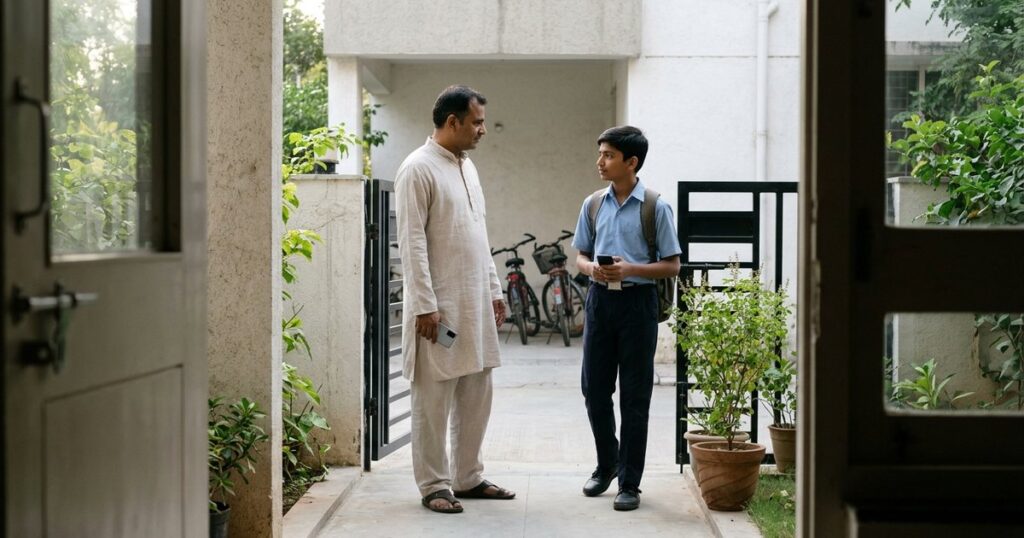
When Should a Child Get a Smartphone? My Answer to Indian Parents
I would not give a child a smartphone simply because classmates have one, because the school WhatsApp group is active, or because the child has turned thirteen. My answer to “when should a child get a smartphone?” is: when the child has a genuine need for independent communication and has shown enough judgement to use the device without constant supervision. For many children, that is around 14 or 15. For some, it is earlier. For many, it can safely be later.
The age is less important than the reason, the type of phone, and the rules around it. A smartphone is not just a telephone. It is a television channel, gaming arcade, shopping mall, camera, publishing platform, search engine and social club, all placed in a child’s pocket. Giving one to a child is not like giving her a schoolbag. It is closer to giving her an unsupervised room in a city she has never visited.
I have been thinking about this because parents bring the question to me in different forms. A mother tells me that her twelve-year-old is the only child in the class without Instagram. A father says his fourteen-year-old needs a phone because he travels alone to tuition. Another parent wants to monitor every message because she is frightened of what might happen online. All three are asking about a phone, but they are really asking about independence, safety, trust and fear.
There are three different devices hiding behind the word “phone”
Parents often debate the right age without first deciding what they are handing over. That is a mistake.
| Device | What it allows | Reasonable use | My view |
|---|---|---|---|
| Basic phone | Calls and perhaps SMS | Travelling to school, tuition or activities | Often appropriate from 10–13, depending on circumstances |
| Restricted smartphone | Calls, maps, school tools and selected apps | Growing independence with parental limits | Reasonable for some children from 12–14 |
| Unrestricted smartphone | Social media, browsers, games, video, messaging and app stores | Requires sustained judgement and self-control | Usually later than parents think; often 15 or beyond |
A child may need a way to call home without needing YouTube Shorts, Snapchat or an unrestricted browser. If the genuine need is “I want to know when you reach dance class,” a basic phone solves it. If the parent buys a ₹20,000 smartphone with unlimited data, the parent has solved a small logistical problem by creating several larger ones.
I am not suggesting that every child should be kept away from technology. That would be unrealistic and, in some cases, unhelpful. Children need to learn how digital tools work. But learning to use a tool is different from being exposed to every business model designed to capture attention.
A smartphone is not a neutral object. It is a device designed by companies that make money when your child spends more time looking at it.
When should a child get a smartphone?
I would ask five questions before I looked at the child’s age.
- Does the child have a real need for independent communication? Does she travel alone, attend activities in different locations, or spend time away from both parents?
- Can the child follow boring rules? A child who cannot put down a television remote or return a borrowed book is unlikely to manage a powerful internet-connected device well.
- Can the child tell an adult when something uncomfortable happens? Online safety depends less on predicting every danger than on making sure the child will ask for help without fearing punishment.
- Are the parents willing to model the rules? A father who checks his phone during every meal has little credibility when he bans phones at the dinner table.
- Can the family tolerate delay? If the child cannot have a smartphone this year, can the parents withstand the complaints, comparisons and accusations of unfairness?
The last question is not trivial. Many parents give in because they want a quiet life. They call it a birthday present, but it is really a surrender. I understand the temptation. Parenting is tiring. Yet a device given to stop an argument teaches the child that persistent pressure works.
My broad rule would be this: a basic phone when there is a practical safety need; a restricted smartphone when the child can handle limited independence; and an unrestricted smartphone only after the child has demonstrated judgement over time. I would not use the child’s birthday as the deciding factor.
The strongest argument for an early phone is safety
Parents are right to worry about safety. A child returning from coaching at 8 pm may need to call home. A child travelling by school bus may need to report a change in plans. A teenager may be stranded after a cancelled class. These are sensible reasons for communication.
But “safety” is often used to justify a device that provides far more than communication. A basic phone, a watch with calling capability, or a parent’s old phone with only approved contacts may meet the need. The solution should match the problem.
I would also teach the child what the phone is for. The rule could be: “This is your way to reach us when you are away from home. It is not yet your private entertainment centre.” That distinction is clear, honest and easier to enforce than a vague instruction to “use it responsibly”.
Location tracking deserves separate thought. It can reassure parents, but it can also become a substitute for trust and conversation. I am uncomfortable when parents monitor a teenager’s location continuously without telling him. If tracking is used, the child should know what is being tracked, why, and for how long. Safety should not become a permanent surveillance arrangement.
The social pressure is real, but it is not a sufficient reason
Children do not invent the pressure. Schools, coaching centres and peer groups increasingly assume that every student has access to a smartphone. Homework may be posted in a WhatsApp group. A teacher may send a last-minute announcement. Friends may coordinate a project through messaging apps.
Parents should not dismiss this as childish weakness. Belonging matters to children. Exclusion hurts. But the answer is not automatically to provide an unrestricted device. It may be possible to use a family phone for school communication, create a parent-managed group, or ask the school to provide information through a channel that does not require children to be online all evening.
This is where Indian schools need to take responsibility. A school should not quietly outsource its communication system to children’s personal devices and then complain about distraction. If a notice is essential, it should be available to parents as well. If an assignment requires a particular app, the school should explain why and provide an alternative where possible.
Parents can also speak to one another. I have seen parents privately agree that no child in a class will receive a social-media account before a certain age, only to discover that everyone was waiting for someone else to say it aloud. A shared boundary is easier for a child to accept than an apparently arbitrary family rule.
Why smartphones are unusually difficult for children
Children are still developing the ability to delay gratification, resist impulses and judge long-term consequences. This is not a moral failure. It is part of growing up. Adults struggle with the same apps, despite having decades more experience.
The phone also removes natural stopping points. A book has a last page. A television programme ends. A board game reaches a conclusion. Social media feeds continue until the user becomes tired, distracted or summoned by a parent. Games offer rewards at carefully chosen intervals. Notifications interrupt homework, sleep and conversation.
I see a similar pattern in my work as an angel investor. A founder may say that she can raise money, hire rapidly and launch in three cities because each individual decision seems manageable. The danger lies in the system created by all those decisions together. A smartphone is the same. One message is harmless. One video is harmless. One late night is harmless. The repeated loop can still damage sleep, attention and family life.
I would be especially cautious with a child who already has difficulty sleeping, concentrating, managing anger or stopping online gaming. A smartphone will not cause every such problem, but it can amplify it. If a child is struggling emotionally, the answer is not to hand over a private device and hope that self-control appears.
Do not confuse parental control with parenting
There are excellent tools for setting screen-time limits, approving apps, filtering content and managing purchases. Parents should use them. The Google Family Link guidance and Apple’s Screen Time parental controls explain what these tools can do.
But a control panel is not a substitute for a relationship. A determined child may find workarounds. A parent may block one app while missing a more serious problem on another. Technical restrictions reduce risk; they do not teach judgement.
I would set up the phone together with the child. We would discuss the passcode, approved contacts, app downloads, photographs, location sharing and what happens if a stranger sends a message. I would explain that privacy will increase as responsibility is demonstrated. I would not promise complete secrecy from the start, because a minor’s safety remains the parent’s responsibility. But I would also not read every message casually, as though the child has no right to a private conversation.
The distinction I would make is between supervision and inspection. Supervision means knowing the rules, checking usage patterns and remaining available. Inspection means opening every chat because anxiety demands certainty. The second approach may produce compliance, but it can also teach children to hide rather than seek help.
The family agreement matters more than the handset
Before buying the phone, I would write a short agreement. Not a legal document. One page, in plain language. The child should help draft it, because rules that are understood are more durable than rules announced from above.
My agreement would include the following:
- The phone charges overnight outside the bedroom.
- No phone during meals, family conversations or study periods.
- No social-media account without a discussion about the particular platform.
- No sharing of private photographs, passwords, school details or live location with strangers.
- No forwarding of humiliating photographs, rumours or abusive messages.
- If something frightening, sexual, threatening or confusing appears, the child can show it to a parent without losing the phone as an automatic punishment.
- Parents may review settings and usage, with increasing privacy as trust is earned.
- Repeated rule-breaking leads to a pause or downgrade, not a long lecture.
The rule about reporting trouble is the most important. If a child believes that showing a disturbing message will result in the phone being confiscated, she may delete the evidence and remain alone with the problem. Parents need to say repeatedly: “You will not be punished for telling me that someone else behaved badly.”
The best safety feature on a child’s phone is a parent the child can approach without fear.
What about social media?
I would delay it. I do not believe a thirteen-year-old needs a public audience of hundreds of acquaintances to develop socially. The minimum age shown by an app is not a developmental recommendation; it is often a legal or commercial boundary. Parents should read the platform’s own Common Sense Media guidance on social media, but they should not outsource the decision to a website.
If a teenager wants an account, I would begin with a private account, a small circle of known contacts and no public posting. I would discuss screenshots, permanence, impersonation, sexual exploitation, bullying and the fact that an apparently disappearing message may not disappear at all. I would ask the child to show me how the privacy settings work. If the child cannot explain them, the child is not ready to use the platform independently.
I would also ask what the account is meant to do. Is it for keeping in touch with close friends? Sharing art? Following cricket? Or is it mainly for watching strangers perform their lives? The purpose matters. A tool used deliberately is different from a feed used whenever the child feels bored, lonely or anxious.
Gaming is not automatically the villain
I do not support the lazy argument that every game is harmful. Games can provide pleasure, challenge, friendship and even useful skills. Some children learn persistence from difficult games in a way they never learn from worksheets.
The problem begins when the game controls the family timetable. If the child cannot stop at the agreed time, becomes aggressive when asked to stop, lies about usage or gives up sleep and schoolwork, the family has a problem regardless of whether the game is educational. Parents should watch the pattern rather than argue about the label.
In-app purchases deserve firm boundaries. I would disable them unless there is a clear reason to allow them. A child should not be able to spend ₹4,000 because a colourful game made the purchase feel like a small step. Pocket money can teach responsibility, as I have written in my earlier post on pocket money, but digital spending needs special care because the transaction is invisible.
What should parents do if the child already has a problem?
Do not begin by shouting or taking the phone away indefinitely. That may be necessary in serious cases, but it should not be the first reflex in every family argument.
I would start by measuring what is actually happening for one week: bedtime, wake-up time, school attendance, homework, meals, exercise, mood and phone use. Parents are often surprised by the gap between their fear and the child’s actual pattern. They are also sometimes surprised in the other direction.
Then I would change one or two structural features:
- Move charging outside the bedroom.
- Turn off non-essential notifications.
- Remove the most compulsive app for a trial period.
- Set a fixed time for gaming and messaging.
- Replace the phone habit with something concrete: sport, music, reading, friends visiting, or a family activity.
- Review the result after two weeks rather than arguing every evening.
Removing a phone without replacing what it was providing rarely works. If the phone is the child’s only social life, taking it away creates isolation. If it is the child’s only source of relaxation, the parent needs to help create another one. If it is being used to escape academic pressure or loneliness, punishment addresses the visible behaviour while leaving the cause untouched.
If there is persistent loss of sleep, severe anxiety, self-harm content, sexual coercion, threats or major changes in behaviour, I would seek professional help. Parents should not assume that every digital problem can be solved by better settings.
The phone should be earned, not used as a reward for marks
I dislike the practice of promising a smartphone for scoring well in an examination. It sends two bad messages: that the device is a prize, and that marks are the measure of maturity. A child can score 95% and still be unable to regulate phone use. Another can score 70% and handle a limited phone sensibly.
Readiness should be based on behaviour: keeping agreements, admitting mistakes, asking for help and respecting other people’s privacy. These are the same qualities I look for in founders before I invest. I do not expect perfection. I look for whether a person can be trusted with increasing responsibility.
That trust should grow in stages. A child can begin by using the family tablet in a common room. Then perhaps a basic phone for travel. Later, a restricted smartphone. The move to greater independence should be reversible. If the arrangement fails, going back to a simpler device is not humiliation; it is feedback.
My practical recommendation to Indian parents
If your child is below 12, I would generally avoid a personal smartphone unless there is a strong family or medical reason. Use a basic phone or a parent-managed device for communication.
Between 12 and 14, I would consider a restricted smartphone only when there is a real need. No unrestricted social media, no overnight bedroom access, no open app store and no unlimited data by default.
From 15 onward, I would begin preparing the child for adult responsibility, but I would not remove all limits. A fifteen-year-old may deserve more privacy and independence, but still needs protection from commercial systems designed to keep attention captive.
These are not laws. A child who travels two hours alone every day may need a phone earlier than a child who walks to a nearby school. A child with a responsible older sibling may manage differently from a child who is impulsive and isolated. The parent’s job is not to copy the average family. It is to judge the particular child.
I would buy the least powerful device that meets the actual need, put the charging station in the living room, create the rules before handing it over, and review the arrangement after one month. I would tell the child exactly what would earn more freedom and exactly what would reduce it.
My own strongest conviction is this: do not give a child a smartphone because you are afraid of being the only parent who says no. Say no when the device solves the parent’s anxiety more than the child’s need. A child can survive being temporarily unpopular. It is much harder to recover years of sleep, attention and trust once they have been traded away for a glowing rectangle.