Part 3 of 15 in Degrees Don’t Do the Job← Part 2Part 4 →
This chapter explains why learning through practical work deserves the same respect as academic learning in India. It helps families, schools, employers and learners understand how apprenticeships can provide fair conditions, useful evidence and routes to advancement.
- Learning alongside experienced practitioners teaches reasoning, not just repeated movements.
- Informal learning can leave learners dependent on a master and limited to routine work.
- Modern apprenticeships need learning plans, fair payment, independent assessment and portable evidence.
- Practical work deserves respect, decent conditions and advancement opportunities.
- AI can support reflection and questions, but qualified people must decide about safety and hazardous work.
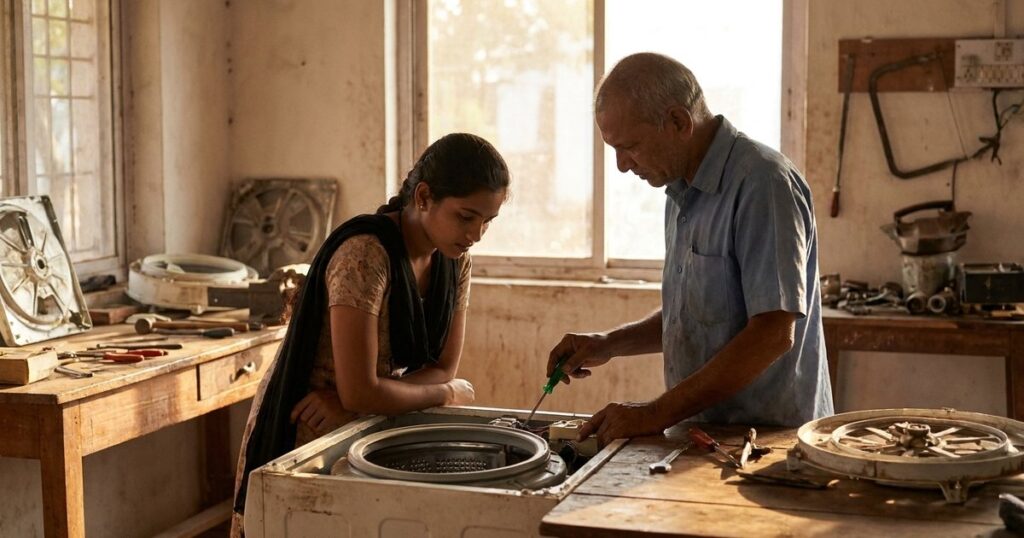
In a fictional repair shop in Nashik, Farida watches an experienced technician diagnose a faulty appliance. The technician asks questions before touching a tool. When did the problem begin? Was there a power fluctuation? What evidence would distinguish a damaged component from a loose connection? Farida is learning a method of reasoning, not merely a sequence of movements.
India already contains extensive traditions of learning alongside practitioners. Workshops, farms, kitchens and family businesses transmit knowledge through participation. Yet familiarity can hide weaknesses. A learner may depend entirely on a master’s goodwill, receive little explanation and remain confined to routine work. Informal learning deserves recognition and improvement together.
The social problem is equally serious. Families may celebrate an office title while dismissing technically demanding work performed with the hands. That hierarchy narrows a young person’s choices before ability or interest has been examined. Skilled service and production deserve respect, decent conditions and routes to advancement.
A modern apprenticeship should preserve close observation and guided practice while adding safeguards: an explicit learning plan, fair payment, independent assessment and portable evidence. The apprentice must be able to demonstrate competence beyond one employer’s walls. Otherwise, the relationship can produce dependence rather than opportunity.
Respect must appear in decisions, not speeches. A school that invites only white-collar alumni to career day quietly teaches children which futures count. A college that treats workshop learning as a fallback sends the same message. Invite a competent maintenance supervisor, a successful fabricator and a service entrepreneur to explain the judgement their work requires.
Families should also examine working conditions without romanticising hardship. A dangerous workshop is not made educational by calling it traditional. Long hours do not automatically create mastery. The right question is whether responsibility grows with competence and whether someone is accountable for the learner’s welfare.
Farida’s mentor can make tacit knowledge explicit by asking her to predict the next diagnostic step and explain why. After the repair, she records the symptoms, tests, conclusion and checks performed. Customer details stay private. Over time, this journal becomes a record of reasoning that another supervisor can examine.
AI can help turn her notes into questions in her preferred language. It can ask what alternative explanation she considered. It cannot certify that equipment is safe or authorise hazardous work. Those decisions remain with qualified people using approved procedures.
The lesson is practical: honour the practitioner’s knowledge, then make the training fairer and more transferable. Tradition can supply the relationship. Deliberate design must supply the learner’s rights and the evidence of progress.
Frequently asked questions
Why should India respect learning by doing?
Workshops, farms, kitchens and family businesses transmit knowledge through participation. Practical learning can develop judgement and competence, not merely manual routines.
What safeguards should a modern apprenticeship include?
It should include an explicit learning plan, fair payment, independent assessment and portable evidence that demonstrates competence beyond one employer.
How can families and schools show respect for technical work?
They can examine working conditions without romanticising hardship and invite competent maintenance supervisors, fabricators and service entrepreneurs to explain the judgement their work requires.
How can AI help apprentices learn safely?
AI can turn notes into questions and ask about alternative explanations. It cannot certify equipment as safe or authorise hazardous work; qualified people using approved procedures must make those decisions.