Part 21 of 26 in What I Want to Tell My School Teacher: An Indian Adaptation of Letter to a Teacher← Part 20Part 22 →
This chapter examines how AI tutors can support children who lack reliable academic help without increasing inequality. It is for teachers, families, and education planners considering practical ways to make these tools useful in Indian schools.
- AI tutors should support major Indian languages and mixed home and school language use.
- Offline or very low-data tools are important because connectivity is uneven and families may share one phone.
- Teachers need short, practical training to identify struggling children and use AI for targeted practice and explanations.
- AI content should match a child’s actual learning needs, not only the official syllabus sequence.
- Human support remains essential because AI cannot recognize hunger, fear, or the risk of leaving school.
Several practical designs can place AI tutors where they will reduce rather than increase inequality.
First, the tools must work well in major Indian languages and must be able to accept a child’s mixture of home language and school language. A child should be able to ask a question in the words they actually use and receive an answer they can understand.
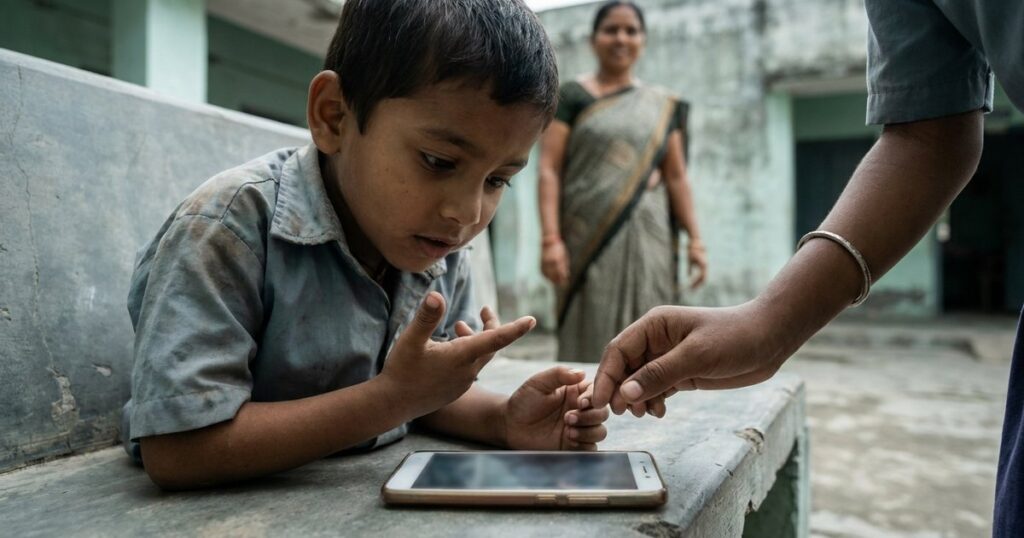
Second, the tools should be available offline or on very low data, because connectivity remains uneven. Many families share a single phone; the software must be simple enough for a child or a lightly literate parent to open and use.
Third, teachers in government and low-fee schools need short, concrete training: how to see which children are stuck, how to assign a short AI practice session, how to use the tool to generate a simpler explanation or an extra example. Without this, the technology sits unused or is used only by the most confident.
Fourth, the content should be aligned with what the child needs next, not only with the official syllabus page for that week. A child in Class 6 who cannot yet read a Class 3 text needs reading practice, not another unread chapter.
Fifth, there must be a human backstop. AI can explain a mathematics problem; it cannot notice that a child is hungry, frightened, or about to leave school. The combination of adaptive digital practice and a teacher or older student who cares remains the closest approximation we currently have to the intensity of Barbiana.
Experiments with free AI tutors mapped to school curricula are already under way in India. The measure of success is not how many children in already-advantaged schools use them. It is how many children who would otherwise have no one to ask finally receive patient answers.
Frequently asked questions
How can AI tutors reduce inequality in Indian schools?
They can provide patient answers to children who might otherwise have no one to ask, especially when designed for major Indian languages and uneven connectivity.
Why should AI learning tools work offline or use very little data?
Connectivity remains uneven, and many families share a single phone. Simple, low-data software can make the tools easier to access.
What training do teachers need to use AI tutors?
Teachers need short, concrete training on identifying stuck children, assigning brief AI practice, and generating simpler explanations or extra examples.
Why do AI tutors still need human support?
AI can explain a mathematics problem, but it cannot notice that a child is hungry, frightened, or about to leave school. A caring teacher or older student remains essential.