As an IVF embryologist, I have the privilege of witnessing one of nature’s greatest miracles every single day.
We often take human reproduction for granted because it happens so naturally. But when you observe embryos developing under the microscope, you cannot help but marvel at the elegance and intelligence of the process.
Every step has a purpose.
Every structure has a function.
And one of the most fascinating events is the hatching of the blastocyst.
Why Does the Embryo Have a Shell?
The journey of a newly fertilized embryo is a hazardous one.
After fertilization, the embryo must travel through the fallopian tube towards the uterus while its cells continue to divide rapidly.
During this journey, the embryo is enclosed within a protective shell called the zona pellucida.
This shell acts like a biological safety helmet.
It protects the delicate embryonic cells from mechanical damage, prevents the embryo from implanting in the wrong place, and allows it to reach the uterus safely.
Without this protective covering, successful pregnancy would be impossible.
But Once It Reaches the Uterus, the Shell Becomes a Barrier
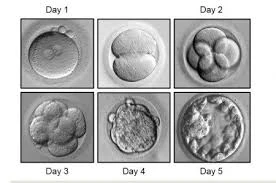
When the embryo reaches the uterine cavity about five days after fertilization, it has developed into a blastocyst.
At this stage, the embryo needs to implant into the lining of the uterus.
However, as long as it remains trapped inside its shell, implantation cannot occur.
The blastocyst has to escape.
This process is called hatching.
How Does a Blastocyst Hatch?
A chick uses its sharp beak to crack open its eggshell.
But a human blastocyst has no beak.
So how does it escape?
The answer is beautifully ingenious.
The blastocyst is not a static structure. It is alive and metabolically active.
Its cells continuously pump fluid from the surrounding environment into a central cavity known as the blastocoel.
As more and more fluid accumulates, the blastocoel expands like a balloon.
This creates increasing hydrostatic pressure inside the embryo.
The pressure stretches the zona pellucida, making it progressively thinner until eventually it ruptures at its weakest point.
The blastocyst then gently squeezes through this opening and emerges from its protective shell.
Only after hatching can it come into direct contact with the endometrium and begin the process of implantation.
Implantation Is an Extraordinary Biological Conversation
Once the blastocyst hatches, it attaches to the uterine lining and gradually burrows into the endometrium.
This is not a passive process.
The embryo and the uterus communicate continuously using complex molecular signals.
The uterus has to recognize and accept the embryo.
The embryo has to invade just enough—but not too much.
The mother’s immune system has to tolerate the embryo without rejecting it while still protecting her from infection.
It is an extraordinarily delicate biological balancing act.
Why Is Implantation So Inefficient?
Patients are often surprised that even a beautiful blastocyst does not always result in a pregnancy.
The reason is simple.
There are so many steps involved in implantation, and every one of them has to happen perfectly.
The embryo must be genetically normal.
It must hatch successfully.
It must synchronize precisely with a receptive endometrium.
It must attach, invade, establish a blood supply, and continue developing.
Failure at any one of these stages means implantation will not occur.
This is why embryo implantation remains one of the least efficient processes in human biology.
Even under ideal circumstances, many embryos never become babies.
Nature Is Remarkably Well Designed
When we watch blastocysts hatch in the IVF laboratory, we are reminded of the extraordinary intelligence built into human reproduction.
The same shell that protects the embryo during its journey must later be discarded to allow implantation.
The same fluid that nourishes the embryo creates the pressure needed for its escape.
Nothing is accidental.
Everything has a purpose.
As IVF specialists, we can help create embryos and provide the best possible environment for their development.
But once the blastocyst is transferred into the uterus, nature takes over.
And that is perhaps the greatest lesson IVF teaches us.
Science can assist reproduction.
But the miracle of creating a baby still belongs to biology.
That is why every successful pregnancy remains nothing short of extraordinary.
Please get your doubts resolved free using our chatbot which is powered by AI based on Dr Malpani’s 40 years of clinical expertise and experience at https://www.drmalpani.com/chat-w-chatbot/index.html. This will ensure you’re on the right path and potentially save significant costs in the long run.