Part 14 of 24 in School Is Not Education← Part 13Part 15 →
This chapter discusses the concept of community microschools, highlighting their potential to personalize learning and foster a sense of belonging. It is useful for educators and parents interested in alternative education models.
Quick Summary
-
Community microschools focus on small, personalized learning groups.
-
The educator acts as a coach, not just a lecturer.
-
Microschools balance personalized learning with community and accountability.
-
Parents receive regular updates and are involved in the learning process.
-
The goal is to ensure each child is noticed and engaged.
Personalisation begins with a simple act that large systems struggle to perform: noticing the learner in front of you.
A community microschool is not simply a smaller conventional school.
If we shrink forty students to twelve but keep the same lecture, notes, worksheets and exams, we have created a boutique version of the old model.
The opportunity is to redesign the role of the room.
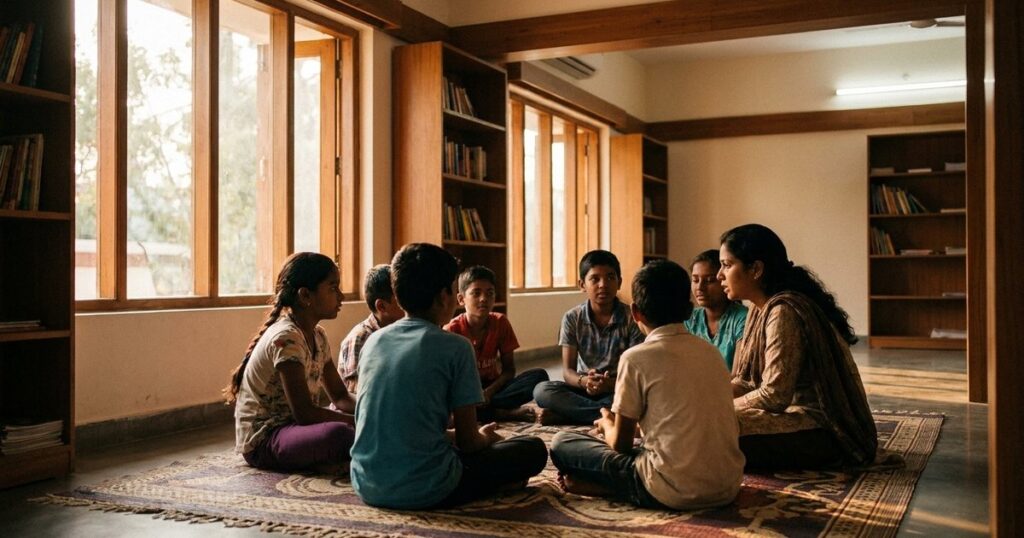
TeachToEarn describes a community microschool as a small local learning group — often around eight to fifteen learners — guided by an educator in a home, community centre or modest rented space, with digital infrastructure and personalised learning. [12] The exact numbers matter less than the principle: the group should be small enough that every learner is known.
Research on microschools as a category is still emerging, so parents should not accept sweeping claims that “microschools are proven.” What is better established are several ingredients the model can combine: targeted small-group tuition, frequent feedback, peer tutoring, metacognition and individualised instruction. Evidence summaries from the Education Endowment Foundation find positive average effects for these approaches, while also emphasising that implementation quality matters. [8]
Think of the microschool as an operating system for these ingredients.
The adult is not primarily a lecturer. She is a learning coach, diagnostician, curator and community builder. She helps each child choose goals, notices when a learner is stuck, groups children for peer explanation, creates projects, protects focus, communicates with parents and makes sure AI is being used to deepen rather than bypass thinking.
A typical morning may begin with a fifteen-minute planning circle. Each learner states the main goal for the day. Then children enter individual learning blocks with Eklavya or other curriculum resources. The facilitator circulates, watching dashboards and conversations. A child who is stuck receives a short human intervention. Two learners with the same misconception work together. A student who has mastered the concept helps a younger peer explain it.
Later, the group shifts into a shared project, discussion, experiment or presentation. Screens stop being the centre of the room. Learning becomes social and physical again.
This architecture solves a problem that neither schools nor AI can solve alone. Large schools have community but struggle to personalise. Pure online learning can personalise content but often lacks belonging and accountability. The microschool tries to combine both.
Parents remain important. A microschool should not become another black box where the parent waits for a report card. Weekly updates can show what the child attempted, which concepts were mastered, what errors recur, what project is underway and what goal comes next.
Most importantly, the child participates in this conversation. She should be able to say, “This is what I am working on. This is where I am stuck. This is what I will try next.”
That sentence is the sound of ownership developing.
The magic is not in the small room.
The magic is in designing the small room so that the child cannot disappear inside it.
Parent reflection
• Is the group small enough that every learner is noticed?
• What exactly is the facilitator responsible for beyond “supervision”?
Frequently asked questions
What is a community microschool?
A community microschool is a small local learning group with personalized education, guided by an educator in a home or community setting.
How does a microschool differ from a traditional school?
Microschools focus on personalized learning with small groups, whereas traditional schools often have larger classes and standardized teaching methods.
What role does the educator play in a microschool?
The educator acts as a learning coach, diagnostician, curator, and community builder, focusing on individual student needs and goals.
How are parents involved in a microschool?
Parents receive weekly updates on their child’s progress and are encouraged to engage in conversations about their child’s learning and goals.