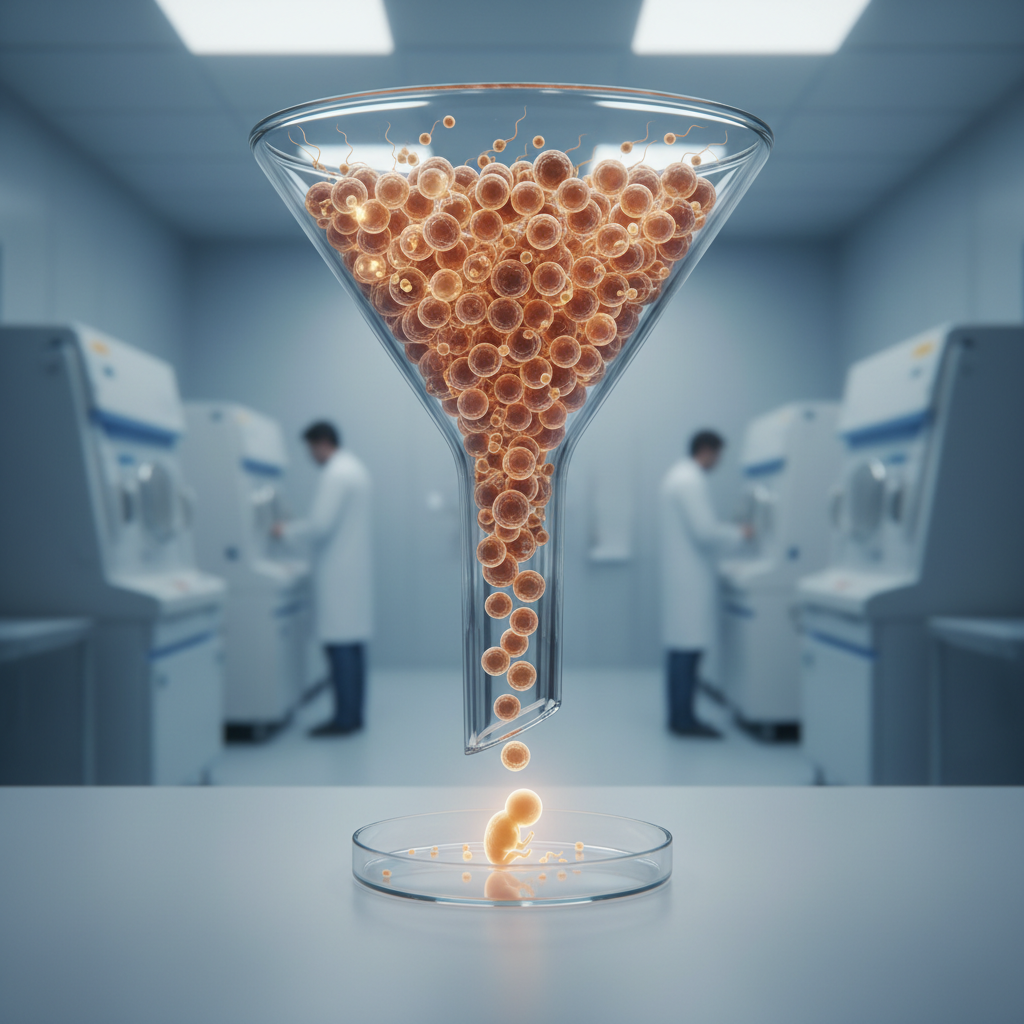
Patients often assume that IVF should guarantee success. After all, embryos are created in a laboratory, carefully selected, and then placed directly into the uterus. So why doesn’t every embryo transfer result in a baby?
Because the one step that truly matters—embryo implantation—is completely outside the doctor’s control.
The Reality: IVF Is Not the Final Step
IVF allows us to:
- Retrieve eggs
- Fertilize them
- Grow embryos
- Transfer them into the uterus
We are very good at these steps.
But once the embryo is inside the uterus, nature takes over.
Implantation is not something:
- doctors can force
- drugs can guarantee
- technology can control
And this is the same biological bottleneck that exists in natural conception.
Nature Is Inefficient—By Design
Even in perfectly healthy couples:
- Pregnancy does not happen every month
- The natural conception rate per cycle is only 15–25%
Yet couples accept this quietly when trying naturally.
Ironically, the moment IVF enters the picture, expectations jump to 100%—and disappointment turns into blame.
That’s misplaced.
Because whether conception happens:
- in the bedroom
- or in the lab
…the final step is still implantation.
Why Implantation Fails
The biggest reason is simple and brutal:
👉 Most embryos are genetically abnormal
This is not a flaw—it’s a feature.
Nature uses implantation failure as a quality control mechanism to:
- prevent abnormal pregnancies
- avoid birth defects incompatible with life
So when an embryo doesn’t implant, it’s often because:
“This embryo was not meant to become a baby.”
The Genetic Problem: We Still Don’t Have the Tools
Humans have ~20,000–30,000 genes.
Our current technologies—like Preimplantation Genetic Testing (PGT)—can only check:
- chromosome number (aneuploidy)
This helps identify embryos that are:
- euploid (correct chromosome count)
- or aneuploid (abnormal count)
But here’s the uncomfortable truth:
👉 A euploid embryo is not necessarily a healthy embryo
It may still have:
- subtle genetic defects
- metabolic problems
- developmental issues we cannot detect
So even with PGT:
- implantation is not guaranteed
- miscarriage can still occur
The “Perfect Embryo” Myth
Doctors often use reassuring language like:
- “top-grade embryo”
- “excellent quality”
- “very high chance”
But embryo grading is:
- visual
- subjective
- imperfect
In reality:
- Beautiful embryos sometimes fail
- “Ugly” embryos sometimes succeed
There is no reliable way to predict:
which embryo will become a baby
The Psychological Trap
When natural conception fails:
- couples are patient
- they accept uncertainty
When IVF fails:
- expectations are higher
- emotional investment is higher
- blame is immediate
This creates:
- frustration
- depression
- mistrust
But blaming the doctor for failed implantation is like:
blaming a pilot for turbulence after landing the plane safely
The doctor got the embryo into the uterus.
What happens next is biology—not skill.
What You Can Control
Patients do have agency—but in the right areas:
Choose wisely
- clinic quality
- lab standards
- transparency
Demand data
- blastocyst photos
- lab success rates
- honest counselling
Avoid hype
- unnecessary add-ons
- “guarantee” claims
- miracle marketing
What No One Controls
Be very clear about this:
- Implantation → uncontrollable
- Embryo genetics → mostly uncontrollable
- Outcome of a transfer → always uncertain
The Take-Home Truth
IVF is powerful—but it is not magic.
It improves the odds.
It does not eliminate uncertainty.
And that uncertainty exists because:
human reproduction is inherently inefficient—and always will be.
Bottom Line
If you remember just one thing, make it this:
The success of IVF is determined not by how well we create or transfer embryos—but by whether nature accepts them.
And nature is a ruthless gatekeeper.
Need more guidance !
Please get your doubts resolved free using our chatbot which is powered by AI based on Dr Malpani’s 40 years of clinical expertise and experience at https://www.drmalpani.com/chat-w-chatbot/index.html. This will ensure you’re on the right path and potentially save significant costs in the long run.