Finding out that you’re pregnant is one of the happiest moments in a woman’s life.
Unfortunately, the first few weeks of pregnancy can also be filled with anxiety, especially if there is bleeding, pain, or uncertainty about whether the pregnancy is developing normally.
The good news is that modern medicine provides us with two extremely valuable tools to monitor an early pregnancy:
- Serial serum β-hCG (human chorionic gonadotropin) levels
- Transvaginal ultrasound scans
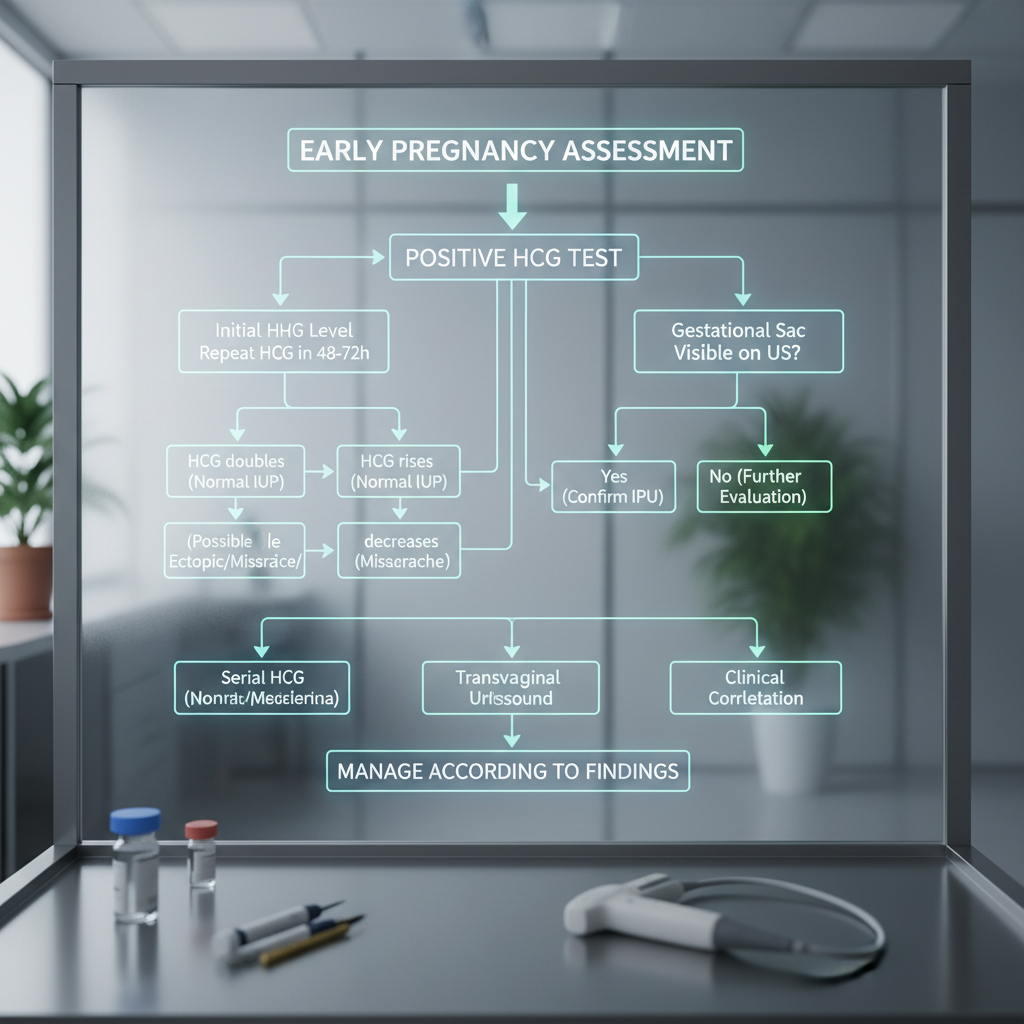
When interpreted together, these tests allow us to diagnose most early pregnancy problems accurately and guide appropriate treatment.
Why Is It Important to Measure hCG Levels Repeatedly?
A single hCG value provides only limited information.
What matters is how the level changes over time.
In a healthy early pregnancy, the hCG level generally rises steadily.
If the hCG level plateaus or falls, it usually suggests that the pregnancy is unfortunately not viable and is unlikely to result in the birth of a baby.
Before reaching any conclusions, however, the test should always be repeated after 24 hours to exclude a laboratory or clerical error.
If there is any doubt, repeating the test at another laboratory can provide additional reassurance, although serial measurements should ideally be performed in the same laboratory for consistency.
When hCG Is Above 1000 mIU/ml but No Sac Is Seen Inside the Uterus
One of the most important situations occurs when the hCG level rises above 1000 mIU/ml, but a transvaginal ultrasound does not show an intrauterine pregnancy sac.
This should raise a strong suspicion of an ectopic pregnancy, where the embryo has implanted outside the uterus, usually in the fallopian tube.
An ectopic pregnancy can become life-threatening if not diagnosed promptly.
Management of an Early Asymptomatic Ectopic Pregnancy
If the patient is stable, has no significant pain, and the ectopic pregnancy is detected early, surgery may not be necessary.
Treatment with a single intramuscular injection of Methotrexate 50 mg can often successfully resolve the ectopic pregnancy.
The hCG level should then be monitored regularly until it falls to zero, confirming complete resolution.
When the Ultrasound Shows an Ectopic Pregnancy
Sometimes the ultrasound clearly demonstrates a pregnancy sac outside the uterus.
Management depends entirely on the patient’s clinical condition.
If the Ectopic Has Ruptured
If there is internal bleeding or blood in the pelvis and the patient is unstable, this is a medical emergency.
Immediate laparoscopy or laparotomy is required to stop the bleeding and remove the ectopic pregnancy.
If the Patient Is Stable
If the ectopic pregnancy is visible but unruptured and the patient remains clinically stable, a conservative approach may be possible.
Under ultrasound guidance, potassium chloride (KCl) can be injected directly into the ectopic gestational sac to stop its development.
Serial hCG levels should then be followed until they become undetectable.
What If the Pregnancy Is Inside the Uterus but There Is No Baby?
Sometimes the ultrasound shows a gestational sac inside the uterus but no fetal pole after six weeks.
This suggests an anembryonic pregnancy (blighted ovum) or a missed abortion.
However, before making this diagnosis, repeat the ultrasound after four days to confirm the findings.
A wanted pregnancy should never be terminated on the basis of a single scan.
Avoid an Unnecessary D&C
Many women are immediately advised to undergo a D&C.
In most cases, this is unnecessary.
D&C can damage the uterine lining and may lead to Asherman syndrome (intrauterine adhesions), which can create fertility problems in the future.
Medical management using Mifepristone followed by Misoprostol is usually a safer and less invasive option.
Why Do Most Early Miscarriages Occur?
The commonest cause of an early miscarriage is a genetic abnormality in the embryo.
This is nature’s quality-control mechanism to prevent the birth of a baby with severe chromosomal abnormalities.
These genetic errors occur randomly but become more common as women grow older because eggs age over time and accumulate chromosomal defects.
Importantly, nothing the mother did caused the miscarriage.
Please do not blame yourself.
There Is Good Reason to Be Hopeful
Although a miscarriage is heartbreaking, it also proves that fertilization and implantation were possible.
The fact that you conceived once means your chances of conceiving again—and ultimately having a healthy baby—remain excellent.
Most women who suffer an early miscarriage go on to have a successful pregnancy.
Do not lose hope.
The Bottom Line
Early pregnancy assessment should always combine serial hCG measurements with high-quality transvaginal ultrasound.
Interpreting these tests together allows doctors to distinguish between:
- A normal developing pregnancy
- An ectopic pregnancy
- A non-viable pregnancy
- A missed miscarriage
Accurate diagnosis prevents unnecessary interventions while ensuring that potentially dangerous conditions such as ectopic pregnancy are treated promptly.
Above all, remember that medicine has become very good at diagnosing early pregnancy problems—but every new pregnancy is a new opportunity for success.
Please get your doubts resolved free using our AI-powered chatbot, built on Dr. Malpani’s 40 years of clinical expertise and experience:
https://www.drmalpani.com/chat-w-chatbot/index.html
This will help ensure you’re on the right path and could potentially save significant costs and unnecessary treatments in the long run.