India, a country with one of the youngest populations in the world, faces a formidable challenge in its education sector. The sprawling diversity of our nation is reflected in the disparities in education, resulting in a system marked by distinct issues including overcrowded classrooms, inadequate teacher training, and a focus on rote learning.
Current statistics paint a dire picture. As per ASER 2020, only 16% of children in class 1 in rural India can read at the prescribed level, while 40% cannot even recognize letters. Add to this the seismic digital divide, and it is clear that India’s future generations are at a perilous juncture. How can we become a world power if our schooling system is stuck in the Dark Ages ?
The over-reliance on rote learning is an archaic carryover from colonial times, designed to create obedient clerks, not innovative thinkers. Despite numerous curriculum reforms, rote learning remains entrenched in our schooling system. As a result, our students often lack critical thinking skills, creativity, and the ability to learn independently. This does not bode well for a nation that seeks to become a global knowledge economy.
Our classrooms, frequently bursting at the seams, are unable to provide the personalized attention each child needs. A high student-to-teacher ratio exacerbates this issue, making it nearly impossible for teachers to address individual learning needs or cultivate a love for learning among students.
To top it off, teacher training often fails to equip educators with the skills necessary to foster inclusive, child-friendly environments. The approach remains largely one-dimensional, neglecting the social, emotional, and mental aspects of a child’s development.
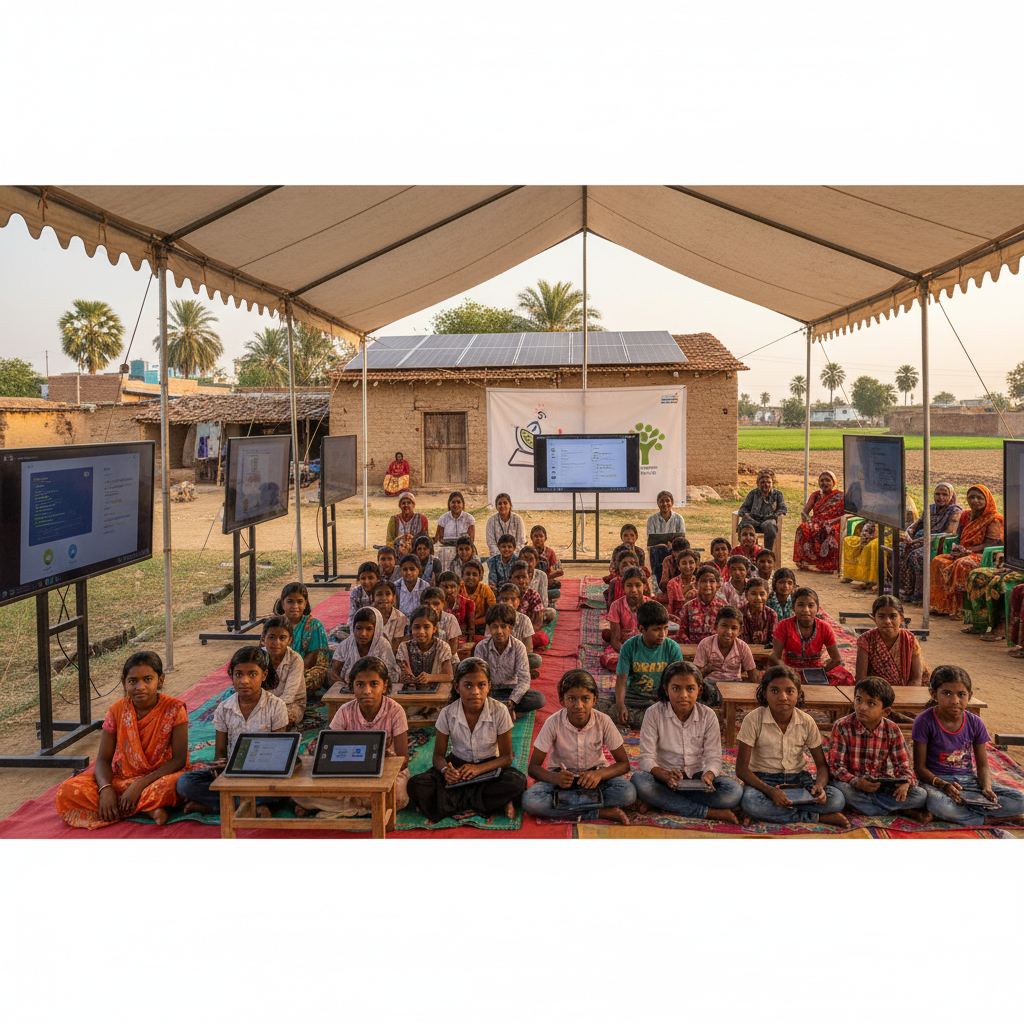
However, a potential solution to these problems is emerging: community-based micro-schools. These small, localized learning environments cater to a handful of students, often combining multi-age groups in a single classroom. Micro-schooling allows for flexible, personalized learning experiences that can adapt to the individual needs of each child, thereby pushing aside the one-size-fits-all approach of conventional schooling. They will be equipped with PCs , so that students have access to the world’s best resources , most of which are available online ! Students can learn according to the curriculum, using the flipped classroom model, if they so desire. They can also explore their own interests in their free time, and teach and learn from each other.
Micro-schools can bring about significant improvements in the quality of education. They prioritize student engagement and holistic development, fostering creativity, critical thinking, and problem-solving skills. This hands-on, project-based learning approach not only makes learning more enjoyable but also better prepares students for the real-world challenges that lie ahead.
Furthermore, micro-schools leverage community resources in a way that large schools often fail to. By integrating community members and local knowledge into the learning process, students get a contextual and relevant education, instilling a deep-rooted sense of responsibility and connection with their communities. This local-first approach can nurture the kind of active citizens we need for our rapidly changing world. Kids can be taught in their mother tongue – which is far more effective !
The community-based nature of micro-schools also brings about stronger parent-teacher-student relationships. The close-knit community enables a participatory model where parents, teachers, and students collaboratively take decisions, thus democratizing education. The partnership can result in heightened accountability, greater engagement, and the recognition of education as a shared responsibility. These learning pods are also much more cost-effective, because there is no time and money wasted on commuting; and the purpose is not to make a profit at the expense of the student !
This is also much better for educating girls, as parents know they will be learning within the community itself, and do not need to travel and be subjected to teasing and harassment.
Implementing micro-schools also addresses the issue of teacher training. In smaller, community-driven settings, teacher training can be more personalized and context-specific. Emphasis can be given to training teachers not just as transmitters of knowledge, but as facilitators and guides. This, in turn, will lead to a shift from rote learning to a more comprehensive, competency-based education model.
However, the transition to micro-schooling is not without its challenges. The setup, regulation, and funding of such decentralized models require thorough planning and execution. Policies must be adapted to ensure that micro-schools can operate effectively within the broader educational system. The quality of education in these schools should be consistently high, regardless of their location or the socio-economic status of their students. We are making a step in this direction by running Community-Based Digital Learning Centers, and sharing our journey at www.apnipathshala.org.
We are building in public, so we can create a community, and share our lessons, failures and successes. We will be publishing a live digital open-source Handbook, which will allow others to replicate our efforts for themselves, so this can grow organically, scalably and sustainably ! We will also be releasing a free LMS ( Learning Management System) based on Moodle, so it will be possible to track learning outcomes over time, and these how effective this model is.
We hope that we will be able to create a national community of empowered students, parents and teachers, who want to make learning available, accessible and affordable, so that it’s fun and meaningful.