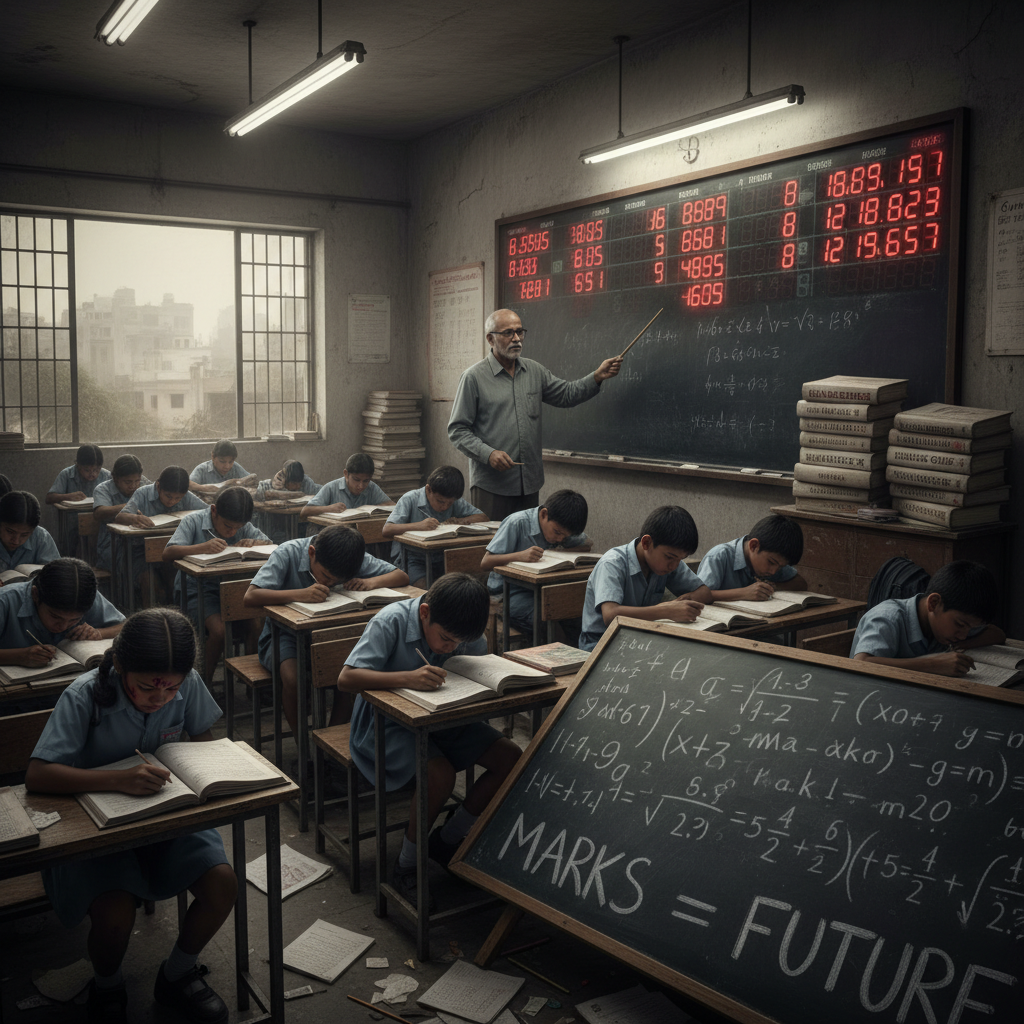
India’s education system is broken. Not because our children lack intelligence, but because the system rewards memory more than curiosity. Children spend years listening to lectures, copying notes, attending tuition classes, and cramming answers for exams. They learn how to score marks, but not how to think.
This is tragic, because India is sitting on a demographic goldmine. We have millions of young people who could become creators, problem-solvers, entrepreneurs, scientists, artists, and innovators. But if we fail to educate them properly, this demographic dividend can quickly become a demographic disaster.
The question is simple: how do we unlock the potential of every Indian child?
Our answer is equally simple: give every child access to a PC, a safe learning space, and the freedom to explore.
A PC is not just a machine. It is a window to the world. With a PC, a child can learn English on Duolingo, travel virtually using Google Maps, understand maths on Khan Academy, watch science experiments, create art, code, write stories, and discover subjects far beyond the outdated school textbook. The child is no longer trapped by the limitations of the local classroom.
But we also understand that giving a PC alone is not enough. Technology without guidance can become another toy. This is why we are partnering with educational NGOs across India to create community-based digital learning pods called Apni Pathshalas.
We provide the PCs free of charge. Our NGO partners provide the space, the staff, and the students. Together, we create safe learning environments where children can explore what excites them, learn from one another, and become self-directed learners.
This is not charity in the old-fashioned sense. This is social investment. It is a frugal experiment in nation-building.
Today, we have about 30 Apni Pathshala centres across the country. Our next goal is to create at least 70 more. We are learning what works, what does not, and how this model can be improved. Eventually, we want to create a clear SOP and manual so that any NGO, school, parent group, tuition teacher, or community leader can replicate this model without depending on us.
That is when this becomes a movement.
The model can extend to community microschools, after-school learning centres, tuition classes, and even homeschooling. The larger goal is to help parents and children take charge of learning instead of remaining helpless victims of an outdated education system.
For me, the most special moments are when children have their “Aha!” moments. When they discover something new. When they realise they can learn anything that any child anywhere in the world can learn. That smile is priceless.
We are trying to bridge the digital divide. Earlier, every child needed a pencil and paper to learn. In the future, every child will need access to a PC.
India’s greatest strength is not minerals, oil, robots, or algorithms. It is our human capital. Other countries can manufacture machines, but they cannot manufacture young Indian minds. Our job is to give those minds the tools, confidence, and freedom to shine.
The combination is powerful: intrinsic motivation, a safe space, adult supervision, peer learning, and technology. This can transform education from the bottom up.
And that is why Apni Pathshala exists.
Because when a child learns how to learn, India wins.
Get a head start with the APNA PC : https://www.teachtoearn.in/apna-pc/