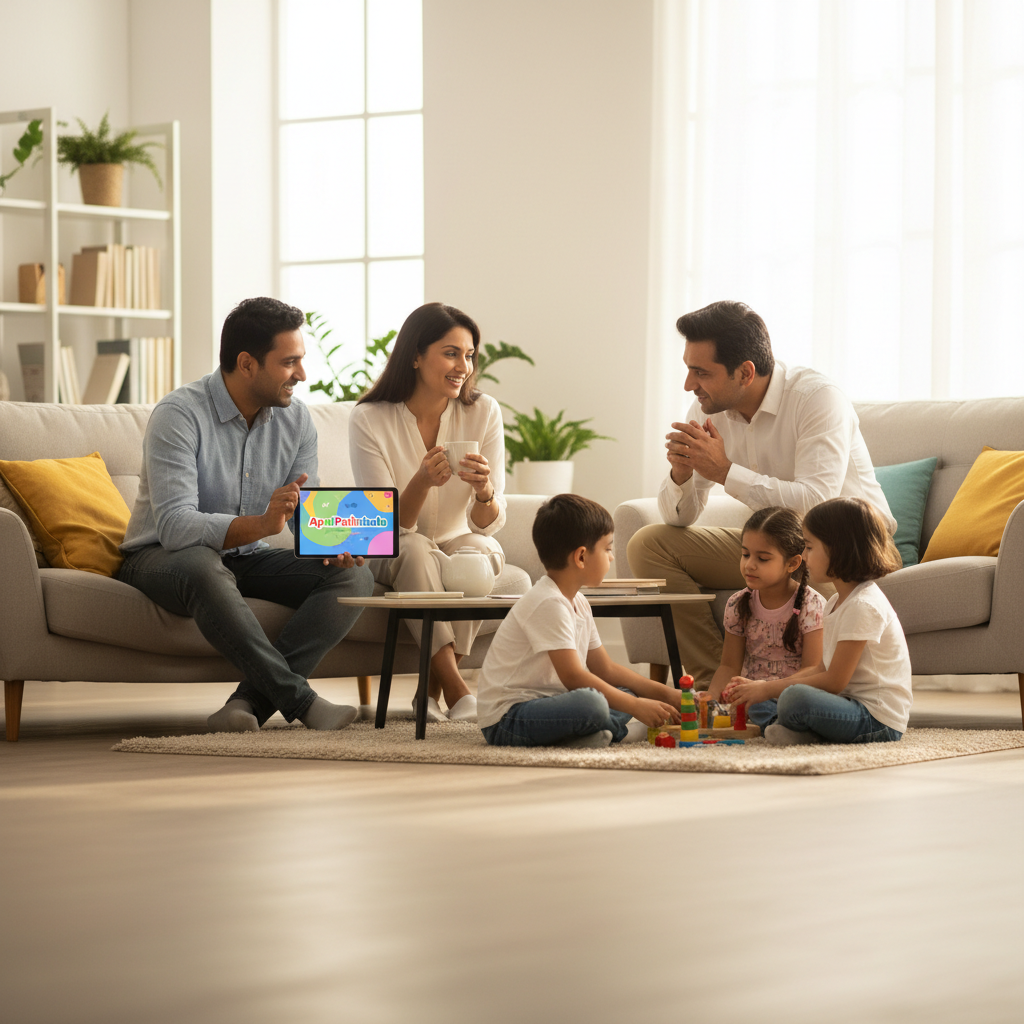
Parent A: Yaar, can I tell you something honestly? I’m exhausted with this school system. Every year fees rise, homework rises, pressure rises… but my child’s excitement for learning drops like the Sensex in a panic.
Parent B: (laughs) Welcome to the club. Same story here. We’re all paying premium-school prices for an experience that feels like 1985 with air-conditioning.
Parent A: Exactly! That’s why I’ve been exploring ApniPathshala. It’s a completely different approach. Not top-down, not bureaucratic — it’s literally the opposite of everything that frustrates us.
Parent B: I’ve heard a bit. Isn’t it some kind of “pod” model?
Parent A: Yes, but not the overpriced, designer “learning pods” abroad.
This is community-run, small, flexible, mixed-age learning spaces — owned by parents, seniors, volunteers, and local champions. Ten to twenty kids learning together, guided by a pod manager from their own neighbourhood. No outsiders deciding what our children need.
Parent B: So the community actually makes the decisions?
Parent A: 100%. That’s what makes it powerful.
Think of ApniPathshala as a bottom-up, student-first, community-controlled ecosystem. Not “school rules first,” but “children first.”
Parent B: That already feels more sensible than half of what we’re dealing with.
Parent A: And because it’s small, it’s agile. No waiting for years for curriculum changes. If our kids need more English, we change it.
If they want robotics, we bring it in.
If the community wants life skills, financial literacy, communication — done.
It’s literally education with a steering wheel.
Parent B: I like that. Schools move slower than government offices sometimes.
Parent A: Exactly the problem! They’re too big, too rigid, too stuck in their ways. ApniPathshala works like a startup — fast, adaptive, constantly learning.
Parent B: But what do the kids actually learn? Is it only academics?
Parent A: No, thank God. It’s not marks-obsessed.
Kids learn:
- academics at their pace
- digital skills
- using an AI tutor
- communication
- real-world problem-solving
- creativity
- collaboration
- financial basics
and most importantly — what they’re curious about
Because here’s the truth — kids learn best when they learn what matters to them, not what looks nice on a school brochure.
Parent B: So it isn’t forcing them into the same mould?
Parent A: That’s the whole point! Mixed-age pods make it even better.
You’ve seen this at home: the younger ones watch the older ones, the older ones feel responsible and explain things… It’s natural, instinctive learning. Not this artificial age-wise segregation we force in schools as if every 9-year-old thinks identically.
Parent B: True. Kids learn more from each other than from teachers sometimes.
Parent A: And ApniPathshala leverages that beautifully.
The pod manager isn’t a textbook dictator. They’re a learning facilitator, helping kids explore, ask questions, and become independent learners.
Parent B: And the digital part? I heard every child gets an Apna PC?
Parent A: Yes! Every kid gets access to an Apna PC with an AI tutor, plus a browser-based learning dashboard. They can track their own progress. Parents can see exactly what they’re learning — no guesswork, no vague report cards.
And because learning is digital, personalised, and self-paced:
- fast learners go ahead
- slower learners take time
- no one feels left out or left behind
Schools move all kids at one speed — the speed of the slowest chapter.
ApniPathshala moves each child at their speed.
Parent B: This actually sounds like the way education should be in 2025.
Parent A: Exactly. Future-ready kids need future-ready systems.
Not chalk-and-talk, not rote, not outdated textbooks.
And here’s another thing — because the model is flexible, the pod evolves with community needs. If tomorrow there’s demand for coding or entrepreneurship or robotics or AI literacy, it gets added immediately.
Parent B: So it stays relevant?
Parent A: Always. That’s the beauty of a distributed model.
Not just decentralized — distributed. Each pod is an autonomous mini-learning ecosystem. The quality does not depend on a giant institution; it depends on the community’s involvement.
Parent B: And affordability? Because private schools today cost more than engineering college.
Parent A: ApniPathshala is dramatically cheaper because:
no fancy buildings
no bloated admin
no forced tuitions
no overpriced textbooks
no hidden fees
We pay only for what truly matters — learning.
Quality education should not be a luxury item.
ApniPathshala brings it back within reach.
Parent B: Honestly, this feels like the sort of reform we have been waiting for.
Parent A: It’s reform without waiting for the system to change!
We stop begging schools to improve.
We start creating better learning spaces ourselves.
Parent B: And what does the child get at the end of all this?
Parent A: The three things schools have forgotten to teach:
Independence
Agency
Lifelong learning
Every child learns to set goals, learn independently, use digital tools, think critically, and adapt — the skills that determine success in the real world, not marks.
Parent B: You’re making me rethink everything.
Parent A: Good. That’s the first step to real change.
When we stop outsourcing our child’s future to institutions and start shaping it with our own hands, that’s when genuine, meaningful learning begins.
ApniPathshala isn’t just a model.
It’s a movement.
A movement to return learning to those it belongs to — the child and the community.
You can buy an ApnaPC at www.apnapc.com – open the world of world-class learning to your children