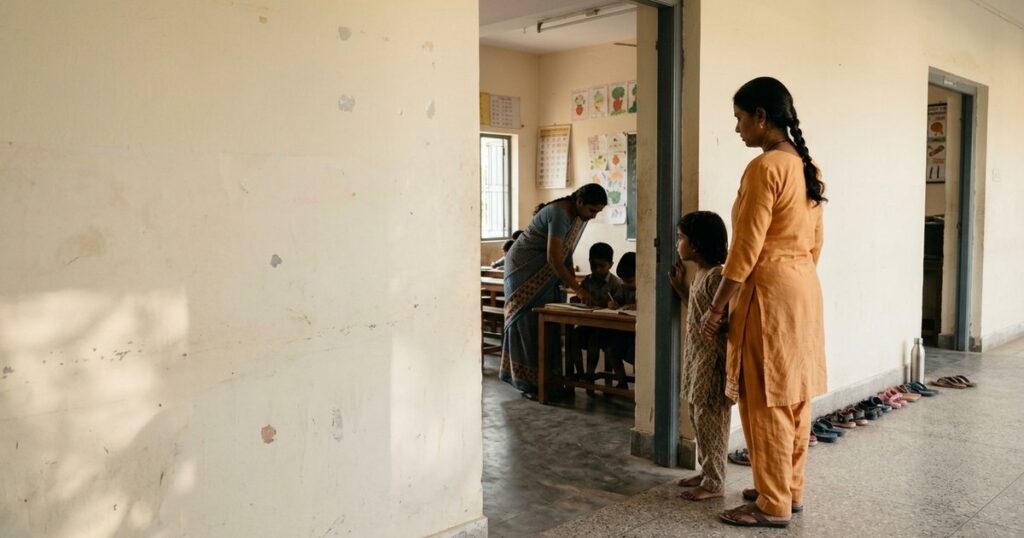
Private vs Government School in India: How I Would Choose
I am often asked whether a child should attend a private school or a government school. My short answer is uncomfortable: the label matters far less than the particular school, the particular teacher, the child’s needs, and the family’s ability to participate. A good government school can be far better than a mediocre private school. A good private school can offer choices and attention that a government school may not. I would never choose only because one school charges fees and the other does not.
I have seen parents stretch their finances to pay private-school fees because they assume the uniform, English-medium instruction, and air-conditioned reception area guarantee learning. I have also seen parents dismiss a government school without visiting it, because they assume that free education must be poor education. Both assumptions are lazy. School choice deserves more care than this.
India has roughly 54 percent of its schoolchildren enrolled in government schools, according to the UDISE+ 2021–22 report. Private-school enrolment fell during the pandemic period after growing between 2015 and 2020, while school dropout rates have generally declined. These numbers tell us something about access and preference. They do not tell us whether a child in one classroom is reading well, asking questions, or receiving sensible feedback from a teacher.
Private vs government school in India: what is the real difference?
The usual story is simple. Government schools are free but poor. Private schools are expensive but better. This story is repeated so often that parents stop examining it.
The reality is much messier.
| Factor | Government school | Private school | What I would actually check |
|---|---|---|---|
| Cost | Usually low or free, though families may still pay for transport, uniforms, books, and activities | Fees can vary enormously; transport, uniforms, meals, and miscellaneous charges add substantially | Total annual cost, not just the advertised tuition |
| Teachers | Often formally qualified and employed with greater security; attendance and motivation vary by school | Quality varies widely; some schools have energetic teachers, others have high turnover and limited autonomy | Observe a class and speak to teachers, not only the principal |
| Language | May teach in the regional language or a bilingual format | Often markets itself as English-medium, but classroom English may be limited | Ask the child to read and explain something in the claimed medium |
| Peer group | Often socially and economically diverse | May offer a more homogeneous group, depending on fees and location | Whether the child feels safe, included, and challenged |
| Flexibility | May have more bureaucratic constraints but can offer public schemes and support | May offer more activities and communication, though not always meaningful choice | How the school responds when a child struggles |
This is why I resist broad claims about either category. “Government” describes who runs a school. “Private” describes who runs another. Neither word tells me whether the head teacher knows the names of the children, whether the school measures reading ability, or whether a teacher can explain what a child should do next.
What government schools get right
Government schooling is not merely a cheaper version of private schooling. It serves a different public purpose.
A government school is one of the few institutions where children from different castes, religions, income groups, and family backgrounds may sit together. That matters. Schooling is not only about examinations and jobs. It also teaches children what sort of society they inhabit and what sort of behaviour they can expect from fellow citizens.
Aditya Natraj, who has worked closely with the government school system, has described public education as part of the work of building a democracy and a shared idea of India. I find that persuasive. A country as diverse as ours cannot leave the work of social cohesion entirely to private markets.
Government schools also have reach. They are often present in places where a fee-charging school would not find enough paying families. They provide access to children whose parents cannot choose between three or four schools. Midday meals, scholarships, textbooks, uniforms, and other public programmes can make the difference between a child attending school and staying at home.
There are excellent government schools. Some have committed head teachers who have created a culture of punctuality, reading, cleanliness, and high expectations despite limited resources. I have visited schools where the children were curious and articulate, and where the teachers were doing far more with less than many expensive schools I have seen.
The problem is that quality is uneven. A government school may have a good building and still fail to teach basic reading. It may have qualified teachers but weak supervision. It may have a head teacher who wants to improve but spends too much time on administrative work. The official presence of a teacher is not the same as effective teaching.
A school building is an input. Learning is an outcome. Parents must inspect both.
Parents should not confuse government provision with government monopoly. Public education must remain strong, but the state should not assume that one model will work for every child or every family.
What private schools get right—and what they pretend to get right
The strongest argument for private schools is not that every private school is better. It is that parents should have choice, and that a monopoly rarely serves people well.
India already recognises several forms of schooling: government schools, aided schools, unaided private schools, religious schools, alternative schools, and different boards. Kerala, often praised for its educational outcomes, has a large private-school presence. The existence of private schools does not automatically weaken public education. In some cases, it gives parents an alternative and gives schools an incentive to respond.
Private schools can be more responsive. A parent may get a phone call when a child is absent. A principal may be easier to reach. A school may experiment with a different timetable, a reading programme, a sports activity, or a teaching method without waiting for several layers of approval.
But private schools also sell an image. English-medium signage, smart classrooms, branded uniforms, and a long list of clubs can create the impression of quality without producing much learning. I have met parents who pay fees that consume a painful share of their income, only to discover that their child is memorising answers and cannot explain the underlying idea.
Private schools are not charitable institutions. They have to pay salaries, maintain buildings, and earn a surplus or at least cover their costs. There is nothing wrong with that. But parents should know what they are buying. I have written separately about what school fees in India actually pay for, because the fee receipt often conceals the difference between useful spending and cosmetic spending.
A low-fee private school may provide a closer-to-home option for a family that dislikes the local government school. It may also employ teachers on low salaries, with little training and high turnover. A high-fee private school may offer excellent facilities, but facilities are not a substitute for a teacher who can notice that a child has misunderstood fractions for three months.
When I evaluate a startup, I do not invest because the founder has a beautiful presentation. I want to know whether the product works, whether customers return, and whether the team learns from failure. I apply the same discipline to schools. I am interested in what children can do, not what the brochure claims.
Do not pay for English; pay attention to learning
English is a legitimate concern for Indian parents. It can widen access to higher education, professional opportunities, and information. Parents are right to want their children to become comfortable in English.
But many schools use “English-medium” as a marketing label. The teacher may translate every sentence into the regional language. The child may memorise textbook answers without being able to hold a basic conversation. At the same time, a child in a well-run regional-language school may develop strong conceptual understanding and learn English later with less difficulty than parents expect.
I would ask the school to show me actual student work. I would listen to a child read. I would ask a simple question about a story, a science experiment, or a mathematical problem and see whether the child can explain the answer in her own words. I would not be impressed by a child who can recite a paragraph but cannot tell me what it means.
Language is a tool. It is not proof of intelligence, discipline, or school quality.
The most important variable is the head teacher
Parents often compare schools by board, fee, building, and distance. I would put the head teacher near the top of the list.
A strong head teacher sets expectations for everyone. Teachers arrive on time because someone notices. Children read because reading is treated as a daily habit rather than a special event. Parents are told when there is a problem. Weak teaching is addressed rather than politely ignored.
This is true in both government and private schools. A poor private school can hide behind fees and branding. A poor government school can hide behind rules and bureaucracy. A good head teacher makes it difficult for either system to remain complacent.
When I visit a school, I would ask:
- How does the school identify a child who is falling behind?
- What happens after the child is identified?
- How often do teachers meet to discuss student learning?
- Can I see notebooks and assessments from ordinary weeks, not only prize-winning work?
- What is the teacher turnover over the past three years?
- How does the school handle bullying, absenteeism, and learning difficulties?
- Can I speak to two parents whose children are not among the school’s top performers?
The answers reveal much more than a tour of the computer laboratory.
How I would choose for a child
I would begin with the child, not with the school’s reputation.
A confident child who enjoys competition may do well in a large, demanding school. A shy child may need a smaller environment where teachers know her well. A child with dyslexia, attention difficulties, hearing problems, or anxiety may need support that a prestigious school is unwilling or unable to provide. A child who travels two hours each way to attend a famous school is losing time, sleep, play, and family interaction. The brand may not justify the cost.
I would then look at the family’s constraints. Can the family afford the fees without borrowing or sacrificing essentials? Can someone help with homework, or is the school expected to provide all academic support? Is transport safe and reliable? Will the child have time to sleep and play? Is the family comfortable with the school’s language, discipline, religious environment, and expectations?
My order of preference would be roughly this:
- Visit the nearby options. I would not reject a school based on hearsay or social status.
- Observe ordinary teaching. I would ask to sit quietly in a classroom if the school permits it.
- Examine student work. I would look for evidence of thinking, not only neat handwriting.
- Speak to current parents. I would ask what happens when a child is average, not only what happens to the school topper.
- Calculate the full cost. I would include transport, books, uniforms, tuition, activities, devices, and the parent’s time.
- Reassess after admission. Choosing a school is not signing a lifetime contract. If the child is unhappy or not learning, I would act rather than defend my original decision.
I would also ask whether the school allows children to make mistakes. Some schools produce compliant children who are frightened of answering incorrectly. This may look like discipline in the short term, but it is a poor preparation for adult life. In medicine, a patient who is afraid to disclose a symptom makes diagnosis harder. In a startup, a founder who hides bad news destroys trust. Children learn best when they can say, “I do not understand,” without being humiliated.
What about fees and scholarships?
Fees are not a simple proxy for quality. A school charging ₹1 lakh a year is not automatically five times as good as one charging ₹20,000. The extra money may pay for smaller classes and better teachers—or for a swimming pool, a larger campus, and marketing.
I would calculate the annual cost as a percentage of household income. If school fees require both parents to take extra work, force the family into debt, or leave no money for healthcare and emergencies, the choice is too expensive. Education is important, but a family should not make itself financially fragile to purchase status.
Parents should also ask about fee increases. A school that appears affordable in Class 1 may become unaffordable by Class 8. They should ask for the complete schedule of charges, including annual fees, development fees, transport, meals, examinations, books, uniforms, trips, and optional activities. A school that is evasive before admission is unlikely to become transparent later.
Government schools reduce the fee burden, but they do not always eliminate all costs. Uniforms, transport, private tuition, examination preparation, and lost wages when parents must attend school meetings can still matter. Free schooling is not costless schooling.
Should the government run all schools?
No. I do not believe the government should run every school. I also do not believe that education can be left entirely to private providers.
The state has a duty to ensure that every child receives a decent education, regardless of family income. That means funding, regulation, public schools, teacher preparation, transparent measurement, and support for children who need additional help. It does not require the state to prescribe one model for every child.
Private schools can add variety and give parents choice. But choice without information is a sham. A poor family cannot exercise meaningful choice if all it knows is that one school has English signage and another does not. The government should publish useful, comprehensible information about attendance, teacher vacancies, basic learning levels, safety, fees, and complaints. Parents should not have to become investigative journalists to discover whether a school is functioning.
Competition can help, but education is not a normal consumer product. A family cannot easily return a bad year of schooling. A child cannot recover every lost opportunity. Regulation therefore matters, but regulation must focus on learning and safety rather than only building dimensions and paperwork.
My answer to the parent who wants a single rule
If a parent insists on a universal rule, I would offer this one: choose the school where the adults know the children, expect them to learn, and respond quickly when they do not.
That school may be government-run. It may be privately managed. It may be aided, religious, municipal, or part of a low-cost chain. The category is a starting point for investigation, not the answer.
I would rather send a child to a modest government school with a committed head teacher, stable teachers, short travel time, and a culture of reading than to an expensive private school that sells prestige but tolerates weak teaching. I would also gladly choose a private school if it offered a safe environment, honest communication, capable teachers, and a sensible fee.
Parents should not outsource this decision to neighbours, relatives, school advertisements, or the social anxiety of other parents. They should visit. They should ask awkward questions. They should watch what children can actually do.
In my IVF practice, I tell patients that a glossy clinic cannot guarantee a baby, and that a modest clinic is not automatically incompetent. The real question is whether the doctors are honest about probabilities, whether the laboratory is well run, and whether the patient receives appropriate care. School choice is similar. The signboard is not the outcome.
The best school for a child is not the one that makes the parent feel most successful at the school gate. It is the one that makes the child more curious, more capable, and less afraid of the world—without making the family pay a price it cannot afford.